
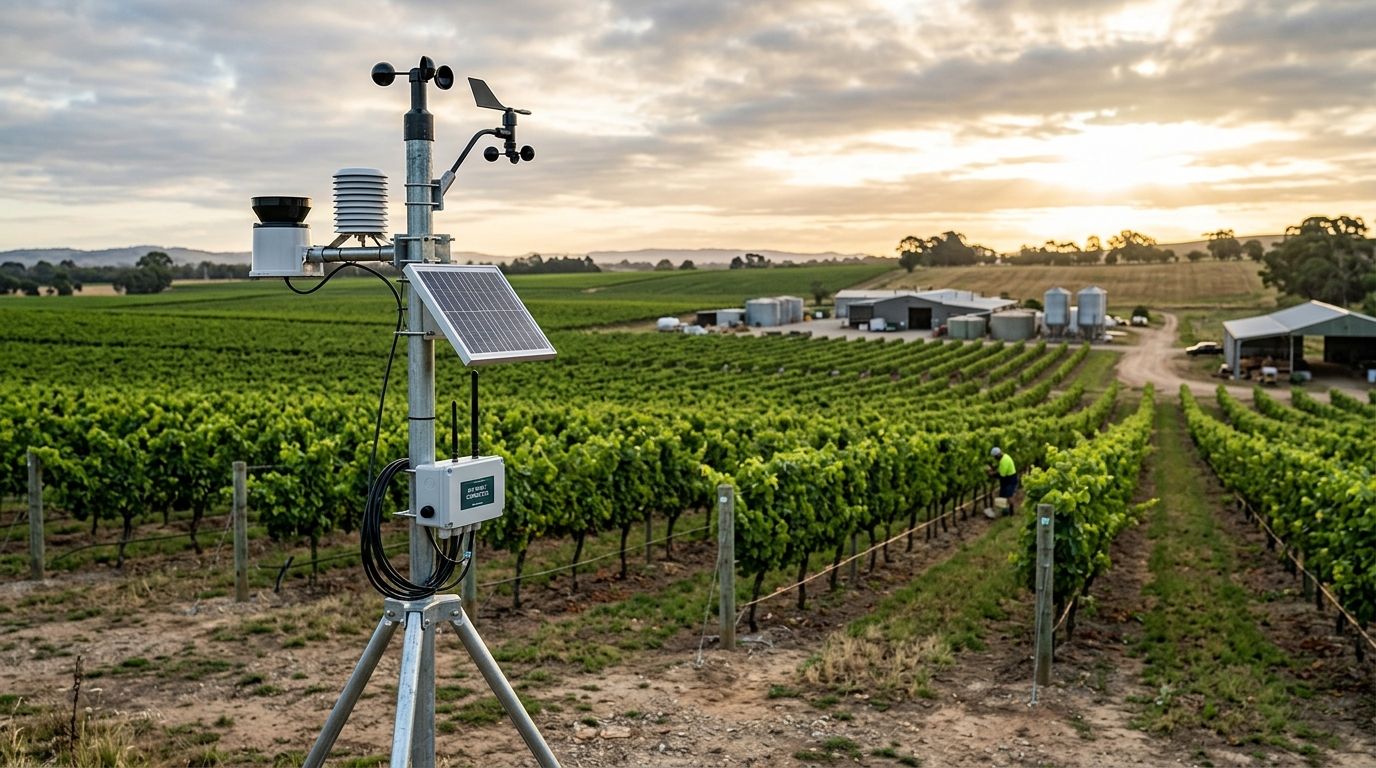
Best overall IoT weather station for industrial and agricultural sites in 2026: a LoRaWAN all-in-one unit reporting temperature, humidity, wind and rainfall into a rules-driven platform. Best for large farms and interference-heavy sites: a mioty-based station. Best for sites already running a PLC or BMS: an MQTT-connected professional weather station. Best for irrigation-driven agriculture: a soil-and-climate combined node. Best budget option for a single site: a compact solar-powered LoRaWAN micro station.
- The best iot weather station for industrial and agricultural sites in 2026 is a LoRaWAN all-in-one unit paired with a rules-driven platform.
- mioty-based weather stations win on range and interference resistance for large farms and shielded industrial yards.
- MQTT-connected professional weather stations fit sites that already run a PLC, BMS or datalogger.
- Soil-and-climate combined nodes matter most for irrigation scheduling on row crops and orchards.
- WMO siting guidance sets standard mounting heights at 2 meters for temperature/humidity and 10 meters for wind sensors.
What does an IoT weather station monitor on industrial and agricultural sites?
An industrial or agricultural weather station reports the parameters that drive a decision, not every parameter a meteorologist tracks. Temperature and relative humidity feed disease-risk and frost-warning rules. Wind speed and direction gate crane, drone and spray-boom operations. Rainfall from a tipping-bucket gauge triggers irrigation holds. Barometric pressure and solar radiation matter less on their own and more as inputs to evapotranspiration math for scheduled irrigation.
The station itself is only half the job. Readings have to reach a platform that can turn a 25 mph gust or a sub-freezing overnight low into an alarm a supervisor or grower actually sees. The Kilo IoT Platform runs a built-in LoRaWAN and mioty network server plus an MQTT connector, so any of the station types below report into the same dashboard and rules engine without a separate network server to stand up.
What makes the best IoT weather station for industrial and agricultural sites
- Sensor accuracy and calibration traceability across temperature, humidity, wind, rain and barometric pressure
- Protocol range and penetration — LoRaWAN, mioty or MQTT over an existing gateway
- Mounting height compliant with WMO siting guidance so readings are comparable and defensible
- Battery and solar-assist life through low-light seasons without a truck roll
- A rules engine on the receiving end that can escalate a threshold breach, not just log it
- An enclosure rated for the site's actual weather, not a lab spec sheet
IoT weather stations at a glance
| Station type | Best for | Standout feature | Key limitation |
|---|---|---|---|
| LoRaWAN all-in-one station | General industrial and agricultural sites | Full parameter set on one pole | Uplink payload size caps parameter count |
| mioty weather station | Large farms, interference-heavy sites | Telegram splitting resists RF noise | Fewer hardware SKUs on the market |
| MQTT-connected professional station | Sites with an existing PLC/BMS | Reuses instrumentation already onsite | Depends on the existing network's uptime |
| Soil-and-climate combined node | Irrigation-scheduled agriculture | Pairs soil moisture with climate on one uplink | Soil probes need periodic recalibration |
| Compact solar LoRaWAN micro station | Single-site budget deployment | Fast to provision, light structural load | No wind data |
1. LoRaWAN all-in-one weather stations: best for general industrial and agricultural sites
A LoRaWAN all-in-one station bundles temperature, humidity, barometric pressure, an anemometer/wind vane and a tipping-bucket rain gauge into one pole-mounted unit that reports on an operator-set interval. It's the default choice because the hardware ecosystem is the widest and a single pole covers most of the parameters a site actually needs. Coverage and enclosure selection matter more than the sensor spec sheet once the unit is outdoors year-round — the guide on choosing sensors for outdoor industrial IoT deployments in extreme weather walks through IP ratings and enclosure material for exactly this scenario.
LoRaWAN weather station pros:
- Single pole mount, minimal wiring
- Reports directly into a built-in LoRaWAN network server with no separate server to deploy
- Solar-assisted battery life spans multiple growing seasons on most commercial units
- Works across a site without relying on site Wi-Fi
LoRaWAN weather station cons:
- LoRaWAN's uplink payload size limits how many parameters fit per transmission
- Steel structures and grain silos attenuate signal near the mounting point
- Needs a clear sky view for the solar panel to keep up in winter
Best for: a single industrial yard or farm that needs one pole covering the full parameter set.
Verdict: Buy for most single-site industrial and agricultural deployments in 2026. Skip if the site has heavy steel construction blocking signal near the mount — check mioty instead.
2. mioty weather stations: best for large farms and interference-heavy industrial sites
mioty (standardized as ETSI TS 103 357) uses telegram splitting, which spreads each message across many short bursts on different frequencies and time slots. That resists collisions and RF noise better than LoRaWAN at high device density, which matters on a multi-hectare farm running dozens of sensors or an industrial yard full of motors and cranes competing for the same 868/915 MHz band.
mioty weather station pros:
- Better link budget in electrically noisy or RF-crowded sites
- Fewer missed uplinks at high device density
- A good fit alongside other mioty sensors for underground and shielded environments already on a mixed-protocol site
mioty weather station cons:
- Fewer commercial hardware SKUs than LoRaWAN
- Smaller installer base for field troubleshooting
- Still requires a mioty-capable network server on the receiving end
Best for: large farms, mining sites, or facilities with underground or shielded equipment runs.
Verdict: Buy when device density or RF interference has caused missed LoRaWAN uplinks on a large site. Skip for a single small plot where LoRaWAN already reports reliably.
3. MQTT-connected professional weather stations: best for sites with an existing PLC or BMS
Many industrial and agricultural sites already run a professional-grade weather datalogger tied into a BMS or PLC. Instead of adding new radio infrastructure, the existing datalogger publishes readings over MQTT to a platform, which is the fastest path onto a rules engine when instrumentation is already in the ground.
MQTT weather station pros:
- Reuses instrumentation already calibrated to WMO siting practice
- No new gateway to install
- Sits alongside existing Modbus/PLC tag data flowing to the same site
MQTT weather station cons:
- Depends on the existing network and power reliability for the datalogger
- Adds a translation step if the original system uses a proprietary protocol
- Not the fastest path for a greenfield site with no prior instrumentation
Best for: sites that already run a BMS or industrial datalogger and want alarms without new hardware.
Verdict: Buy if a professional weather station is already onsite and publishing data. Skip if starting from zero — a LoRaWAN unit deploys faster.
4. Soil-and-climate combined nodes: best for irrigation-scheduled agriculture
A combined node pairs above-ground climate sensors with in-ground soil moisture, and sometimes leaf wetness, on the same uplink. That matters for irrigation because a decision needs both sides of the water balance: what the atmosphere is pulling out of the soil and what's actually left in the root zone. The LoRaWAN soil moisture sensors for agriculture and irrigation guide covers probe placement and depth in more detail.
Soil-and-climate node pros:
- One uplink covers evapotranspiration inputs and root-zone soil moisture together
- Fewer separate radios per field
- Leaf wetness data supports disease-risk timing on row crops and orchards
Soil-and-climate node cons:
- Soil probes need periodic recalibration as soil type and compaction change
- Costs more per node than a climate-only station
- Burial depth has to match the crop's root zone, which varies by planting
Best for: row crop and orchard operations running scheduled irrigation.
Verdict: Buy for irrigation-driven operations. Skip for a site where irrigation isn't scheduled by weather data, which covers most non-agricultural industrial sites.
5. Compact solar-powered LoRaWAN micro stations: best budget option for a single site
A micro station drops the full anemometer mast and covers core parameters — temperature, humidity, rain — in a smaller footprint aimed at one gateway, one site. It's the fastest and cheapest way to get baseline climate data flowing before deciding whether a site needs full meteorological instrumentation.
Micro station pros:
- Lighter structural load, simpler pole mount
- Solar-assist keeps battery swaps rare
- Fast to provision on a platform's device onboarding flow
Micro station cons:
- No wind data, which limits crane, drone or spray-timing decisions
- Tipping-bucket rain accuracy drops in heavy downpours on smaller units
- Not built for multi-hectare coverage
Best for: a single building, yard or small plot that needs baseline climate data, not full instrumentation.
Verdict: Buy for a first deployment on a limited budget in 2026. Skip if wind or solar radiation data drives a safety or spray decision.
“If a wind sensor's uplink arrives faster than the escalation rule that fires on it, the alarm is decorative.”
Hardware for any of these station types, plus gateways and antennas, ships worldwide through Kilo Electronics, Kilo's sister hardware company.
How are IoT weather stations ranked for industrial and agricultural use?
Each type above is scored against the criteria listed earlier: sensor accuracy and WMO-aligned mounting, protocol range and penetration, battery/solar durability, and whether the readings feed a rules engine that escalates instead of just logging. No station wins every category — a mioty unit that resists interference on a 200-acre farm is the wrong pick for a single greenhouse where a micro station is cheaper and faster to provision.
Connect your weather station data to one dashboard
LoRaWAN, mioty and MQTT feeds land in the same rules engine and alarm inbox.
Which IoT weather station is best for your industrial or agricultural site?
Default to a LoRaWAN all-in-one station if you're deploying to one site in 2026 and need the full parameter set on one pole. Move to mioty the moment device density or RF interference starts costing you missed uplinks on a large farm or industrial yard. Take the MQTT path if a professional weather station already sits on the property. Add a soil-and-climate combined node the moment irrigation scheduling becomes the reason you're buying a station at all, and start with a compact micro station if the budget or the use case doesn't justify a full mast yet.
FAQ
What is the best IoT weather station for industrial sites in 2026?
A LoRaWAN all-in-one weather station is the best general-purpose choice for industrial sites in 2026 because one pole-mounted unit covers temperature, humidity, wind and rainfall without extra gateway infrastructure. Sites with heavy RF interference or underground equipment should look at mioty instead.
Is mioty better than LoRaWAN for agricultural weather stations?
mioty performs better than LoRaWAN on large farms or sites with dense sensor deployments because its telegram-splitting method (ETSI TS 103 357) resists collisions and RF noise. LoRaWAN remains the better fit for a single small plot with fewer devices competing for airtime.
How high should an industrial weather station's anemometer be mounted?
The World Meteorological Organization's Guide to Instruments and Methods of Observation (WMO-No. 8) sets a standard anemometer height of 10 meters, with temperature and humidity sensors at 2 meters. Matching these heights keeps readings comparable across sites and defensible in compliance reporting.
Can a weather station connect to an existing PLC or BMS?
Yes, an existing professional weather datalogger can publish readings over MQTT to a platform without adding new radio hardware. This is the fastest path when a site already has calibrated instrumentation tied into a PLC or building management system.
What sensors does an industrial or agricultural weather station need?
At minimum, temperature, relative humidity, wind speed and direction, and a tipping-bucket rain gauge. Agricultural sites running irrigation schedules also add soil moisture and sometimes leaf wetness sensors on the same uplink.
Do LoRaWAN weather stations work in remote fields without Wi-Fi?
Yes, LoRaWAN stations report over long-range radio to a gateway rather than site Wi-Fi, which is why they're the default for remote agricultural fields and industrial yards with no existing network.
What's the difference between an industrial weather station and a consumer one?
Industrial and agricultural weather stations use WMO-aligned mounting heights, enclosures rated for continuous outdoor exposure, and report into a rules engine that escalates alarms, where consumer stations typically just display readings on an app.
What's the most overlooked spec in an IoT weather station?
Most buying guides stop at sensor accuracy and skip the alarm chain, but a station reporting a sub-freezing overnight low is worthless without a rule that escalates it to the right person before sunrise. Kilo's rules engine runs on CEL expressions with version control and one-click rollback, and its alarms carry five severity tiers with multi-step escalation across email, SMS and push, plus quiet hours so a 2 a.m. frost warning doesn't wait for a supervisor to check a dashboard. Pilot one station and a couple of soil probes on Kilo's free plan — 0 EUR for up to 5 devices, no card required — before scaling to the 25 EUR/month Starter tier at 25 devices.