
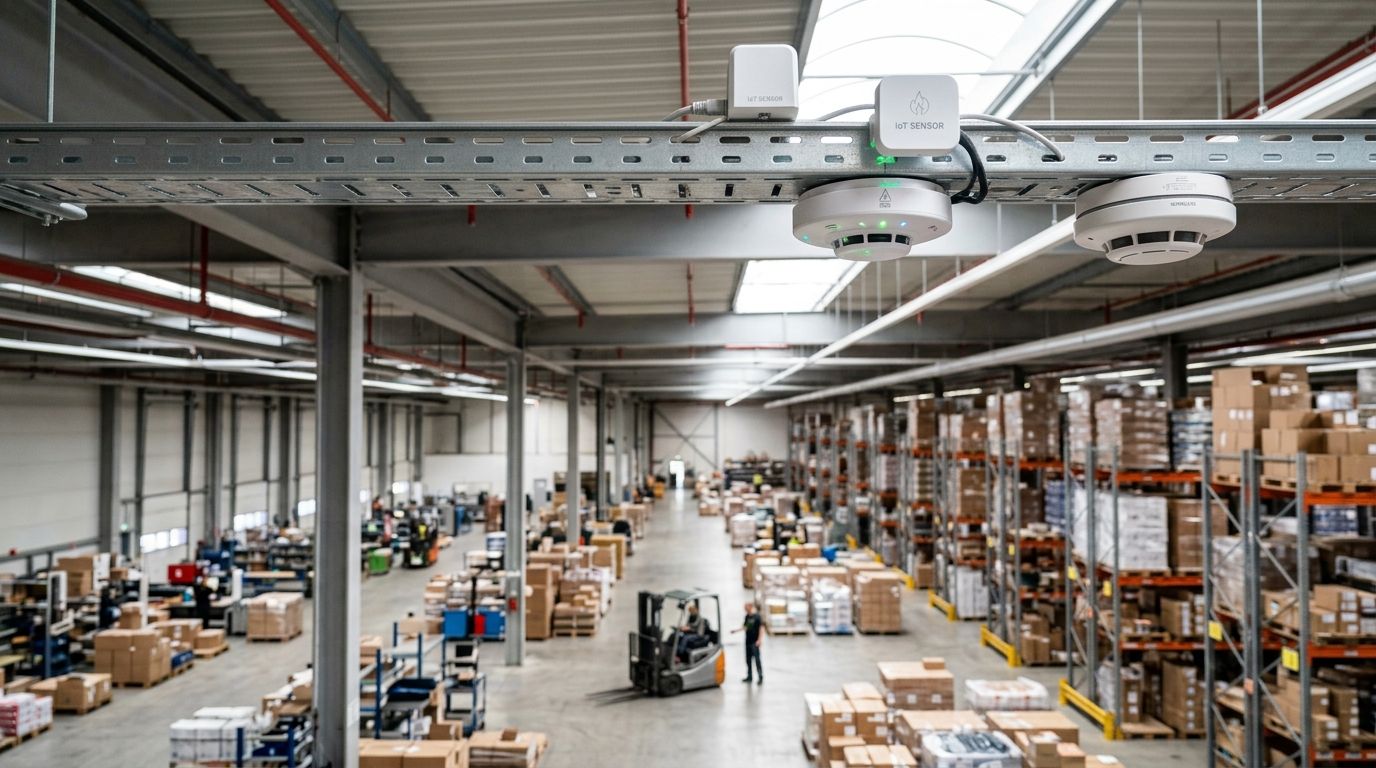
Warehouses catch fire from forklift battery charging stations, cardboard racking, aerosol storage, and dust from packaging lines — and the sensor that catches it fastest depends entirely on what's burning and where. Best overall for high-bay racking and cold storage (ceilings 30 ft and up): aspirating smoke detection (ASD). Best for dusty, forklift-heavy floors: heat detectors set to rate-of-rise. Best budget option for open-plan dry storage: photoelectric spot smoke detectors on a LoRaWAN or MQTT backbone feeding a monitoring platform like the Kilo IoT Platform.
- Aspirating smoke detection (ASD) wins for high-bay warehouse racking and cold storage above 30 ft — it samples air through ceiling piping instead of waiting for smoke to reach a spot detector.
- Heat detectors avoid the nuisance trips that photoelectric smoke sensors get from forklift exhaust and dust near dock doors.
- Linear heat detection cable gives continuous coverage along racking aisles and conveyor lines where a single spot sensor leaves gaps.
- Gas and CO sensors flag propane forklift leaks before ignition, but they are not a substitute for smoke or flame detection.
- IoT smoke fire detection sensors for warehouses only earn their keep when paired with an alarm rules engine that escalates to the right person — sensors alone don't stop a fire.
How iot smoke fire detection sensors work in a warehouse
A fire alarm panel is designed to do one thing: trip a listed detector and sound a horn per NFPA 72, the National Fire Alarm and Signaling Code. That system is code-required and it isn't optional.
What it doesn't do well is tell a facilities manager in real time which zone tripped, escalate to a second contact if the first one doesn't respond, or log the event next to temperature and humidity data from the same rack. That's the gap IoT-connected detection closes — a relay output or dry contact from the panel, or a standalone wireless sensor, feeds into a platform that runs rules and sends alerts. In 2026, more warehouses are running this as a parallel layer rather than a replacement for the code system.
What makes the best iot smoke fire detection sensors for a warehouse
- Ceiling height fit — a spot detector rated for a 10 ft office ceiling won't perform the same way at 35 ft over pallet racking.
- Nuisance-alarm resistance — dust, forklift exhaust, and steam from washdown areas trip photoelectric sensors that heat detectors ignore.
- Response speed for the fuel load — smoldering cardboard produces smoke long before flame; a solvent fire produces flame with almost no early smoke.
- Protocol and retrofit path — LoRaWAN and mioty suit wireless retrofits into existing buildings; MQTT suits pulling relay outputs off an existing fire panel.
- Standards alignment — UL 268 governs smoke detector listing in the US, UL 521 covers heat detectors, and NFPA 230 addresses fire protection for storage occupancies specifically.
- Escalation, not just detection — a tripped sensor that only shows up on a dashboard nobody's watching is worse than no sensor at all.
iot smoke fire detection sensors for warehouses at a glance
| Sensor type | Best for | Standout feature | Key limitation |
|---|---|---|---|
| Aspirating smoke detection (ASD) | High-bay racking, cold storage, 30 ft+ ceilings | Samples air through ceiling piping at high sensitivity | Installation complexity, needs duct or pipe routing |
| Photoelectric spot smoke detectors | General dry storage, open floor plans | Catches large-particle smoke from smoldering fires early | Spacing and ceiling height limited by NFPA 72 guidance |
| Heat detectors (rate-of-rise / fixed) | Dock doors, forklift charging bays, dusty zones | Ignores dust and exhaust that trip smoke sensors | Detects the fire later than a smoke sensor would |
| Linear heat detection (LHD) cable | Racking aisles, conveyor lines, cable trays | Continuous coverage, pinpoints the zone along the run | No early smoke-stage warning |
| Combustible gas / CO sensors | Propane forklift fleets, chemical storage rooms | Flags a leak before it reaches ignition | Not a substitute for smoke or flame detection |
| Flame detectors (UV/IR) | Flammable liquid and solvent storage | Reacts to open flame in milliseconds | False triggers from welding arcs or direct sunlight |
1. Aspirating smoke detection: best for high-bay racking and cold storage
Aspirating smoke detection pulls air continuously through a network of small-bore pipes mounted at the ceiling and analyzes it at a central laser chamber, instead of waiting for smoke to drift down to a single spot detector. That design is what lets it perform reliably above 30 ft, and high-sensitivity units are commonly rated for ceilings up to 60 ft — well past where a standard photoelectric detector loses effective coverage.
Aspirating smoke detection pros:
- Detects smoldering fires in deep pallet racking before visible flame
- Works in cold storage where condensation fouls standard spot detectors
- Covers wide areas from a single sampling network, reducing device count
Aspirating smoke detection cons:
- Piping design and airflow calculation take more upfront engineering
- Costs more to install than spot detectors in low-ceiling areas
Best for: high-bay racking, cold storage, and any warehouse with ceilings above 30 ft. Verdict: Deploy where ceiling height rules out standard spot detectors.
2. Photoelectric spot smoke detectors: best for general dry storage
Photoelectric detectors sense light scatter from large smoke particles, which is why they're the standard choice for smoldering-fire risks like cardboard, paper, and packaging materials in open, lower-ceiling storage areas. UL 268 governs how these units are listed and tested in the US, and NFPA 72 sets the spacing guidance installers follow.
Photoelectric detector pros:
- Fast to detect smoldering, low-flame fires typical of stored paper goods
- Lower unit cost and simpler installation than ASD
- Well understood by fire marshals and AHJs — no unusual approval process
Photoelectric detector cons:
- Loses effective coverage above roughly 30 ft without derating
- Prone to nuisance trips from dust and vehicle exhaust near active floor traffic
Best for: general dry storage and open-plan warehouse floors under 30 ft. Verdict: Deploy as the baseline code-required layer, then add heat or ASD detection where dust or ceiling height is a problem.
3. Heat detectors: best for dock doors and forklift charging bays
Heat detectors trip on either a fixed temperature (commonly 135°F or 200°F ratings under UL 521) or a rate-of-rise threshold, typically around 15°F per minute. They don't see smoke at all, which is exactly why they work in zones where smoke detectors would nuisance-trip constantly.
A smoke detector eight feet from a loading dock will nuisance-trip on diesel exhaust before it ever sees real smoke — that's a heat detector's job instead.
Heat detector pros:
- Immune to dust, exhaust, and steam that plague optical smoke sensors
- Simple, low-maintenance technology with decades of field history
- Cheap enough to deploy densely near equipment and charging stations
Heat detector cons:
- Detects fire later in its growth stage than any smoke-sensing technology
- Not a substitute for the code-required smoke detection elsewhere in the building
Best for: forklift charging bays, dock doors, and dusty production zones. Verdict: Deploy alongside smoke detection, not instead of it.
4. Linear heat detection cable: best for racking aisles and conveyor lines
Linear heat detection (LHD) is a continuous sensing cable run along racking, conveyors, or cable trays that trips at any point along its length rather than at one fixed spot. That continuous coverage is the advantage over discrete point detectors in long, narrow runs where a fire could start between two spot sensors.
Linear heat detection pros:
- No coverage gaps along a long racking aisle or conveyor line
- Rugged in dusty or vibration-heavy environments
- Pinpoints the zone of the trip along the cable run
Linear heat detection cons:
- Still a heat-based technology, so it detects later than smoke sensing
- Runs need to be planned into the racking layout at install time
Best for: racking aisles, conveyor lines, and cable trays. Verdict: Deploy as a supplement in long linear runs where point detectors leave gaps.
5. Combustible gas and CO sensors: best for propane forklift fleets
Combustible gas and carbon monoxide sensors don't detect fire directly — they detect the conditions that precede it, like a propane leak from a forklift cylinder or CO buildup from poor ventilation. OSHA 1910.164 covers employee alarm systems more broadly, and a facility running propane-powered material handling equipment has a real reason to monitor for leaks continuously.
Gas/CO sensor pros:
- Flags a fuel leak before it becomes an ignition source
- Protects workers from CO exposure in enclosed loading areas
- Runs on the same wireless network as temperature and humidity sensors
Gas/CO sensor cons:
- Does not detect smoke or flame — it's a precursor-risk sensor, not a fire sensor
- Needs periodic calibration to stay accurate
Best for: propane forklift fleets and chemical storage rooms. Verdict: Deploy as a complement to smoke and heat detection, never as a replacement.
6. Flame detectors: best for flammable liquid and solvent storage
UV/IR flame detectors watch for the specific radiation signature of an open flame and react in milliseconds, which matters in areas where a fire can flash rather than smolder — solvent storage, paint booths, and flammable liquid cages. NFPA 230 speaks directly to fire protection expectations for storage occupancies handling these materials.
Flame detector pros:
- Fastest response of any detector type listed here for open-flame events
- Doesn't depend on smoke reaching a sensor at all
Flame detector cons:
- Can false-trigger on welding arcs, torches, or direct sunlight through a dock door
- Overkill and unnecessary cost in ordinary dry storage areas
Best for: flammable liquid and solvent storage areas. Verdict: Deploy only where the fuel load justifies it — skip it for general racking.
How to choose between these warehouse fire detection sensors
Rank each option against the same six criteria: ceiling height fit, nuisance-alarm resistance, response speed for the actual fuel load, protocol and retrofit path, standards alignment, and whether it connects into an escalation workflow. A warehouse rarely runs one sensor type — most combine a code-required smoke detection layer with heat or gas sensors layered on top in the zones that need them.
Which iot smoke fire detection sensor is right for your warehouse
Start with the code-required layer your local AHJ specifies, then add technology to close the gaps that layer leaves. A warehouse with 35 ft racking should default to aspirating smoke detection over the racking, heat detectors at the dock doors, and linear heat detection along the longest aisles — that combination covers early smoke, late-stage heat, and continuous linear runs without one sensor type trying to do a job it wasn't built for.
Once the sensors are in place, the network and the alarm logic decide whether anyone finds out fast enough. On the Kilo IoT Platform, a relay output from a fire panel or a wireless heat sensor feeds in over MQTT or LoRaWAN, a rule built with CEL expressions checks the threshold, and an alarm with one of five severity tiers escalates through email, SMS, and push until someone acknowledges it — with quiet hours suppressed only for lower-severity events, never for fire. If your team needs the physical detectors or relay modules, Kilo Electronics — Kilo's sister hardware company — ships compatible sensors worldwide; Kilo itself doesn't manufacture detectors and only recommends units from that partner catalog.
“A smoke detector eight feet from a loading dock will nuisance-trip on diesel exhaust before it ever sees real smoke.”
Route fire alarms to the right person
Set up SMS and email escalation for critical sensor thresholds.
FAQ
What is the best iot smoke fire detection sensor for a warehouse with 30-foot ceilings?
Aspirating smoke detection (ASD) is the best fit above 30 ft because it samples air through ceiling piping instead of relying on smoke drifting down to a spot detector. High-sensitivity ASD units are commonly rated for ceilings up to 60 ft.
Can regular smoke detectors trigger false alarms from forklift exhaust or dust?
Yes — photoelectric smoke detectors are prone to nuisance trips from dust, exhaust, and steam. Heat detectors are the standard fix because they ignore particulates entirely and only trip on temperature change.
Do IoT fire sensors replace a code-required fire alarm system?
No — IoT-connected sensors add monitoring and escalation on top of a code-required system built to NFPA 72. They don't substitute for the listed detection your local authority having jurisdiction requires.
What's the difference between LoRaWAN and mioty for fire-related sensors?
Both are wireless protocols suited to retrofitting sensors into existing buildings without running cable. mioty is designed for higher interference resistance in dense industrial RF environments, while LoRaWAN has the broader ecosystem of pre-built sensor templates.
How fast does a heat detector respond compared to a smoke detector?
A rate-of-rise heat detector typically trips around a 15°F per minute increase, which is slower than a smoke detector catching a smoldering fire's earliest smoke output. That's why heat detectors are placed where smoke detection would nuisance-trip instead of as a primary early-warning layer.
Can a warehouse use wireless sensors for fire detection under NFPA 72?
The code-required, listed fire alarm system still needs to meet NFPA 72 and UL 268/521 listing requirements directly. Wireless IoT sensors typically sit alongside that system as a monitoring and alerting layer, not as the primary listed detection.
Do gas sensors count as fire detection in a warehouse?
No — combustible gas and CO sensors detect the conditions that precede a fire, like a propane leak, not smoke or flame directly. They're a useful complement in warehouses running propane forklifts but aren't a substitute for smoke, heat, or flame detection.
What most warehouses get wrong about warehouse fire detection sensors
The sensor choice gets all the attention and the escalation logic gets none — and a tripped alarm nobody sees for twenty minutes because it only appeared on an unwatched dashboard defeats the entire point of installing it. Build the alarm chain — who gets notified first, who gets escalated to second, and what happens if nobody acknowledges within a set window — before debating which sensor type to buy.