
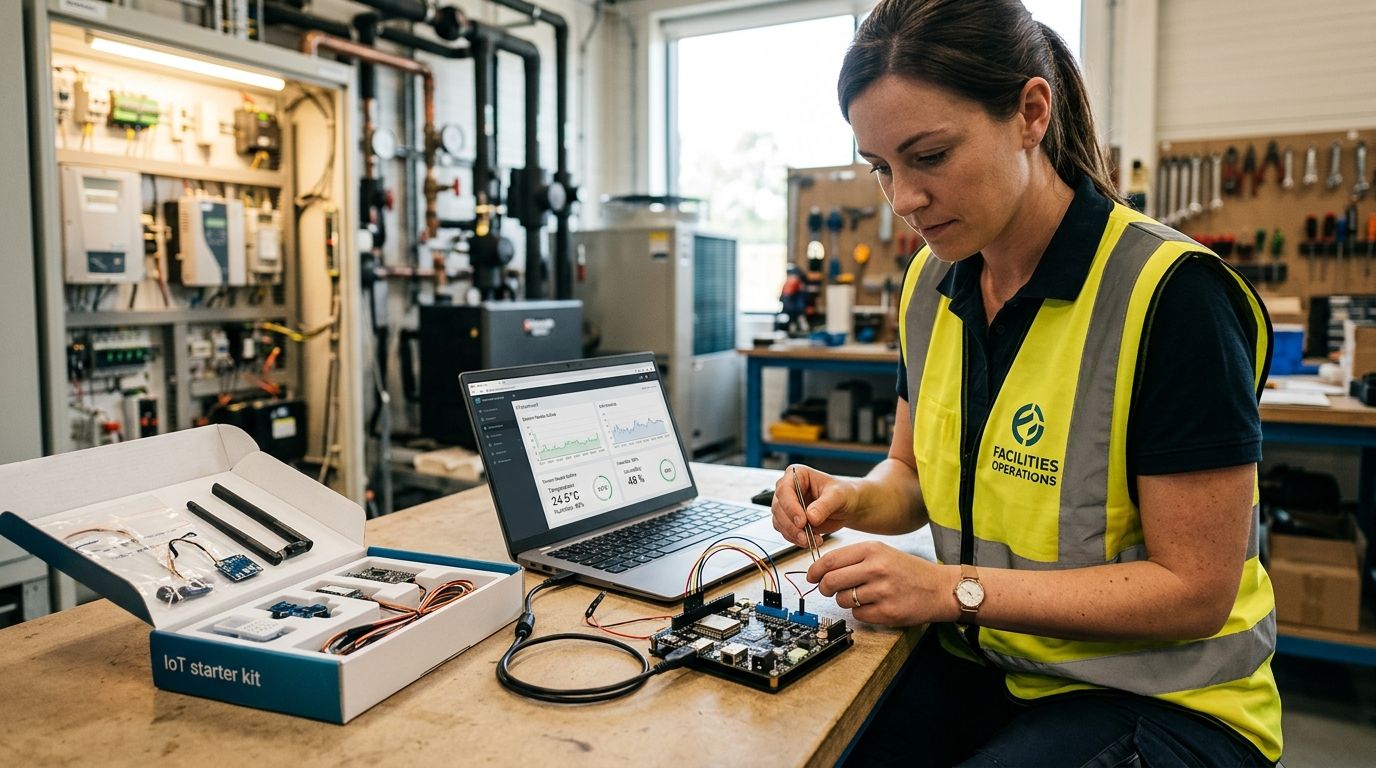
Most facilities teams don't need a full IoT rollout on day one — they need a starter kit that catches one failure mode reliably before anyone signs off on scaling it. This guide breaks down the five IoT starter kit configurations that actually match how operations and facilities teams work, not a spec sheet full of protocol jargon.
- The best iot starter kit for facilities teams matches sensor type to failure mode: temperature and humidity for cold storage, vibration for rotating equipment, door contacts for loading docks.
- A cold chain starter kit has to catch CDC-defined vaccine storage ranges of 2°C to 8°C every time, not most of the time.
- LoRaWAN and mioty both fit a facilities starter kit; mioty's telegram splitting gives it an edge in underground or shielded rooms.
- A legacy building retrofit kit needs wireless sensors and a gateway, not new conduit — this is where most facilities teams start in 2026.
- The Kilo IoT Platform's entry tier caps at 5 devices, 1 dashboard and 1 rule, enough to pilot a single failure mode before committing to more.
Why a starter kit beats a full sensor rollout in 2026
A facilities manager who buys 200 sensors before proving one failure mode usually ends up with a dashboard nobody checks. A starter kit is deliberately small: a handful of sensors tied to one real problem, wired to a platform that can escalate an alarm to the right person before the freezer door has been open for twenty minutes.
The Kilo IoT Platform is one place to run that pilot — it ships with a built-in LoRaWAN and mioty network server, so there's no separate network server to stand up, plus an MQTT connector for any PLC, energy meter or BMS already on site. That's the software half of the kit. The hardware half — sensors, gateways, trackers — comes from a device partner catalog; Kilo Electronics is the sister hardware company that ships sensors and gateways worldwide if you need a source.
What should be in an IoT starter kit for facilities teams?
Before comparing configurations, know what separates a starter kit that gets used from one that gets abandoned after month two.
- Sensor-to-failure-mode fit — a temperature probe solves a cold chain problem; it does nothing for a bearing that's about to seize.
- Protocol match to the building — LoRaWAN covers most indoor and campus deployments; mioty's telegram splitting holds up better in underground or steel-shielded rooms.
- Alarms, not just dashboards — a chart nobody watches is worthless; an alarm with an escalation chain to a phone is what stops the loss.
- A device cap you can pilot inside — start with one failure mode across one site before adding a hundred more sensors.
- A path to a digital twin or multi-site view — the kit should scale into a floor-plan or a multi-location dashboard without a platform swap.
- Open API or MQTT access — so the data can eventually feed a BI tool or a work order system without a rebuild.
IoT starter kit for facilities teams: comparison at a glance
| Kit type | Best for | Standout feature | Key limitation |
|---|---|---|---|
| Cold chain kit | Pharmacy and cold storage compliance | Continuous temp/humidity logging with escalation | Needs tight threshold tuning to avoid false alarms |
| Legacy retrofit kit | Older buildings with no existing wiring | Wireless sensors, no new conduit | Wall/floor materials can affect signal range |
| Industrial equipment kit | Vibration and motor health on rotating gear | Vibration + temperature on the same node | Needs correct mounting to read true baseline |
| Multi-site kit | Facilities teams running several locations | One dashboard across every site | More setup time up front to standardize sensor types |
| Warehouse/dock kit | Distribution centers and loading bays | Door contact + humidity zoning | Coverage gaps possible in large open-bay layouts |
1. Cold chain IoT starter kit: best for pharmacy and cold storage compliance
This kit pairs temperature and humidity sensors with an alarm chain tuned to a compliance threshold, not a comfort range. The CDC's Vaccine Storage and Handling Toolkit sets refrigerated vaccine storage at 2°C to 8°C — a starter kit built for this use case has to alarm the moment a reading drifts outside that band, not after a nightly log review.
Cold chain kit pros:
- Catches excursions in near real time instead of during a manual walk-through
- Generates the excursion history compliance audits ask for
- Multi-step escalation means a missed text still reaches someone by email or push
Cold chain kit cons:
- Threshold tuning takes a pass or two to avoid door-open false alarms
- Sensor placement inside the unit matters more than most teams expect
Best for: clinics, pharmacies and food storage operators with compliance reporting requirements. A deeper walkthrough of this exact setup is in pharmaceutical cold chain distribution center monitoring.
2. Legacy building retrofit IoT starter kit: best for buildings without existing wiring
Older buildings weren't built for a BMS, and running new conduit through finished ceilings is expensive. A retrofit starter kit skips that entirely: battery-powered wireless sensors, a gateway placed centrally, and a rules engine that turns raw readings into alarms without touching a single wire.
Legacy retrofit kit pros:
- No electrician or conduit work required for the pilot
- Sensors relocate easily if a room's use changes
- Works alongside whatever partial BMS already exists via MQTT
Legacy retrofit kit cons:
- Thick masonry or metal-clad walls can shrink LoRaWAN range
- Battery replacement becomes a recurring task at scale
Best for: property managers and facilities teams in buildings older than the wiring standards they're now expected to meet. Full guidance is in how to retrofit legacy buildings with wireless IoT sensors.
3. Industrial equipment IoT starter kit: best for vibration and motor health monitoring
This kit puts a vibration sensor — sometimes paired with a surface temperature probe — directly on a pump, motor or compressor. The goal isn't a prediction; it's a threshold. When vibration amplitude crosses a defined limit, a rule fires and an alarm escalates to the plant engineer before the bearing fails outright.
Industrial equipment kit pros:
- Flags a developing mechanical problem days before a hard failure
- One node covers both vibration and heat on the same asset
- Alarm severity tiers let a minor drift stay quiet while a critical one pages someone immediately
Industrial equipment kit cons:
- Mounting position affects reading accuracy — it has to sit on a rigid part of the housing
- Needs a short baseline period before thresholds mean anything
Best for: plant engineers and maintenance leads watching rotating equipment on a production floor. Setup detail lives in industrial pump and motor vibration monitoring.
4. Multi-site IoT starter kit: best for facilities teams managing multiple locations
A single-site pilot is easy. The harder problem is standardizing that pilot across five, ten or fifty locations without five separate dashboards. This kit is less about sensor type and more about the platform layer: one login, one rules engine, and alarms that route by location.
Multi-site kit pros:
- One dashboard replaces a spreadsheet of separate site reports
- Rules built once can be deployed with version control across every site
- Centralized alarm inbox means nothing gets lost between locations
Multi-site kit cons:
- Standardizing sensor types across sites with different ages takes planning
- Rollout takes longer than a single-site pilot by nature
Best for: regional facilities directors and multi-location operations managers.
5. Warehouse and dock door IoT starter kit: best for distribution center monitoring
Dock doors left open bleed conditioned air and let humidity swing inside storage zones. This kit combines door contact sensors with humidity sensors placed by zone, so a door propped open for too long triggers an alarm instead of a silent energy loss.
Warehouse kit pros:
- Catches doors left open long before energy waste shows up on a utility bill
- Zone-level humidity readings flag moisture problems before product is damaged
- Scales cleanly to more dock doors as the facility grows
Warehouse kit cons:
- Large open-bay layouts can create gateway coverage gaps without planning
- Door contact sensors need periodic battery checks in high-cycle doors
Best for: distribution center operations managers tracking dock activity and zone conditions.
See how the pieces fit together
Dashboards, rules and alarms built from real facility sensor data.
How was this IoT starter kit ranking put together?
Each configuration above was scored against the same six criteria: sensor-to-failure-mode fit, protocol match, alarm depth, pilot-friendly device counts, a scaling path, and open data access. No two kits compete for the same use case — a cold chain kit and a warehouse kit solve different problems, so the ranking reads as a decision tree rather than a leaderboard.
Which IoT starter kit should a facilities team choose in 2026?
Start with the failure mode that costs you the most right now. If it's spoiled product, start with the cold chain kit. If it's an old building with no sensor infrastructure, start with the retrofit kit. If it's unplanned equipment downtime, start with the vibration kit. Whichever one you pick, prove it on one site before asking a multi-site rollout to justify itself — that's the sequence that keeps an IoT starter kit from becoming shelfware.
FAQ
What's included in a typical IoT starter kit for facilities teams?
A starter kit includes a small set of sensors matched to one failure mode, a gateway or built-in network server for connectivity, and a software platform for dashboards and alarms. It's scoped to prove one use case, not cover an entire building.
Is LoRaWAN or mioty better for a facilities starter kit?
LoRaWAN covers most indoor and campus deployments and has the larger device ecosystem. Mioty's telegram splitting technology gives it an advantage in underground rooms or steel-shielded spaces where LoRaWAN signal degrades.
How many sensors does a facilities team need to start?
Enough to cover one failure mode at one site, typically a single-digit device count for a pilot. The Kilo IoT Platform's entry tier, for example, supports up to 5 devices, 1 dashboard and 1 rule.
Do I need a gateway for a LoRaWAN starter kit?
Yes, unless the platform you're using has a built-in network server that a partner gateway connects to directly. The gateway is what forwards sensor readings from the site to the cloud platform.
Can an IoT starter kit integrate with an existing building management system?
Yes, through an MQTT connector that accepts data from any publishing device, PLC, energy meter or BMS already on site. This lets a new starter kit sit alongside older infrastructure instead of replacing it.
How long does an IoT starter kit take to deploy?
Deployment time depends on site size and sensor count, but a single-site pilot is designed to go live in days, not months, since wireless sensors skip the wiring work a full BMS install requires.
What's the difference between an IoT starter kit and a full deployment?
A starter kit proves one failure mode at one site with a handful of sensors. A full deployment extends that same rule and dashboard logic across every site and every asset type once the pilot has proven its value.
Does a cold chain IoT starter kit need to log temperature excursions for compliance?
Yes, for pharmacy and vaccine storage, the CDC's Vaccine Storage and Handling Toolkit sets a 2°C to 8°C refrigerated range, and audits typically require an excursion history, not just a live reading.
The detail most teams miss when buying an IoT starter kit
The sensor count matters less than the escalation chain behind it. A five-sensor kit with a properly tuned alarm that reaches the right person in minutes beats a fifty-sensor deployment where alerts sit unread in an inbox. Tune the threshold, confirm the escalation path works on a real test payload, and only then add more devices.