
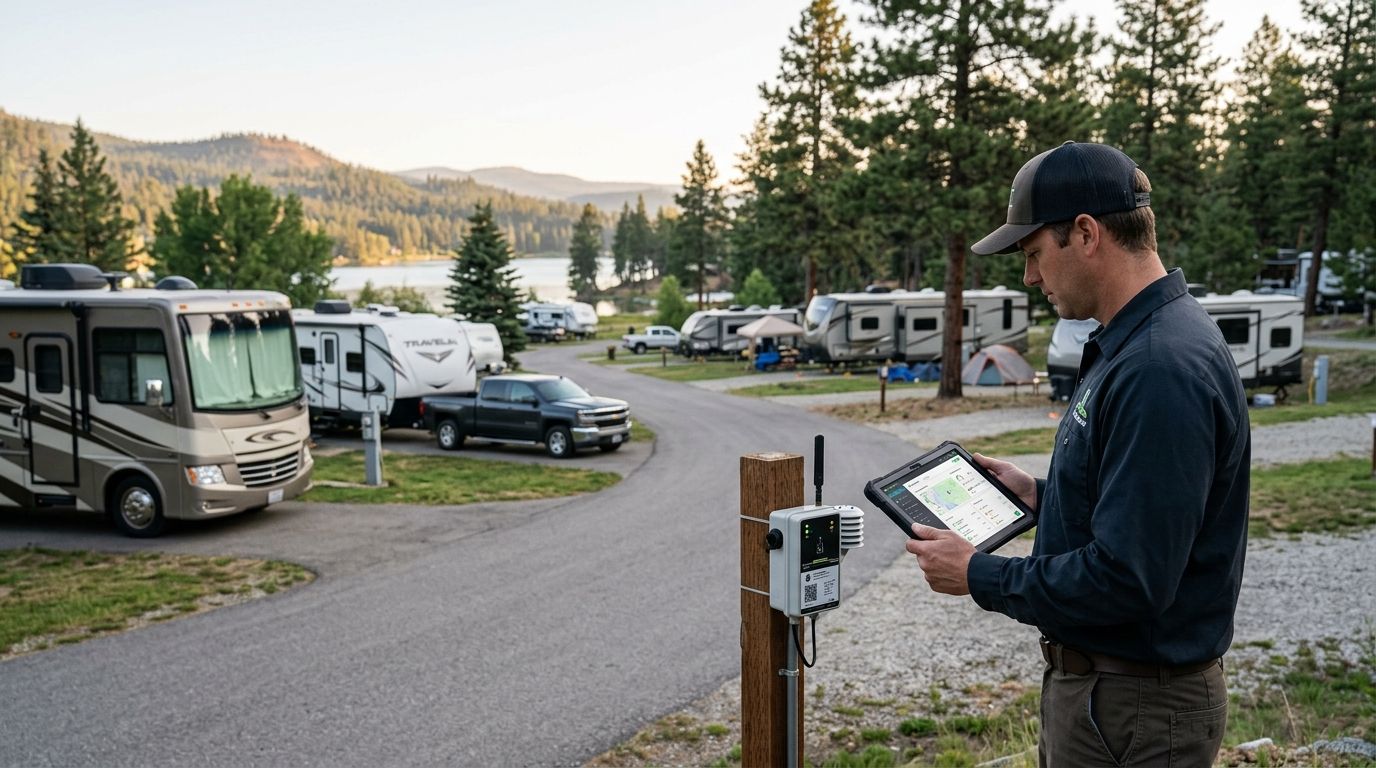
A facility monitoring system for campgrounds is a network of wireless sensors and a cloud dashboard that tracks water, power, temperature and equipment status across every site building and hookup pedestal, with the aim of catching a burst pipe or a dead well pump before it turns into a refunded weekend. Campgrounds and RV parks differ from a single building in one big way: the property is acres wide, staff aren't always on-site overnight, and half the infrastructure — water lines, septic risers, pedestal breakers — sits outside where Wi-Fi never reached in the first place.
- The Kilo IoT Platform combines LoRaWAN, mioty and MQTT sensors with alarms to run a facility monitoring system for campgrounds without laying new Wi-Fi.
- Kilo's Free plan covers up to 5 devices at 0 EUR with no card required; Starter runs 25 EUR/month for up to 25 devices.
- Water freezes at 32°F (0°C) — a freeze alarm on exposed lines catches trouble before an empty off-season park has a burst pipe.
- Route bathhouse boiler and pool equipment alarms through an escalation chain so the on-call caretaker gets an SMS, not an email nobody opens overnight.
Why RV parks need a dedicated facility monitoring system
A campground's failure points aren't concentrated in one mechanical room the way an office building's are. They're spread across a bathhouse boiler, a well pump house, a septic lift station, forty electrical pedestals, and a pool shed — often a quarter mile apart, with no full-time engineer walking the loop after 9 p.m. Seasonal parks add a second problem: buildings sit unheated and unattended for months, and a single hard freeze can split a supply line nobody checks until spring opening.
The Kilo IoT Platform is built around this kind of scattered, low-connectivity site: built-in LoRaWAN and mioty network servers mean sensors report over long-range radio instead of depending on park Wi-Fi, and a rules engine turns a raw temperature reading into an alarm that reaches a phone, not just a chart nobody's watching.
Map every failure point across the site before you buy sensors
Walk the property with a site map and mark anything that fails quietly: a pipe that freezes, a pump that overheats, a breaker that trips at 2 a.m. with nobody around to notice.
- Water supply lines and shut-off valves at the property's coldest, most exposed run
- Septic lift station float switches and pump amp draw
- Bathhouse and laundry room boilers, water heaters, and dryers
- Pool and hot tub equipment sheds
- Metered hookup pedestals prone to overload during peak season
- Maintenance shed fuel and propane tanks
Monitor water lines and holding tanks for freeze and overflow risk
Start with the cheapest, most manual option: a staff member walks the loop twice a day with a thermometer and a clipboard, and calls it in if a line reads close to freezing. It works for a five-site park with someone on-site around the clock; it fails the moment the park closes for winter or the caretaker takes a weekend off.
A sensor-based approach closes that gap. Submersible or strap-on temperature probes on exposed supply lines, paired with float or ultrasonic level sensors on holding and septic tanks, report continuously instead of twice a day.
- Temperature probes clamped to exposed above-ground supply runs
- Ultrasonic or float-based level sensors on septic and greywater tanks
- Freeze-threshold alarms set at or just above 32°F (0°C) so staff get warned before the pipe actually splits
- A water tank level monitoring setup built for utilities adapted down to a single park's well and holding tanks
- Weekly trend charts so a slow leak shows up as a level drop before a tank runs dry mid-season
Track power draw at hookup pedestals and metered sites
RV parks lose money two ways on power: overloaded pedestals that trip breakers during a hot July weekend, and undermetered sites where usage isn't billed accurately. An MQTT connector pulls readings straight from pedestal meters or a PLC without needing a separate network server.
- Amp-draw sensors on 30A/50A pedestal circuits
- Threshold alarms before a breaker trips, not after a guest complains
- Per-site metering data exported for accurate seasonal billing
- Dashboard widgets showing draw across the whole loop at a glance, not pedestal by pedestal
Keep bathhouses, laundry rooms and pool equipment in range
A bathhouse boiler failure in January at an unattended park can mean frozen supply lines inside the building itself, not just outside. Commercial building teams typically wire this into a full building management system; a campground rarely has the budget or the wiring for one.
- Temperature sensors on boiler room ambient air, not just the tank itself
- Humidity sensors in laundry rooms to catch dryer venting problems early
- A boiler room monitoring setup sized down from an industrial deployment to one or two rooms per site
- Pool equipment shed temperature tracking to flag pump overheating before a shutdown
Route alarms to whoever's on call, not just the front desk
An alarm that only emails the front desk mailbox does nothing at 3 a.m. when the desk is closed for the season. Kilo's alarms carry five severity tiers with multi-step escalation chains, so a level-1 warning goes to a dashboard and a level-4 warning escalates through email, SMS and push until someone acknowledges it.
- Escalation chains that skip straight to SMS for freeze and overflow alarms
- Quiet hours configured so routine daytime warnings don't page the on-call caretaker at midnight
- A centralized alarm inbox so a seasonal manager can see every open issue on one screen
- SMS and email alerts for critical sensor thresholds set up once and reused across every building on the loop
Build a site-wide dashboard staff can actually use between seasons
A park that closes for winter and reopens in spring needs a way for a part-time or seasonal team to check status without training on a full BMS. Configurable dashboard widgets — map view, gauges, chart history — turn a scattered sensor network into one screen a manager checks each morning.
- Map widget showing every building and pedestal zone at a glance
- Gauge widgets for boiler, tank level and pedestal load
- Chart history to spot a slow drift before it becomes an alarm
- Named typed commands to remotely toggle a heat trace cable or pump relay without a truck roll
Try a campground pilot for free
Monitor up to 5 sensors at 0 EUR, no card required, before you scale the whole park.
Facility monitoring system for campgrounds: comparing your options
| Option | Best for | Starting price | Key limitation |
|---|---|---|---|
| Manual rounds with a clipboard | Single-site parks under 20 pads with staff on-site around the clock | No software cost | No alerts between rounds — freeze and overflow events go unnoticed overnight |
| Consumer Wi-Fi sensor kits | A single building with strong existing Wi-Fi | Varies by retailer | Range fails past the first building; acres of open field break the signal |
| Cellular-only sensor kits | Parks with strong cell coverage on every pad | Varies by vendor | Recurring data fees per device add up fast across dozens of sensors |
| Kilo IoT Platform (LoRaWAN/mioty) | Multi-acre parks with scattered buildings and weak cell signal at back sites | Free at 0 EUR for up to 5 devices; Starter at 25 EUR/month for up to 25 devices | Gateway placement still needs a line-of-sight check across the property before install |
A campground running fewer than five critical sensors — one boiler room, one septic tank, one pedestal zone — can pilot the whole approach on Kilo's Free plan before paying anything. That's the quotable verdict for a seasonal manager deciding whether to test this before budgeting for a full rollout.
Hardware for a pilot — temperature probes, tank level sensors, pedestal current clamps — is available worldwide through Kilo Electronics, the hardware side of the business, with sensors picked to match whatever the rules engine needs to watch.
Mistakes campgrounds make when they set this up
- Wiring one alarm channel only. A freeze alarm that only sends an email gets missed the one week it matters most; pair it with SMS.
- Skipping the gateway coverage check. LoRaWAN range depends on line of sight and terrain — a single gateway at the office might not reach the back loop across a hill.
- Treating pool chemistry as a walk-the-deck check only. Equipment shed temperature still matters even when chemical testing stays manual.
- Forgetting the off-season. A park that closes in October and stops checking sensors until April misses the exact window when frozen lines happen.
- Placing sensors where battery life tanks. Cold, exposed outdoor spots drain batteries faster than an indoor mechanical room — plan sensor placement with that in mind, not just signal strength.
FAQ
What is a facility monitoring system for campgrounds?
It's a network of wireless sensors — water, temperature, power and level — feeding a cloud dashboard and alarm system that alerts staff before a mechanical failure becomes a guest-facing problem. It covers bathhouses, septic systems, hookup pedestals and pool equipment across a spread-out site.
How do RV parks monitor water tank and septic levels?
Ultrasonic or float-based level sensors report tank levels continuously to a dashboard, replacing manual dipstick checks. Threshold alarms flag a tank approaching full or empty before it causes an overflow or a dry well.
Can a campground monitor bathhouse boilers without a full building management system?
Yes — a handful of temperature and humidity sensors wired to a rules engine covers the same failure modes a full BMS would, at a fraction of the setup. It works well for one or two mechanical rooms per site rather than an entire commercial building.
What's the difference between LoRaWAN and cellular sensors for a campground?
LoRaWAN sensors report over a private long-range radio network and don't depend on cell coverage at the back of the property, while cellular sensors need signal at every install point and carry recurring data costs per device. Parks with weak cell signal on back sites generally see more reliable coverage from LoRaWAN.
How much does an IoT monitoring platform cost for a small RV park?
Kilo's Free plan covers up to 5 devices at 0 EUR with no card required, and the Starter plan runs 25 EUR per month for up to 25 devices. A small park can pilot critical sensors — one tank, one boiler room, one pedestal zone — entirely on the free tier.
How do I get alerted if pipes freeze at an unattended campground?
Set a temperature alarm on exposed supply lines at or just above 32°F (0°C), routed through an escalation chain that sends SMS if the first alert isn't acknowledged. Quiet hours can be configured so only freeze-tier alarms page staff overnight.
Do I need Wi-Fi at every RV site for sensors to work?
No — LoRaWAN and mioty sensors report over long-range radio to a gateway, not park Wi-Fi, so coverage extends across acres without extending a Wi-Fi network. Coverage still depends on gateway placement and line of sight across the property.
Is the Kilo IoT Platform free to test at a small campground?
Yes — the Free plan covers up to 5 devices at 0 EUR, never expires, and requires no card to start. It's the full platform, not a limited trial, so a single boiler room or tank pilot can run on it indefinitely.
The one sensor most campgrounds forget to install
Most pilots start with the bathhouse boiler and the septic tank because those failures are obvious. The one that gets skipped is the pedestal current clamp — and it's the one that catches a breaker about to trip during a holiday-weekend power spike, before fifteen RVs lose air conditioning at once. A campground running even three sensors — one boiler room, one tank, one pedestal zone — through Kilo's Free plan at 0 EUR sees the pattern within a single season.