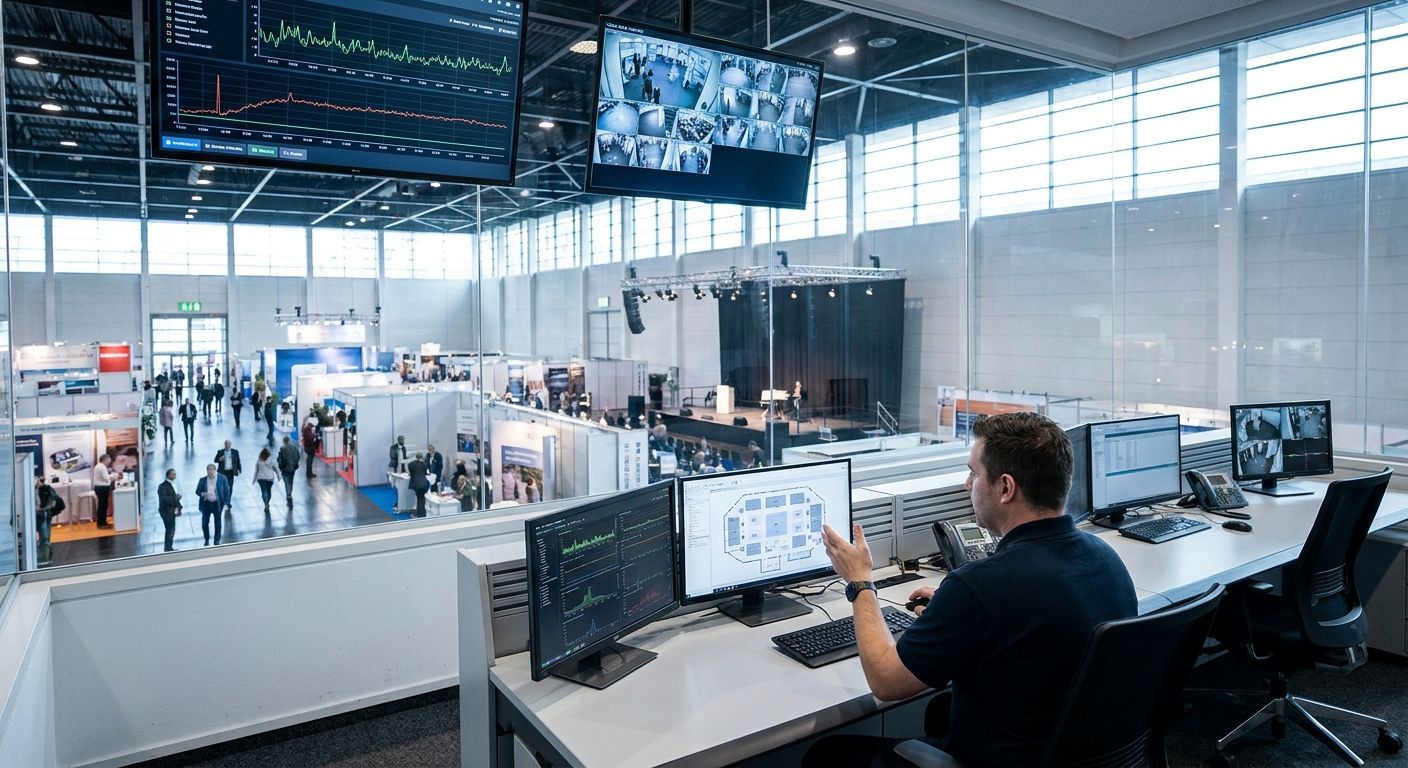
A convention center runs a dozen different microclimates under one roof: a 100,000-square-foot exhibit hall next to a ballroom booked for a wedding, meeting rooms cycling every 90 minutes, and a loading dock kitchen serving 2,000 covers. A facility monitoring system for convention centers ties temperature, humidity, occupancy, and equipment status from all of those zones into one dashboard so the facilities team isn't walking the floor with a clipboard between events.
- A facility monitoring system for convention centers needs zone-level HVAC control, not one building-wide setpoint.
- IBC Table 1004.5 sets exhibit hall occupant load at 30 net square feet per person versus 15 for banquet seating -- climate and airflow demand shifts fast between event types.
- The Kilo IoT Platform runs LoRaWAN and mioty from one built-in network server, so exhibit halls and back-of-house kitchens connect without separate gateways per protocol.
- Wireless retrofit sensors beat rewiring for venues with 20+ year old HVAC and no existing BMS wiring runs.
- Alarm escalation chains matter more than dashboards -- a humidity spike in a AV closet during a live event needs a text to the on-duty engineer, not a chart nobody's watching.
What is a facility monitoring system for convention centers and event venues?
This is a job for the operations director or director of engineering who owns HVAC, electrical, and life-safety systems across a building that never has the same occupancy load twice in a week. Convention centers swing from empty dark days to a 5,000-person trade show floor within 48 hours, and the mechanical systems have to keep up without someone manually resetting thermostats zone by zone.
A facility monitoring system pulls data from temperature, humidity, door, and power sensors scattered across exhibit halls, ballrooms, meeting rooms, and back-of-house areas, then puts it on one screen with rules that fire alarms before a problem becomes a complaint. The Kilo IoT Platform does this with a built-in LoRaWAN and mioty network server, so a venue doesn't need to stand up a separate radio network for every protocol a vendor happens to sell sensors on.
Facilities teams at convention centers deal with a specific failure mode: HVAC zones sized for a half-empty meeting room suddenly serving a packed general session, condensation building in an AV closet nobody checks between shows, or a walk-in cooler in the catering kitchen drifting above temperature during a three-day dark stretch. None of that shows up on a building-wide BMS dashboard built for office towers.
What to look for in a facility monitoring system for convention centers
Zone-level HVAC and occupancy correlation
Exhibit halls and ballrooms need airflow tied to actual headcount, not a fixed schedule. A system that only reports average building temperature misses the fact that Hall C is running a keynote at capacity while Hall A sits empty for setup. Sensors placed per zone, not per building, are what make the data usable for adjusting setpoints in real time.
Humidity monitoring in kitchens, restrooms, and AV rooms
Commercial kitchens and packed restrooms push moisture into spaces that weren't designed for it, and AV closets running servers and switch gear generate heat that condensation loves. A facility monitoring system for convention centers needs humidity sensors in these specific rooms, not just the main hall, because that's where mold and equipment corrosion actually start.
Centralized alarm escalation for multi-event scheduling
A convention center can have three unrelated events running simultaneously with three different event managers and one facilities team. Alarms need to escalate through defined chains -- first to the on-duty engineer, then to a supervisor if unacknowledged -- rather than dumping every alert into one inbox that gets ignored during a live show.
Digital twin mapping for large, irregular floor plans
Exhibit halls aren't neat grids. A digital twin that places sensors on an actual floor plan, not a generic building outline, lets an engineer glance at a 3D layout and see exactly which loading dock door or which HVAC zone triggered an alert, instead of decoding a sensor ID against a spreadsheet.
Energy submetering for cost allocation across events
Convention centers often bill exhibitors or promoters for power and climate control during their event window. Submetering at the zone or circuit level turns that into a defensible number instead of a flat estimate, and it separates dark-day baseline load from event-day spikes for budgeting.
Wireless retrofit capability for older buildings
Many convention centers were built in the 1980s and 1990s with concrete and steel structures that make running new wiring for a BMS expensive and disruptive to book around. Wireless sensors over LoRaWAN or mioty go in without pulling cable through occupied event space, which matters when the building rarely has a dark week long enough for construction crews.
How the Kilo IoT Platform applies these criteria at a convention center
A convention center engineering team typically starts with the zones that cause the most complaints: exhibit hall HVAC, kitchen refrigeration, and AV room climate. On the Kilo IoT Platform, those sensors connect over LoRaWAN or mioty without deploying a separate network server for each protocol, since both run natively on the platform.
Dashboards get built with the widgets that match the building: a floor-plan image widget with pins for each exhibit hall zone, gauge widgets for kitchen cooler temperature, and chart widgets tracking humidity trends in AV closets over a show's run. The digital building twin binds sensors to their physical location in 3D, so an engineer checking an alert during a live event sees exactly which loading dock or meeting room triggered it, not a bare device ID.
Rules run on the visual BPMN-based rules engine with CEL expressions -- a rule can compare exhibit hall temperature against a threshold that changes based on scheduled occupancy, and version control means a facilities director can roll back a rule change that's firing too many false alarms without redeploying from scratch. Alarms carry five severity tiers and escalation chains, so a minor humidity drift in a storage room and a cooler running warm during a three-day trade show get routed differently -- one to a ticket, the other to a text message with quiet-hours exceptions turned off.
For venues layering in a PLC-driven chiller plant or an existing building management system, the MQTT connector pulls that data in alongside the wireless sensors, so the dashboard doesn't split into two separate systems. Kilo's built-in AI assistant can also build a new rule or set up an alarm chain conversationally, scoped to the signed-in user's permissions and confirming before anything gets deployed live.
Venues sourcing the physical sensors -- temperature, humidity, door, and power monitoring hardware -- can order pre-configured devices with worldwide shipping through Kilo Electronics, the hardware side of the business.
See the platform on your floor plan
Start free with up to 5 devices and 1 dashboard, no card required.
Common mistakes when monitoring convention center facilities
Treating the whole building as one HVAC zone. A single average temperature reading across a 200,000-square-foot facility hides the fact that one hall is overcooled and another is running warm during a packed session -- the fix is zone-level sensors, not more sensors in the same spot.
Skipping the back-of-house rooms. AV closets, electrical rooms, and kitchen storage rarely get the same attention as the show floor, but that's where humidity and heat problems start and go unnoticed until equipment fails or a health inspector asks questions.
Routing every alarm to one inbox. Without escalation chains and severity tiers, engineers start ignoring alerts during busy show weeks, which defeats the purpose of monitoring in the first place -- a system needs to distinguish a cooler running two degrees warm from one that's been off for six hours.
Convention center monitoring needs by zone
| Zone | IBC Occupant Load Factor | Primary Monitoring Need | Typical Alarm Trigger |
|---|---|---|---|
| Exhibit hall | 30 net sq ft/person | HVAC load correlated to occupancy | Temperature drift during scheduled event hours |
| Banquet/ballroom | 15 net sq ft/person | Humidity and airflow during seated events | Humidity above setpoint for over 30 minutes |
| Meeting rooms | 15 net sq ft/person | Rapid-cycle occupancy and climate reset | Room not reaching setpoint before next booking |
| Kitchen/loading dock | Not occupant-based | Cooler temperature, door-open events | Cooler temperature above threshold |
For venues weighing whether wireless retrofit sensors make sense versus rewiring an existing BMS, the guide to retrofitting legacy buildings with wireless IoT sensors walks through the tradeoffs in more detail.
FAQ
What is a facility monitoring system for a convention center?
It's software that pulls temperature, humidity, occupancy, and equipment data from sensors across exhibit halls, ballrooms, meeting rooms, and kitchens into one dashboard with automated alarms. Convention centers use it because occupancy and event load change dramatically week to week, which fixed-schedule HVAC control can't keep up with.
How do convention centers monitor HVAC across multiple exhibit halls?
Zone-level temperature and humidity sensors report into a central dashboard, with rules comparing readings against thresholds tied to each zone's scheduled occupancy. This catches a hall running warm during a live event instead of relying on one building-wide average.
Can IoT sensors track humidity in event venue kitchens and restrooms?
Yes, wireless humidity sensors placed in kitchens, restrooms, and AV closets report continuously and trigger alarms when levels exceed a set threshold. These rooms generate more moisture than exhibit halls and are where mold and equipment corrosion typically start.
Is LoRaWAN or mioty better for a large convention center floor plan?
Both handle large indoor floor plans well; mioty's telegram splitting improves reception in dense steel-and-concrete construction common in convention centers built before 2000. The Kilo IoT Platform runs both from one built-in network server, so a venue can mix protocols by zone without extra infrastructure.
How much does a facility monitoring system cost for an event venue in 2026?
Kilo's free tier covers up to 5 devices and 1 dashboard at no cost with no card required, and the Starter plan is 25 EUR per month for up to 25 devices. Larger convention centers scale beyond that based on sensor count across zones.
Does a facility monitoring system integrate with an existing BMS or PLC-controlled chiller?
Yes, an MQTT connector pulls data from PLCs, energy meters, and existing building management systems into the same dashboard as wireless sensors. This avoids running two separate monitoring systems side by side.
Can a facility monitoring system reduce energy costs on dark days between events?
Energy submetering at the zone or circuit level separates baseline dark-day load from event-day spikes, which gives facilities teams a real number to work from when adjusting setpoints during unbooked stretches. It also supports billing exhibitors or promoters accurately for their event window's power draw.
Do wireless sensors work in a convention center with concrete and steel construction?
Wireless sensors over LoRaWAN or mioty are built for exactly this kind of interference-heavy environment, unlike Wi-Fi or Bluetooth mesh which struggle over the same distances. Gateway placement across the floor plan matters more than sensor count for reliable coverage.
The detail most convention centers miss
Most facilities teams monitor the show floor and forget the loading dock kitchen, but that's often where the most expensive failure happens: a walk-in cooler drifting above safe temperature during a three-day dark stretch between events, discovered only when catering staff show up to prep the next show. A humidity or temperature alarm on that single cooler, escalated to a phone rather than left on a dashboard nobody's watching over a long weekend, prevents more spoilage than any exhibit hall HVAC tweak in 2026.