
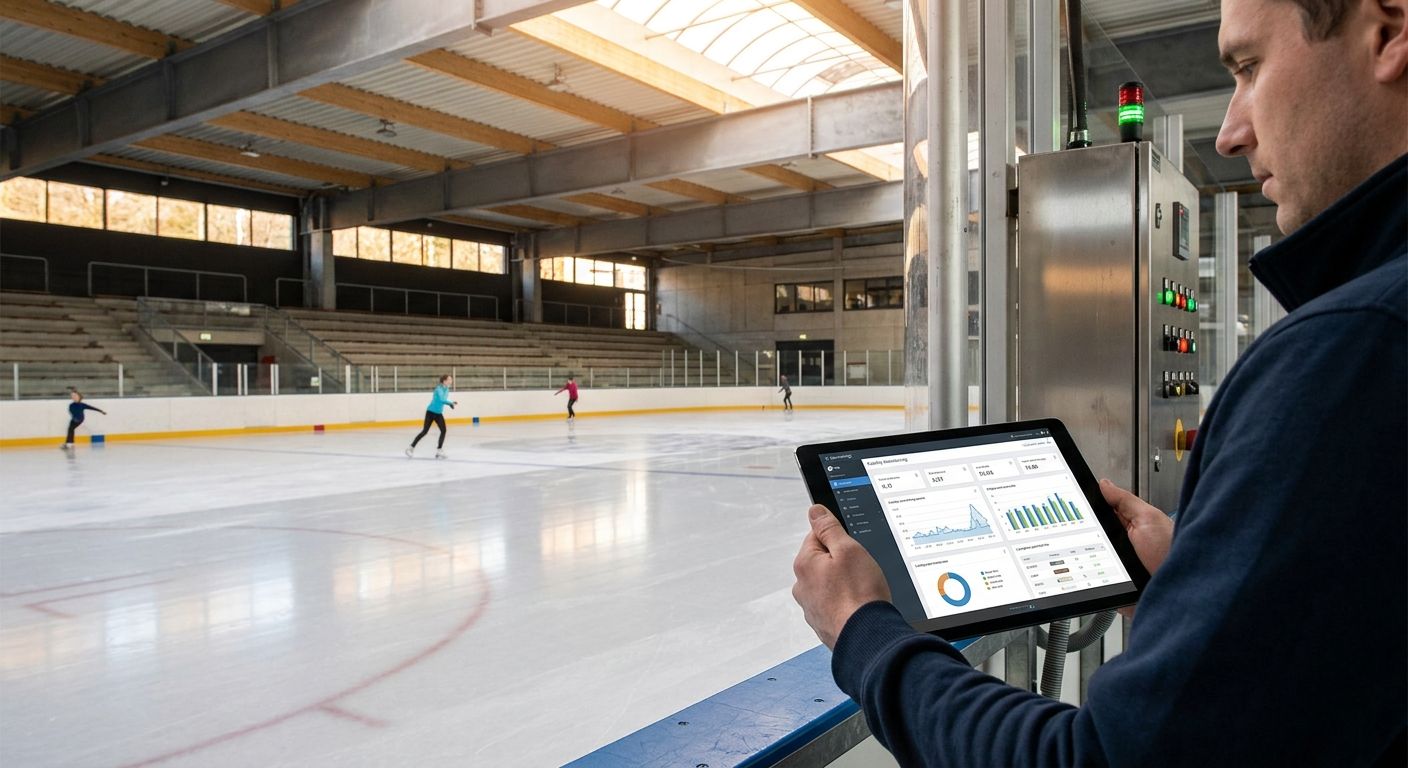
Ice rinks and arenas run one machine that never gets a day off: the refrigeration plant that turns a concrete slab into a sheet of ice. A facility monitoring system for ice rinks and arenas puts that plant, the ice sheet, and the air around it on one dashboard, so a drifting compressor or a rising ammonia reading shows up as an alarm instead of a flooded rink floor or an evacuated building. A single-pad municipal rink and a six-sheet regional arena complex need the same three data streams — temperature, gas, and humidity — but the complex needs them across buildings, not just across rooms.
- A facility monitoring system for ice rinks and arenas tracks ice sheet temperature, machinery room ammonia or refrigerant levels, and rink bowl humidity in one dashboard.
- OSHA's Process Safety Management rule (29 CFR 1910.119) applies once a facility holds more than 10,000 lbs of anhydrous ammonia, which pushes continuous gas monitoring past a nice-to-have.
- NIOSH lists 300 ppm ammonia as immediately dangerous to life; OSHA's 8-hour exposure limit is 50 ppm, so alarms need to fire well before either number.
- Kilo's rules engine and alarm escalation chains replace paper rounds sheets for compressor and gas checks, without claiming to predict a compressor failure before it happens.
Why do ice rinks and arenas need a facility monitoring system?
Refrigeration is the largest mechanical and life-safety system in an ice arena, and it doesn't fail quietly. A short-cycling compressor shows up as soft ice long before anyone reads a fault code on the plant panel. An ammonia release travels fast enough that a walking round every two hours can arrive too late. Most rinks still run on a rounds sheet: a mechanic reads gauges, writes numbers on paper, and hopes nothing moves between visits.
That gap between readings is where a facility monitoring system for ice rinks and arenas earns its keep. The Kilo IoT Platform reads sensors continuously and fires an alarm the moment a value crosses a threshold, instead of waiting for the next round. For a single municipal rink that's peace of mind. For a five-pad regional complex or a chain of arenas under one parks department, it's the difference between five separate control panels and one dashboard a facilities director checks every morning in 2026.
How do you monitor an ice rink or arena facility with IoT sensors?
Eight systems account for almost every incident report at an ice facility. Work through them in order: ice and slab first, gas and humidity next, then the systems around the rink bowl.
Monitor ice sheet and sub-floor slab temperature
Ice hardness and thickness track slab temperature more closely than most maintenance staff assume, and a drifting brine loop shows up on the ice before it shows up on a gauge.
- Walk a handheld infrared thermometer across the sheet at the start of each shift and log the reading
- Pull brine supply and return temperatures off the refrigeration plant gauges twice daily
- Chart daily highs and lows in a spreadsheet to catch slow drift after a resurface or a header change
- Set a different target range for competitive hockey bookings than for public skate or figure sessions, since the ice runs colder for hockey
Track ammonia or refrigerant levels in the machinery room
Ammonia (R-717) is still the refrigerant of choice in most arena-class plants because it's efficient to run, which is also why IIAR guidance calls for fixed gas detection in every machinery room. OSHA's exposure limit sits at 50 ppm over an eight-hour shift; NIOSH puts the immediately-dangerous-to-life level at 300 ppm. A rounds sheet checked every two hours doesn't catch a leak that develops in twenty minutes.
- Install a fixed ammonia detector with a local horn and strobe per IIAR machinery room guidance
- Log ppm readings on the rounds sheet during every walkthrough
- Wire the detector's relay or 4-20mA output into an MQTT connection so Kilo's rules engine can read it continuously and fire an alarm the moment a reading crosses your set point, with escalation to the on-call mechanic's phone before the level gets anywhere near 300 ppm
- Set a lower first-tier alarm well under the 50 ppm exposure limit, so someone gets paged before it becomes a life-safety event
“If the machinery room alarm doesn't reach the on-call mechanic by phone, the ammonia detector might as well be silent.”
Watch dehumidification and dew point across the rink bowl
Ice fog and "rink rain" — condensation dripping off structural steel onto the sheet — both trace back to dew point, not just relative humidity. The dehumidification system and the refrigeration plant behave as one energy system, and the HVAC energy management approach Kilo documents covers the mechanics of tracking that pairing across a building.
- Check a sling psychrometer or standalone dew point meter at rink-side and near the ceiling once per shift
- Log desiccant wheel or refrigerant dehumidifier run hours against outdoor humidity
- Place wireless temperature and humidity sensors at ice level, mid-bowl, and ceiling height so a dashboard shows the vertical gradient instead of one averaged number
- Set a dew point alarm tied to ice surface temperature, since fog forms once the two get close
Set alarms for compressor faults and short cycling
A compressor that starts and stops more often than its duty cycle allows wastes energy and wears out faster, and the plant's own control panel often logs the fault without telling anyone in real time. Detecting refrigeration compressor problems before a breakdown starts with getting discharge pressure, discharge temperature, and run-time data out of the PLC and into a system that watches it continuously.
- Pull discharge pressure, discharge temperature, suction pressure, and amp draw off the plant's PLC or BMS over Modbus or an MQTT connector
- Set a CEL rule in Kilo that flags a run-time pattern outside the expected duty cycle and pushes an alarm instead of waiting for the next scheduled inspection
- Route the alarm through an escalation chain so it reaches the refrigeration mechanic, not just a control room screen nobody watches after hours
- Keep a rolling log of run hours per compressor to plan maintenance against actual load rather than a fixed calendar date
Track locker room, lobby, and mechanical room comfort
Skaters and spectators notice a stuffy lobby or a locker room stuck near 80°F long before a facilities director does.
- Place temperature and CO2 sensors in locker rooms, lobbies, and enclosed viewing areas
- Set separate humidity thresholds for public spaces than for the rink bowl — comfort ranges and ice-preservation ranges are not the same target
- Build a dashboard widget per zone so a duty manager can scan every room at a glance instead of walking the building
Monitor propane or fuel levels for the ice resurfacer
A resurfacer that runs out of fuel mid-session is a scheduling problem the tenants notice immediately. Sensors and gateways for a build like this — including tank level sensors sized for a resurfacer's fuel cylinder — are available through Kilo Electronics, Kilo's sister hardware company, with worldwide shipping.
- Check the resurfacer's fuel gauge and the storage cylinder manually before each session block
- Move to a wireless tank level sensor on the storage cylinder so the reading updates without a physical check
- Set a low-level alarm early enough to reorder or swap cylinders before a scheduled resurface
Watch for water leaks near the Zamboni pit and pipe runs
A slow leak near the ice edging or a cracked header pipe under the bowl usually shows up as a wet spot long before it shows up on a water bill.
- Walk pipe runs and the resurfacer pit visually during rounds
- Place rope or point leak sensors along known-risk runs — header pipes, the resurfacer pit drain, and any floor drain near the machinery room
- Alarm on the first drop of moisture instead of the wet floor
Centralize multi-rink and multi-arena monitoring in one dashboard
A parks department running four rinks, or an operator running a regional arena chain, doesn't need four separate control panels each showing one building. Setting up a facility monitoring dashboard for multiple locations means every pad's ice temperature, ammonia reading, and compressor status lands on one screen, filtered by site.
- Standardize sensor naming and thresholds across every rink so a duty manager reads one dashboard the same way at every location
- Give each rink its own digital twin so an alarm names the exact machinery room or rink bowl, not just "Building 3"
- Set role-based access so a regional manager sees every site while a rink-level mechanic sees only theirs
See ice rink monitoring on one dashboard
Watch ice temperature, ammonia readings and compressor status land in one place.
Which facility monitoring option fits an ice rink or arena?
| Option | Best for | Key limitation |
|---|---|---|
| Paper rounds sheets | Single-pad rinks with tight budgets | No alerting between rounds; gaps of hours between readings |
| Building automation system wired to the refrigeration plant | Large single-site arenas with capital budget for BAS wiring | Expensive to extend to new sensor types; usually covers one building at a time |
| Standalone fixed ammonia detectors | Machinery room life-safety compliance | Local horn and strobe only; no remote visibility or history unless wired into another system |
| Wireless IoT sensor network with a cloud platform (LoRaWAN or mioty), such as Kilo | Multi-pad complexes and chains wanting one dashboard for ice, gas, and humidity data without rewiring the building | Sensors still need periodic calibration and battery swaps in cold machinery rooms |
What mistakes do ice rinks make with facility monitoring?
- Checking the machinery room every two hours instead of continuously, so a leak that develops in twenty minutes gets missed between rounds
- Setting one humidity threshold for the whole building instead of separate thresholds for the rink bowl and public spaces, so alarms either fire constantly or never
- Tracking ice surface temperature without tracking sub-floor brine temperature, so the first sign of trouble is soft ice instead of an early header reading
- Treating each rink in a multi-pad complex as a separate monitoring project, ending up with different sensor brands and thresholds at every pad
- Skipping fuel level checks on the ice resurfacer until a scheduled resurface gets missed mid-session
FAQ
What does a facility monitoring system for ice rinks and arenas actually track?
It tracks ice sheet and sub-floor temperature, machinery room ammonia or refrigerant levels, rink bowl humidity and dew point, and compressor run data, all in one dashboard. Most systems also cover locker room comfort and fuel levels for the ice resurfacer.
How much ammonia is dangerous in an ice rink machinery room?
OSHA sets the 8-hour exposure limit at 50 ppm, and NIOSH lists 300 ppm as immediately dangerous to life. Continuous detection with an alarm set well under 50 ppm gives staff warning before either threshold matters.
Do ice rinks have to monitor ammonia continuously?
OSHA's Process Safety Management rule (29 CFR 1910.119) applies once a facility holds more than 10,000 lbs of anhydrous ammonia. Below that threshold it's not federally mandated, but IIAR still recommends fixed detection in any ammonia machinery room.
Is LoRaWAN or mioty better for an ice arena's machinery room?
Both run on Kilo's built-in network server, so the choice comes down to the environment. Concrete and metal-heavy machinery rooms with shielding or interference issues tend to favor mioty's telegram splitting for reliable delivery.
What causes fog over an ice rink?
Fog forms when the air's dew point gets close to the ice surface temperature. Tracking both together, instead of relative humidity alone, catches the condition before it shows up over the ice.
Can one dashboard cover multiple rinks in different buildings?
Yes. A cloud platform with per-site digital twins and role-based access lets a regional manager see every pad while a rink-level mechanic only sees theirs, on the same underlying dashboard.
Does an IoT platform predict when a compressor will fail?
No. Kilo's rules engine fires an alarm when a reading crosses a threshold or a run-time pattern falls outside the expected duty cycle. That's rule-based detection, not a failure prediction.
What's the most overlooked sensor in ice rink monitoring?
Everyone locks in on ammonia in the machinery room and forgets the resurfacer garage. CDC and NIOSH have both published guidance on carbon monoxide and nitrogen dioxide exposure from propane- and gasoline-powered ice resurfacing and edging equipment inside enclosed rinks — it's a documented indoor air quality issue, not a hypothetical one. A CO and NO2 sensor in the resurfacer storage area, wired into the same alarm system as the ammonia detector, closes a gap most rinks never think about until an air quality complaint forces the issue in 2026.