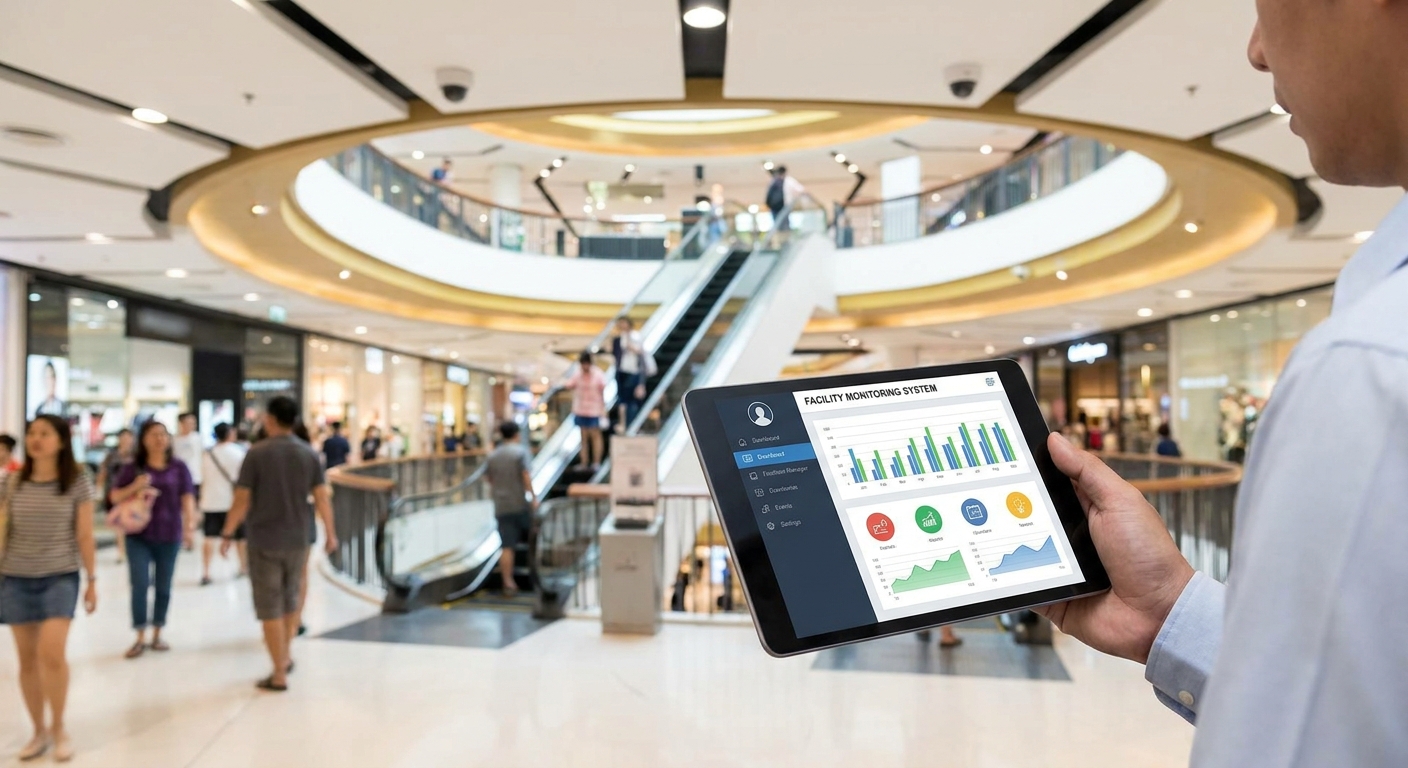
Shopping malls run 20 to 40 mechanical systems across common areas and dozens of independent tenants, and most facilities teams find out something broke after a shopper complains or a repair invoice lands. A facility monitoring system for shopping malls puts sensors on HVAC, refrigeration, water lines and parking structures and feeds all of it into one dashboard instead of five different vendors' spreadsheets.
- Kilo IoT's facility monitoring system for shopping malls tracks HVAC runtime, water leaks and cold storage from one dashboard — buy it if you run 3 or more mechanical zones.
- Parking occupancy sensors cut tenant complaints about full lots, but full multi-level coverage makes this a Consider, not a must-have, for 2026 budgets.
- Food court cold chain monitoring catches a walk-in freezer drifting past -18°C before a health inspector does.
- Multi-site dashboards matter more than single-mall features once a property management group runs 5 or more centers.
- A rules engine that routes alarms to the right vendor beats a dashboard that only logs data after the fact.
Why this matters
A shopping mall's biggest facilities risks are boring until they aren't: an RTU short-cycling for weeks, a slab leak spreading under polished concrete, a walk-in cooler drifting warm overnight. None of these show up as an emergency until the lease dispute, the insurance claim or the health department visit.
Mall leases in 2026 increasingly push CAM cost accountability back onto operators, and insurers are asking for leak-detection logs before they'll settle a water-damage claim. A facility monitoring system built for retail centers turns that documentation into something automatic instead of something someone reconstructs from memory after the fact.
The blind spots are consistent across most enclosed retail centers: HVAC running longer than scheduled hours require, restroom and food court leaks that go unnoticed until they migrate two tenant units over, and parking structures nobody actually meters. Kilo IoT's approach is to put sensors where those blind spots live and let the rules engine, not a person checking five dashboards, decide when something needs a human.
Who this is for
This is for facilities managers and operations directors running an enclosed or open-air shopping center, property management companies overseeing multiple retail properties, and mall owners under pressure to cut utility spend without adding headcount. If your maintenance team is still walking the property with a clipboard to log rooftop unit temperatures, this is the shift you're evaluating.
What to look for in a facility monitoring system for shopping malls
Visibility across common areas and tenant spaces
Most building management systems only cover common-area HVAC and lighting, leaving tenant-space mechanical systems as a black box until a tenant calls. A monitoring layer that can read both, even where the BMS integration stops, closes the gap between what the landlord controls and what tenants actually experience.
HVAC and energy monitoring depth
HVAC is usually the single largest utility line item for an enclosed retail center, and extended retail hours plus food court exhaust systems mean units run longer than a typical office building's schedule. Runtime and setpoint drift data tells you which rooftop unit is quietly costing money months before a technician notices anything wrong.
Water leak detection across long pipe runs
Restrooms, food courts and sprinkler risers cover a lot of linear footage in a typical mall, and a leak left running for 6 hours can spread two tenant units over before anyone notices the ceiling stain. Leak sensors paired with an alarm rule catch this in minutes, not the next time housekeeping happens to walk that hallway.
Cold chain coverage for food court and grocery tenants
A food court freezer or an anchor grocery walk-in drifting above -18°C for 10 minutes is a health code problem, not a maintenance ticket. If the center has food service tenants, temperature logging with automated alarms is not optional — it's what you hand a health inspector when they ask for records.
Alarm routing without alert fatigue
A dashboard that logs everything but alerts on nothing useful trains your team to ignore it within a month. The rules engine needs to route a freezer alarm to the food court manager and a leak alarm to facilities, not blast every threshold breach to one inbox.
Multi-site rollup for portfolio operators
A single mall's dashboard is different from a property management company's need to compare five or ten centers side by side. If you manage a portfolio, the platform needs one view across sites, not five logins.
Top picks for shopping malls and retail centers
HVAC & Energy Monitoring — the biggest utility bill fix
Rooftop units in a mall run longer hours than an equivalent office building because of extended retail hours and food court exhaust demand. Runtime and setpoint tracking through a platform like the one described on the HVAC and energy management page flags a unit short-cycling or running past scheduled hours before it shows up as a bigger utility bill next quarter. Verdict: Buy for any center with more than a handful of rooftop units.
Water Leak Detection — the insurance claim killer
A slab leak under polished concrete in a food court or restroom corridor is expensive precisely because nobody notices it fast. Sensors tied to an automated alert, covered in detail on the water leak monitoring guide, turn a multi-hour leak into a same-hour repair ticket. Verdict: Buy — this is the fastest payback item on the list for centers with older plumbing.
Cold Chain / Food Court Monitoring — the health-inspector favorite
An anchor grocery walk-in or a food court freezer drifting above -18°C for 10 minutes is the kind of gap a health inspector asks about directly. Automated temperature logging with alarm thresholds gives facilities teams a record instead of a guess. Verdict: Buy for any center with food service tenants; Skip only if the property has zero cold storage exposure.
Parking Garage Occupancy — the tenant complaint reducer
Occupancy counts across multiple parking levels cut down on the recurring tenant complaint that the lot looks full when it isn't. Coverage across every level and ramp costs more than most retail centers budget for in year one, which is why this sits below leak detection and HVAC in priority. Verdict: Consider — worth it for centers with chronic parking complaints, not urgent for everyone.
Multi-Site Dashboard Rollup — for portfolio managers running 5+ properties
A property management company running several retail centers needs one dashboard that rolls up alarms, energy trends and open tickets across every site, not five separate logins. The multi-site dashboard setup guide covers what that rollup actually looks like in practice. Verdict: Buy for portfolio operators; Skip if you manage a single property and don't need cross-site reporting.
See the platform for your mall
Check how HVAC, leak and cold chain monitoring come together on one dashboard.
What to avoid
- BMS-only systems that stop at common areas. If the platform can't see into tenant mechanical rooms or leased food court space, you're still blind to where most complaints originate.
- Cellular-only sensors in below-grade parking. Signal drops out in concrete parking structures, which is exactly where leak and occupancy sensors are needed most — check the connectivity method before you commit.
- Dashboards with no rules engine. A system that logs temperature and runtime but can't fire an alarm just gives you a nicer spreadsheet, not fewer surprises.
“If the food court freezer drifts above -18°C for 10 minutes, that's a liability problem, not a maintenance ticket.”
Verdict comparison
| Criteria | Why it matters for malls | 2026 Verdict |
|---|---|---|
| HVAC & energy monitoring | Biggest utility line item, longest runtime hours | Buy |
| Water leak detection | Fast-spreading damage under concrete slabs | Buy |
| Food court cold chain | Health code compliance, spoilage risk | Buy if food tenants present |
| Parking occupancy | Reduces recurring tenant complaints | Consider |
| Multi-site dashboard | Needed only at portfolio scale | Buy for 5+ properties |
FAQ
What does a facility monitoring system for shopping malls actually track?
It tracks HVAC runtime and setpoints, water leaks along pipe runs, cold storage temperature in food courts and grocery tenants, and parking occupancy, feeding all of it into one dashboard with automated alarms.
Is a BMS the same as a facility monitoring system?
No. A building management system typically controls common-area HVAC and lighting, while a facility monitoring layer can extend into tenant spaces, cold storage and leak points a BMS was never built to cover.
How much does mall-wide IoT monitoring cost in 2026?
Cost depends on sensor count and site size, so pricing varies by property; check current options directly on the platform rather than relying on a flat estimate.
Can one dashboard cover multiple retail centers?
Yes, a multi-site dashboard rolls up alarms, energy trends and open tickets across several properties into one view, which matters once a management company runs more than a few centers.
Do food courts need separate cold chain monitoring?
Yes. Food court freezers and anchor grocery walk-ins need their own temperature logging and alarm thresholds, since a drift above -18°C for even 10 minutes is a health code issue.
What's the fastest payback item in a mall monitoring rollout?
Water leak detection typically pays back fastest, since catching a slab leak within the hour instead of overnight avoids the most expensive repair and insurance scenarios.
Does parking occupancy monitoring need sensors on every level?
Full accuracy needs coverage on every level and ramp, which costs more upfront; many centers start with the levels that generate the most complaints and expand from there.
One last thing
Elevator and escalator downtime generates more day-to-day shopper complaints in high-traffic malls than HVAC ever does, yet it's the system most facilities teams forget to instrument in year one. Vibration monitoring on those assets catches bearing wear weeks before a full shutdown, which is worth planning into a second-phase rollout once the core HVAC, leak and cold chain monitoring is live in 2026.