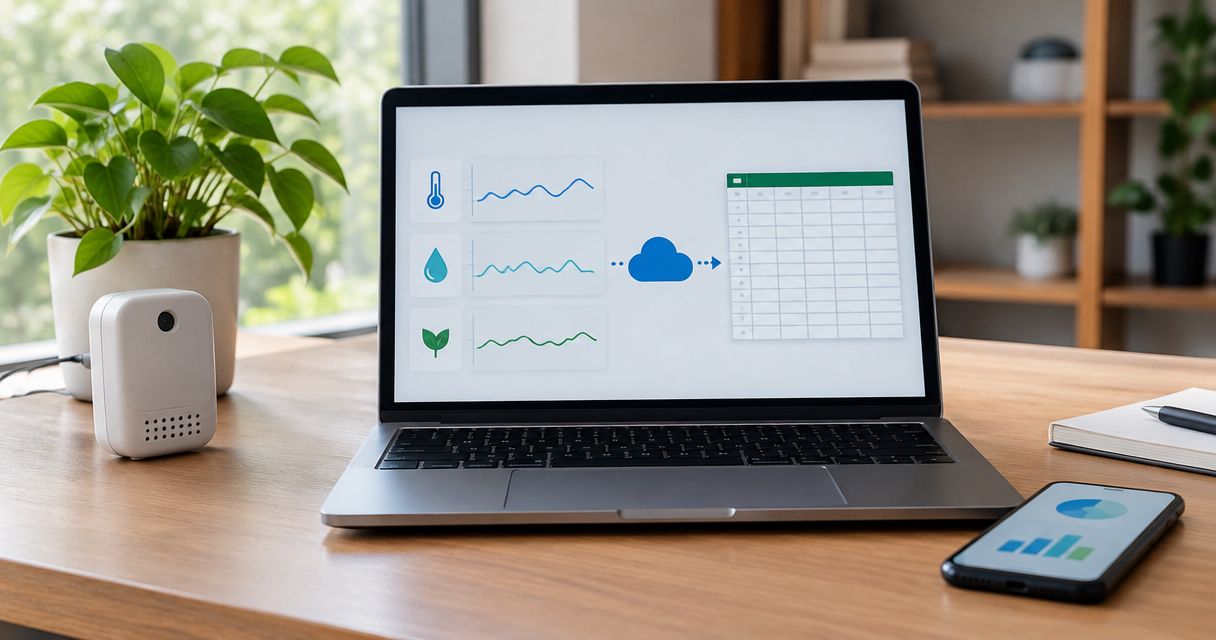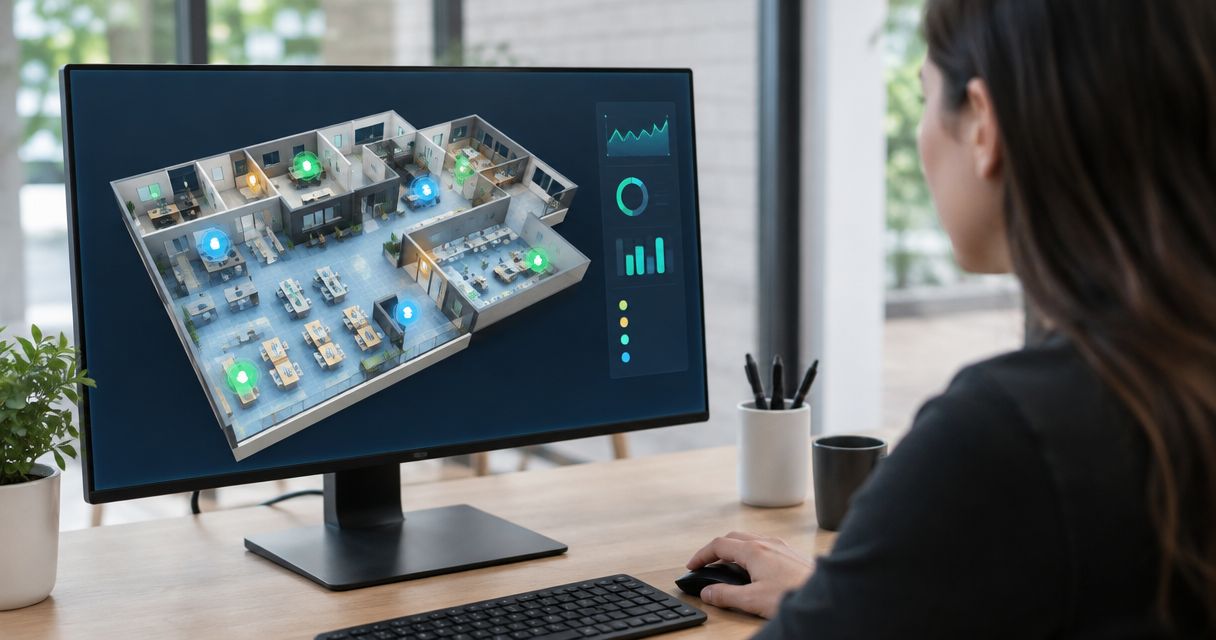
AI generates facility inspection checklists by turning live sensor telemetry and rule breaches into a prioritized, self-updating list instead of a static PDF someone has to guess is still accurate. In 2026, a site already running IoT sensors on doors, tanks, HVAC units or cold storage can turn stale devices and threshold breaches directly into today's checklist instead of a technician writing one from memory every Monday.
- AI generated facility inspection checklists pull from live telemetry and rule breaches, not from memory or a spreadsheet.
- The Kilo IoT Platform's built-in AI assistant can turn offline devices and alarm-tier breaches into a checklist item scoped to the signed-in user's permissions.
- A static PDF checklist never reflects what changed since it was printed; an AI-generated one rebuilds every time a sensor reports.
- Severity tiers and escalation chains decide which checklist item needs a person today versus one that can wait until the weekly round.
- Kilo Electronics supplies the LoRaWAN and mioty sensors the checklist logic depends on, with worldwide shipping.
Why do manual facility inspection checklists fall behind?
A paper or spreadsheet checklist is accurate on the day it's printed and stale the moment a door gets left open or a compressor starts cycling wrong. Facility teams still schedule walk-throughs by calendar because that's what a fixed checklist allows, even when the actual risk on a given day has nothing to do with the calendar.
Some intervals do come from a named standard rather than habit. NFPA 25 sets weekly and monthly test intervals for fire pumps and sprinkler system components, and ASHRAE 180-2018 lays out quarterly and semi-annual inspection tasks for commercial HVAC equipment. Both assume someone remembers to run the check on schedule and writes down what they saw. Moving a facility team off manual logbooks is usually the first step toward a checklist that reflects live conditions instead of a fixed rotation.
“A checklist that doesn't already reflect what the sensors are reporting is just paperwork.”
Once telemetry is already flowing from door sensors, tank levels, vibration monitors or a BMS feed over MQTT, that same data can drive which line items actually show up on the list — and which ones drop off because nothing changed.
How do you use AI to generate a facility inspection checklist?
Building an AI-generated checklist is a five-step process once devices are reporting into a platform:
- Connect the devices. Live telemetry — temperature, humidity, door state, vibration, flow — needs to land in one place before any checklist logic can run on it.
- Set thresholds with a rules engine. In the Kilo IoT Platform this is a visual rules engine built on CEL expressions, version-controlled with one-click deploy and rollback, so a threshold can be tested against a sample payload before it goes live.
- Let the AI assistant turn breaches into checklist items. Kilo's built-in AI assistant can draft and deploy those rules and set up the matching alarms through a plain-language conversation, scoped to the signed-in user's permissions, and it confirms before taking a consequential action rather than acting silently.
- Route by severity. Alarms carry five severity tiers and multi-step escalation chains across email, SMS and push, so a stuck freezer door and a slightly-warm loading dock don't compete for the same person's attention.
- Check the record, not just the alert. An accepted rule or command doesn't prove the physical condition changed — device feedback or the next telemetry reading is what closes the loop, and Kilo keeps an execution history and audit trail so that check has something to point to.
If the checklist depends on sensors that don't exist on-site yet, LoRaWAN and mioty hardware for exactly this kind of monitoring is available through Kilo Electronics, Kilo's hardware sister company, with worldwide shipping.
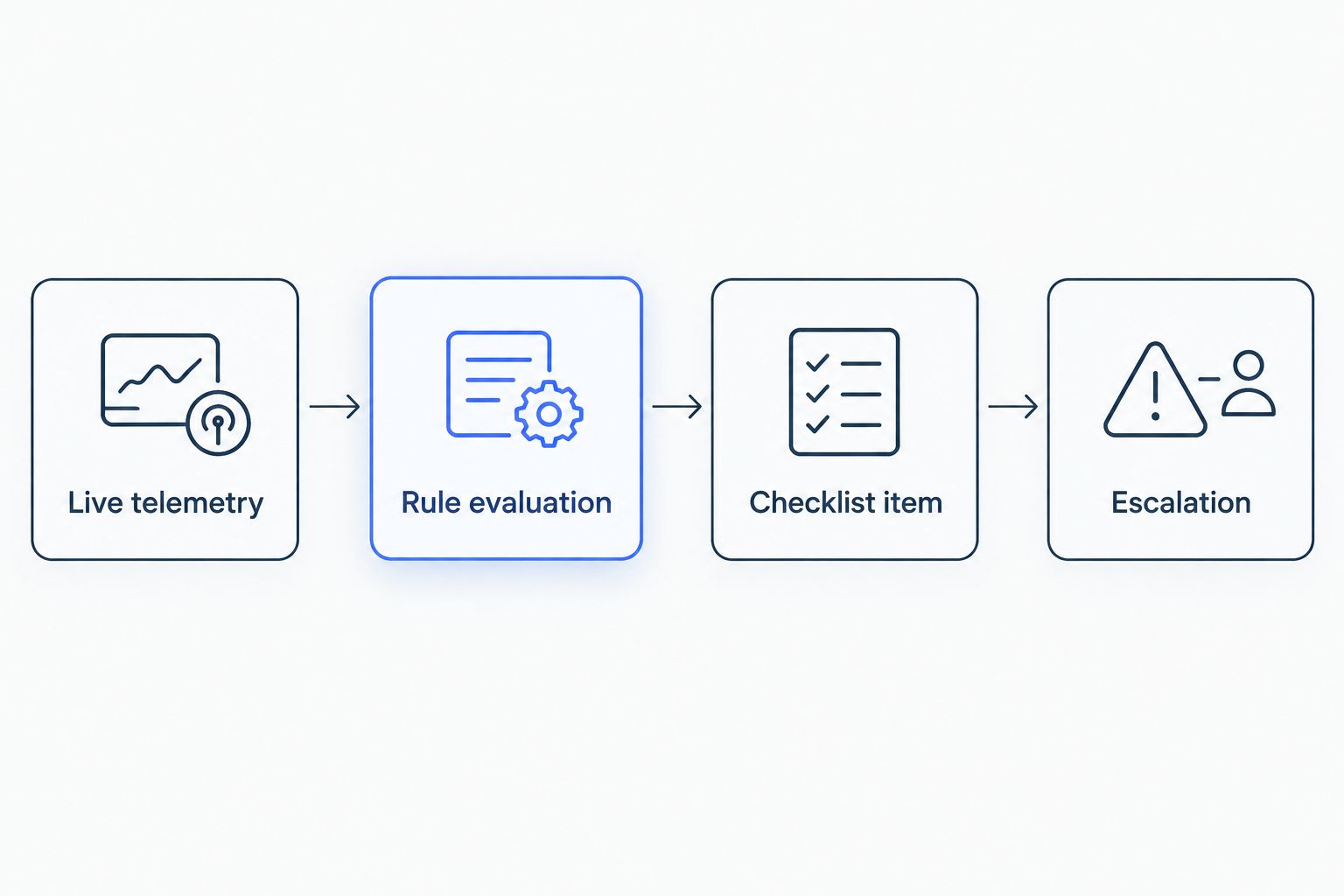
That loop is the practical edge of AIoT: an assistant that already has telemetry and permission boundaries, generating a checklist instead of answering questions with no connection to the building.
Is an AI-generated checklist better than a static PDF checklist?
For a site already running sensors, yes — the checklist reflects what's actually happening instead of what was true when it was printed. For a site with no monitoring at all, there's nothing for the AI to draw from yet.
| Approach | Updates when conditions change | Source of each item | Best for |
|---|---|---|---|
| Static PDF or spreadsheet checklist | No — fixed until someone reprints it | Memory, compliance calendar, past incidents | Sites with no live sensors yet |
| AI-generated checklist (e.g. the Kilo IoT Platform's AI assistant) | Yes — rebuilt as telemetry and rule breaches change | Live sensor readings plus rules-engine thresholds | Sites already running IoT monitoring |
An AI-generated checklist is only as good as the rules behind it — a threshold set too loose produces a clean checklist and a real problem sitting underneath it.
Why do AI-generated inspection checklists vary by facility type?
- Which standard governs the site — NFPA 25 for fire pumps and sprinklers, ASHRAE 180-2018 for commercial HVAC, or an internal cold-chain policy for pharma and food storage
- Sensor density and protocol mix — a site running LoRaWAN and mioty side by side reports on a different cadence than one pulling readings from a BMS over MQTT
- How many rule breaches or offline devices exist at the exact moment the checklist is generated
- Who is allowed to see or close an item — permission and organization boundaries decide what shows up on whose list
- Escalation policy — how fast an unresolved alarm needs to reach a person before it needs to reach their manager
- Whether the checklist has to produce an audit trail for a regulator, insurer or corporate compliance team
Can AI create OSHA-compliant inspection checklists?
AI can structure a checklist around the intervals and trigger conditions a standard specifies, but no software certifies compliance on its own. The facility team still owns the interpretation of the standard; the platform's job is making sure the relevant sensor data and rule breaches actually surface when they happen, in 2026 or any other year.
How often should an AI-generated checklist update?
An AI-generated checklist updates as often as the underlying telemetry arrives and the rules re-evaluate, which for most wireless sensors is every few minutes to an hour, not on a fixed weekly or monthly cycle. That's the main difference from a printed checklist: the update frequency is set by the sensor's reporting interval, not by someone's calendar reminder.
Does AI replace the person doing the physical walk-through?
No — AI narrows down which of hundreds of devices actually needs eyes on it today, but a person still confirms physical condition and closes the item out. An accepted command or a rule that hasn't fired doesn't prove the equipment is fine; someone still has to look, or wait for the next telemetry reading to confirm it.
What's the biggest risk with AI-generated inspection checklists?
The biggest risk is treating an accepted command or a quiet alarm inbox as proof nothing's wrong. Prioritizing maintenance alerts with AI severity scoring only works if someone still checks the follow-up telemetry, because command delivery and actual device state aren't the same thing. The second risk is scope: an AI assistant that can connect to IoT devices through MCP should still be bound to the signed-in user's permissions and confirm before it acts — not silently close items on its own.
FAQ
What is an AI-generated facility inspection checklist?
It's a checklist built from live sensor telemetry and rule breaches instead of a fixed printed list. Items appear when a threshold is crossed or a device goes offline, and drop off once conditions return to normal.
How does the Kilo IoT Platform generate a checklist from IoT data?
Kilo's rules engine evaluates live telemetry against CEL-based thresholds, and the built-in AI assistant can draft and deploy those rules plus the matching alarms through plain-language conversation. Each breach becomes a checklist-style item routed by severity tier.
Do I need LoRaWAN sensors to use an AI-generated checklist?
You need some source of live telemetry, whether that's LoRaWAN, mioty or MQTT from an existing BMS or PLC. LoRaWAN and mioty sensors for this kind of monitoring are available through Kilo Electronics with worldwide shipping.
Can an AI-generated checklist replace a compliance audit?
No, it supports one. An audit trail of rule changes, alarms and execution history gives a regulator or insurer a record to review, but the audit itself still requires a qualified reviewer.
What happens when a device goes offline mid-inspection cycle?
An offline device is itself a checklist item — no data isn't the same as a normal reading. A rule can flag a device that stops reporting past its expected interval and route that as its own alarm.
Is an AI-generated checklist the same as predictive maintenance?
No. A checklist built this way reacts to a threshold or a stale device right now; it doesn't forecast a future failure. Kilo's rules and alarms fire on current conditions, not a machine-learning prediction.
What does it cost to start generating AI checklists with Kilo?
Kilo's free plan covers up to 5 devices, 1 dashboard and 1 rule, never expires, and requires no card. Starter is 25 EUR per month for up to 25 devices, with gateways unlimited on every tier.
The honest limit worth stating plainly: an AI-generated checklist is only as complete as the rules and sensors feeding it. A tank with no level sensor, or a door with no contact switch, won't generate a checklist item no matter how good the AI assistant is — it can only act on telemetry that actually exists in 2026, not on equipment nobody instrumented yet.