
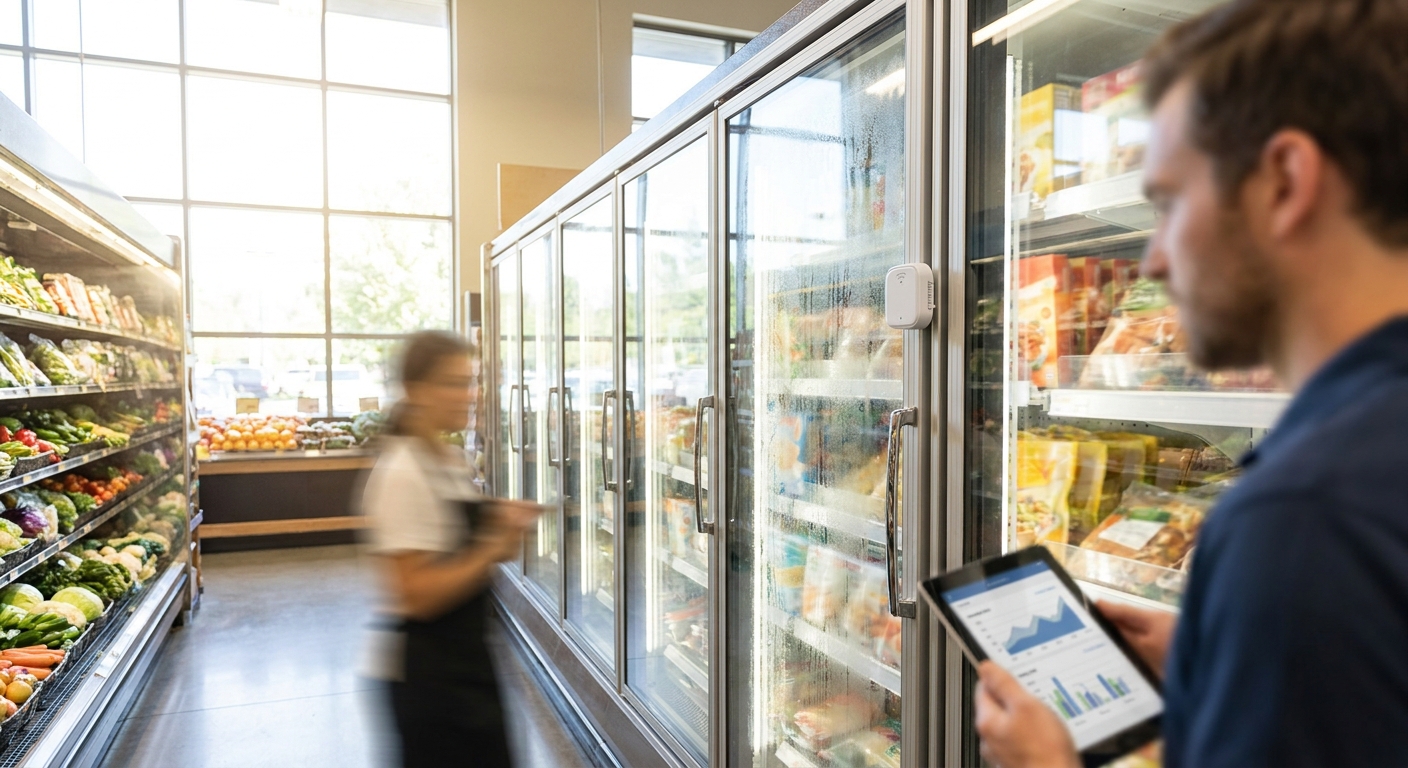
Grocery and convenience stores lose product every time a freezer door sits open during a rush delivery or a distracted restock, and IoT freezer door monitoring for grocery stores exists to catch that gap before it turns into a write-off.
- IoT freezer door monitoring for grocery stores catches doors left open before product crosses 41°F (5°C). Buy: door + temperature combo sensors.
- Cold chain compliance sensors log every open/close event for FDA-style audits — skip standalone door sensors with no logging.
- Multi-site retail chains need one rollup dashboard, not ten separate logins, to catch one bad freezer across a chain.
- A rules engine that ignores restocking under 30 seconds cuts the false alarms that get systems muted within weeks.
Why this matters
The FDA Food Code sets 41°F (5°C) as the top of the safe zone for refrigerated product and 0°F (-18°C) for frozen goods. Cumulative time above those lines counts against you: four hours in the 41°F-to-135°F danger zone and the product gets tossed, no matter how good it looked an hour before. A door propped open during a busy Saturday delivery can burn through that clock fast.
Most grocery and convenience operations in 2026 still catch a bad freezer door the way they did in 2016: a manager walks the aisle, eyeballs a thermometer, and hopes nobody left the walk-in ajar overnight. That works until it doesn't.
IoT freezer door monitoring for grocery stores swaps that walk-around for a door contact sensor paired with a temperature probe, both reporting to a rules engine that tells a 20-second restock apart from a door left open for 20 minutes — the same logic behind Kilo IoT's walk-in cooler and freezer monitoring setups, built for commercial kitchens and convenience store back rooms alike.
Who this is for
This guide is for the ops manager or facilities lead running walk-in freezers and reach-in cases across a grocery banner or a convenience store chain — someone tired of finding out about a bad compressor or a stuck door from spoiled product instead of an alert. Independent single-store owners can run the same setup; the payoff climbs fast once you're managing more than three or four sites off separate keypads and spreadsheets.
What to look for in IoT freezer door monitoring for grocery stores
IoT freezer door monitoring for grocery stores lives or dies on six criteria, and Kilo IoT's platform is built around each one.
Door-open alert speed
The alarm only matters if it reaches someone before the case clears its safe range. Combo door-and-temperature sensors report state changes in roughly 30 to 60 seconds, fast enough to catch a door left open mid-shift instead of finding out on the next walk-through.
Temperature-door correlation
A door sensor alone tells you a door opened; it doesn't tell you whether that mattered. The setups worth buying correlate door state with the temperature curve that follows, so a 15-second restock doesn't trigger the same alarm as a door that stayed open long enough to push a case past 41°F (5°C).
Compliance-ready logging
Health inspectors want a paper trail, not a promise. Look for logging that timestamps every open/close event and every temperature reading, exportable when an inspector asks for the last 90 days of records.
Multi-site dashboard rollup
One store, one freezer, one manager checking a phone — that's easy. Ten stores across a convenience chain is a different problem, and the platform needs one dashboard rolling up every door and every case across every location, not ten separate logins.
False-alarm handling
The fastest way to kill an alarm system is to let it cry wolf. If every restock delivery pages the district manager, staff mute the system within a month and the whole investment sits dead.
Cold-rated hardware
Sensors built for retail signage or home smart-plugs aren't rated to sit at -18°C for years. Freezer door monitoring needs hardware built for sub-zero duty cycles, not repurposed consumer electronics.
Top picks for grocery and convenience store freezer doors
The workhorse pick: door contact + temperature combo
This is the setup that covers most grocery freezer doors without extra engineering — one door contact sensor and one temperature probe per case or walk-in, matched to exactly this door-and-case combination. The number that matters: a 30-to-60 second reporting interval on the door state, paired with a temperature reading tied to the same event. Verdict: Buy in 2026 — this is the baseline, not an upgrade.
The compliance pick: cold chain logging kit
Built for the store that gets audited, not just the store that wants an alert. Cold chain compliance sensors log every door event and every temperature reading with a timestamp, so a 90-day export answers a health inspector's question in one file instead of a scramble through a paper log. In 2026, more health departments ask for a digital export during inspections rather than a handwritten sheet. Verdict: Buy if your store or chain has failed a temperature-logging check in the last two years.
The chain-wide pick: multi-site rollup dashboard
For a convenience chain running a dozen or more locations, the win isn't the sensor — it's the one screen showing every freezer door across every store, ranked by which one is closest to a violation right now. A district manager watching one dashboard catches the store with a bad gasket before the regional visit does. Verdict: Consider if you're running fewer than five sites — the per-site value climbs fast past that.
The alarm-tuning add-on: false-alarm suppression rules
This is the fix for the system everyone already muted. A rules engine tuned for cutting false alarms ignores door opens under roughly 30 seconds — a normal restock — and escalates only when the door state and the temperature curve both cross the line. Verdict: Buy as an add-on to any door sensor deployment already triggering more than a couple of alerts a week.
See freezer door alerts live
Watch door and temperature events roll up across every store from one Kilo IoT dashboard.
What to avoid
- Standalone door sensors with no temperature correlation — they tell you a door opened, not whether product is at risk, so every restock looks identical to a real incident.
- Consumer smart-home sensors — Wi-Fi door and leak sensors built for a home garage aren't rated for sub-zero duty and drop off the network the first time a nearby compressor kicks on.
- Alert systems with no escalation logic — a single text to one manager's phone means a missed alert during a shift change goes nowhere; the setup needs a chain of who gets notified next.
Verdict comparison
| Pick | Door-alert speed | Compliance logging | Multi-site rollup | False-alarm handling | Verdict |
|---|---|---|---|---|---|
| Door + temp combo | 30-60 sec | Basic | No | Manual thresholds | Buy |
| Cold chain compliance kit | 30-60 sec | Full audit export | No | Manual thresholds | Buy |
| Multi-site rollup dashboard | 30-60 sec | Full audit export | Yes | Manual thresholds | Consider |
| False-alarm suppression add-on | 30-60 sec | Depends on base setup | Depends on base setup | Automated | Buy (add-on) |
FAQ
What's the best way to monitor freezer doors in a grocery store?
The best setup pairs a door contact sensor with a temperature probe on the same alarm rules engine, the approach Kilo IoT uses for grocery and convenience store freezer monitoring. A door sensor alone can't tell you whether an open door actually put product at risk — the temperature reading does that.
Is IoT door monitoring better than a manual temperature log?
Yes, because a manual log only catches a problem on the next walk-through, while a door-and-temperature sensor combo flags it in roughly 30 to 60 seconds. A paper log also can't alert anyone after close, when most bad freezer nights happen.
How much does freezer door monitoring cost for a convenience store?
Cost scales with the number of doors and sites, and in 2026 most vendors quote per sensor and per site rather than a flat fee. Ask for a quote based on your actual door count instead of comparing list prices across platforms.
What temperature triggers a freezer door alarm?
Most setups alarm once a freezer case rises past 0°F (-18°C) for frozen goods or a cooler passes 41°F (5°C) for refrigerated product, matching FDA Food Code thresholds. The alarm should fire on the temperature trend, not just the door state, so a quick restock doesn't trip it.
Can one dashboard monitor freezer doors across multiple store locations?
Yes — a multi-site rollup dashboard shows every door and every case across every location on one screen, ranked by which store is closest to a violation. That setup is worth adding once you're running more than four or five locations off separate logins.
How do you stop false alarms from restocking freezer doors?
Set the rules engine to ignore door-open events under roughly 30 seconds, since that's a normal restock, and escalate only when the door state and temperature curve both cross the line. Systems without that logic get muted by staff within weeks.
Is freezer door monitoring required for FDA food safety compliance?
The FDA Food Code doesn't mandate a specific sensor, but it does require documented temperature control, and as of 2026 more health departments ask for digital logs during inspections instead of accepting handwritten sheets. A compliance-ready sensor setup produces that export in minutes.
How long do freezer door sensors last in cold environments?
Sensors built for cold-chain use are rated for sub-zero duty cycles and last years on battery power, unlike consumer smart-home sensors designed for room-temperature installs. Confirm the operating temperature rating before installing any sensor inside a walk-in freezer.
One last thing
The failure mode that actually costs grocery and convenience chains money in 2026 isn't a broken sensor — it's a working alarm that got muted after the third false page from a normal delivery. Kilo IoT's rules engine treats a 20-second restock differently than a 20-minute door left open, and that distinction is what keeps staff from muting the alarm in the first month. Fix the false-alarm rate before adding more sensors; a system nobody trusts is worse than no system at all.