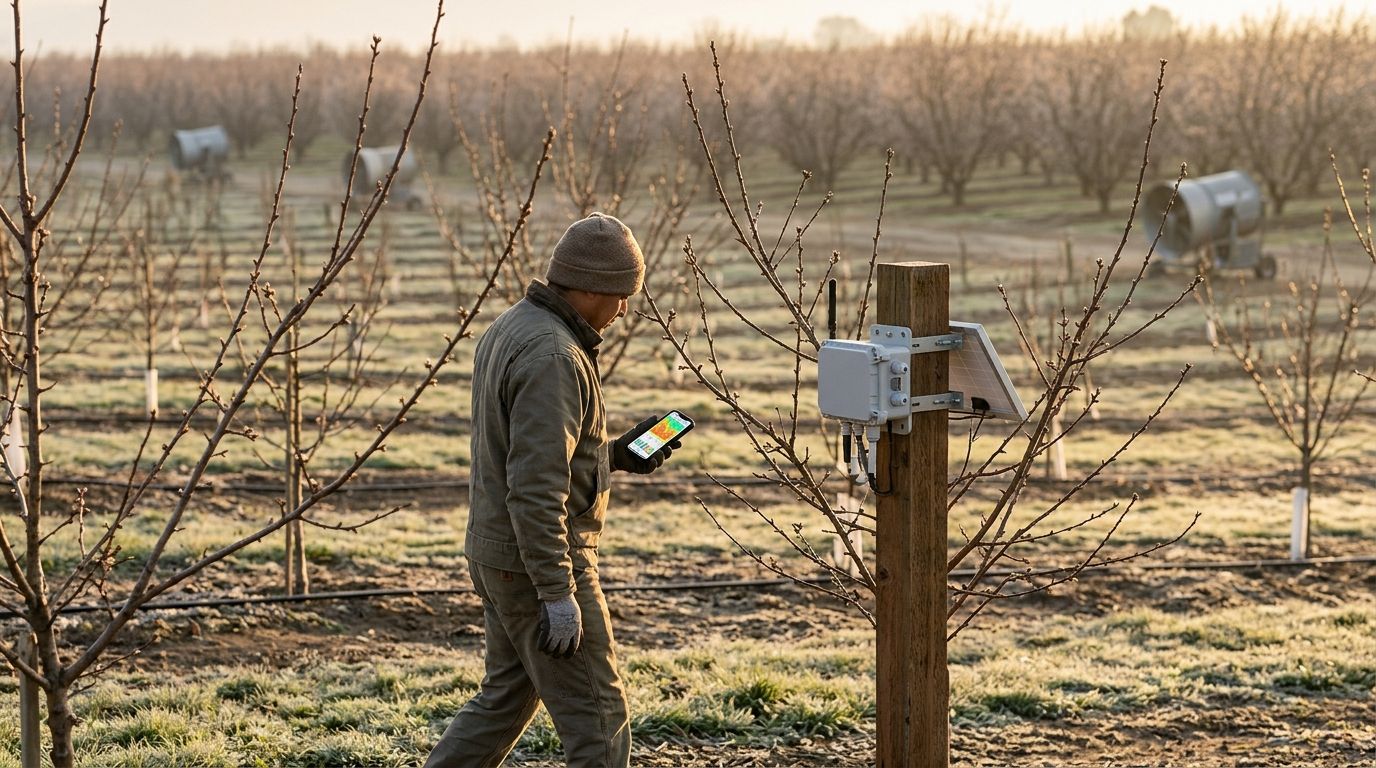
Orchard and tree farm frost protection monitoring is IoT temperature, wind, and canopy sensing that fires an alarm before a block crosses its critical bud-stage temperature, not after frost has already formed on the wood. Bloom and early fruit set are the two stages where a few degrees separate a normal 2026 harvest from a wiped-out one, and the risk window changes week to week as buds advance. A single thermometer at the farmhouse can't tell you what's happening in the low corner of block 4 at 4 a.m.
- IoT frost protection monitoring for orchards pairs canopy-height temperature sensors with threshold alarms tied to each block's bud stage, not a single farm-wide number.
- The Kilo IoT Platform runs LoRaWAN or mioty sensors through a rules engine that escalates a frost alarm by SMS, email, or push before a manual dawn check would catch the drop.
- Cold air drains into low blocks and frost pockets on calm, clear nights, so a sensor at the equipment shed reads several degrees warmer than the coldest row.
- Wind machines and irrigation frost protection work against radiation frost but not advective freezes, which arrive with wind and a genuinely cold air mass.
Why does a single frost night threaten an entire orchard's harvest?
A fruit tree's tolerance for cold changes constantly through the season. Dormant buds survive far colder air than the same buds at full bloom, which is why land-grant extension services publish critical-temperature tables by crop, variety, and bud stage rather than one blanket number. Apple bloom commonly loses 10% of buds around 28°F and heavier losses well below that, depending on variety and duration of exposure.
The National Weather Service classifies a "light freeze" around 29-32°F, and a "hard freeze" at 24°F or below, categories built for general forecasting rather than orchard bud stages. That gap between a forecast category and a block's actual critical temperature is exactly what IoT frost protection monitoring for orchards is built to close: a sensor at canopy height in the coldest block tells you the real number, not a regional estimate.
The cost of getting this wrong isn't a maintenance ticket. It's the crop. That's the difference between orchard frost monitoring and monitoring almost anything else on the Kilo IoT Platform: a missed threshold here doesn't get fixed next week, it's gone until next season.
How to set up frost protection monitoring for your orchard
The steps below start with what any grower can do with a thermometer and a phone, then move into where an automated platform starts saving hours during the exact nights you can least afford to lose sleep.
Map critical temperatures by crop, variety, and bud stage
Before any sensor goes in the ground, you need a threshold worth alarming on. That threshold moves through the season, so the first job is tracking bud stage, not installing hardware.
- Walk each block weekly during bloom and record bud stage by eye
- Pull critical-temperature tables from a land-grant extension service for each crop and variety you grow
- Note that critical temperatures rise as buds advance from dormant to full bloom to fruit set
- Keep a written threshold per block, not one number for the whole farm
- Re-check thresholds after any freeze event, since already-stressed buds get more sensitive
Place temperature sensors where frost actually forms
Cold air is heavier than warm air. On calm, clear nights it drains downhill and pools in low spots and closed-in rows, sometimes leaving a block several degrees colder than a sensor 200 yards away at higher ground.
- Identify frost pockets: low points and enclosed rows where cold air settles overnight
- Mount sensors at canopy height, not on a pole above the trees or at knee height
- Cover every distinct block, not just the one nearest the equipment shed
- Add a station at the highest point of the property as a control reading
- Add wind and humidity sensing to the same network if a block also needs that data alongside temperature
Set threshold alarms before the season's most sensitive stage arrives
A manual check works fine until the night you're asleep, out of cell range, or checking the wrong block. This is the point where an automated rule beats a phone alarm set for "probably around 3 a.m."
- Build a rule per block tied to that block's current critical temperature
- Escalate by SMS, email, or push fast enough to start protection equipment before damage begins; see setting up SMS and email alerts for critical IoT sensor thresholds
- Set a second, earlier warning threshold that gives time to start wind machines or irrigation
- Route the alarm to more than one person so a missed call doesn't cost the block
- Kilo's built-in assistant can draft that rule from a plain-language description of the threshold, scoped to your permissions and confirming before it deploys
Layer in wind and humidity data to tell radiation frost from advective freeze
These two frost types call for opposite responses, and mixing them up wastes fuel or water on a night when it won't help.
- Track wind speed at canopy height, not from a weather station miles away
- Radiation frost forms on calm, clear nights when the ground radiates heat and cold air settles at the surface
- Advective freezes bring in a genuinely cold air mass with wind and often cloud cover; wind machines and irrigation mainly redistribute air that's already too cold to help
- Add dew point and humidity readings, since dry air cools faster and drops temperatures further overnight
Automate escalation so the right person is woken up, not everyone
A farm with several blocks and a small crew needs alarms that scale with severity, not one channel that pages everyone for a two-degree warning.
- Set severity tiers so an early warning doesn't page the same person as a bud-kill-level alarm
- Build a multi-step escalation chain that tries the block manager first, then the owner
- Log every escalation attempt with a timestamp for later review
- Keep a centralized alarm inbox showing every open frost event across the property at once
Confirm wind machines, irrigation, or heaters actually ran
An accepted command is not proof that a wind machine started or a valve opened. Frost protection equipment fails quietly, usually at 3 a.m., which is the worst possible time to find out.
- Check for a temperature recovery in the sensor closest to the equipment after it should have started
- Keep a manual backup check for the first few nights of any new automated setup
- Record run time for fuel or water tied to frost protection equipment for the season's records
- Treat command delivery and physical confirmation as two separate facts, not one
Log every frost event for insurance claims and next season's plan
Once the night is over, the sensor data becomes a record, not just an alert.
- Export temperature history for the exact hours of the freeze, by block
- Keep records at the block level, since crop insurance and loss assessments are usually done that way
- Compare actual damage against the critical-temperature table you used to see if a threshold needs adjusting for 2026
- Check sensor uptime after the coldest nights, since battery chemistry loses capacity in extreme cold and the coldest night is exactly when you need every sensor reporting
Which frost monitoring option is right for your orchard?
| Option | Best for | Key limitation |
|---|---|---|
| Analog min/max thermometers checked by hand | Very small plantings on tight budgets | No alert before the check; damage is discovered after sunrise |
| Wireless home-weather-station clusters | A rough overnight read from the house | Consumer-grade accuracy near freezing, and poor coverage across multiple blocks |
| Public ag weather networks (state mesonet, NOAA COOP stations) | Regional forecasting and historical baselines | A station can sit miles from the specific block or frost pocket that matters |
| Cellular telemetry frost alarm boxes | A handful of monitoring points with strong cellular coverage | Per-device data plans scale awkwardly across dozens of blocks |
| LoRaWAN or mioty sensor network on an IoT platform | Multi-block orchards needing canopy readings, escalation, and rules | Requires a gateway and sensor placement work before the first frost night |
A grower running more than two or three blocks generally outgrows a phone-alarm setup by the second frost season, mainly because thresholds differ by block and nobody wants to check five apps at 3 a.m.
What frost monitoring mistakes do orchard managers make most often?
- Relying on one thermometer near the equipment shed instead of the coldest block on the property
- Setting a single seasonal threshold instead of tracking bud-stage-specific critical temperatures week to week
- Skipping wind data, so wind machines get run against advective freezes they can't fix
- No confirmation step after firing frost protection equipment, so a stalled pump goes unnoticed until sunrise
- Ignoring sensor battery performance during the coldest snaps, when full sensor coverage matters most
FAQ
What temperature triggers frost damage in fruit trees?
It depends on crop, variety, and bud stage; extension frost charts commonly cite around 28°F as a threshold for meaningful apple bloom damage, with heavier loss further below that. A dormant bud tolerates far colder air than the same bud at full bloom.
Is IoT frost monitoring better than a thermometer and a phone alarm?
For one or two blocks, a thermometer and a set alarm can work if someone checks it every night. Past that, IoT frost protection monitoring for orchards scales better because each block gets its own threshold and alarm without a person checking five separate spots.
How many sensors does an orchard need for frost monitoring?
At minimum, one sensor per distinct block or frost pocket, plus one at the highest point of the property as a control reading. Blocks with known cold-air drainage or enclosed rows need canopy-height sensors specifically in the low spots.
Can IoT sensors trigger wind machines or irrigation automatically?
A rules engine can send a command to compatible equipment, but an accepted command isn't proof the machine physically started. Check for a temperature recovery or other telemetry after the command to confirm it ran.
Does frost monitoring work without cell service on a farm?
LoRaWAN and mioty sensor networks run over their own gateway rather than cellular data, so they work at rural sites with weak or no cell coverage as long as a gateway has backhaul to the internet.
How much warning do frost alerts give before bud damage starts?
Warning time depends on how far above the critical temperature the alarm threshold is set. Setting a second, earlier warning threshold above the actual kill point gives time to start wind machines or irrigation before damage begins.
What's the difference between radiation frost and advective freeze?
Radiation frost forms on calm, clear nights when the ground radiates heat and cold air settles near the surface; wind machines and irrigation help here. Advective freezes bring in a genuinely cold air mass with wind, and mixing an already-cold air mass around doesn't raise its temperature.
Do LoRaWAN sensors work in near-freezing temperatures?
LoRaWAN and mioty sensors are commonly deployed outdoors year-round, but battery chemistry loses capacity in extreme cold, so uptime should be checked after the season's hardest freezes rather than assumed.
See frost monitoring on the Kilo platform
Set up canopy sensors, thresholds, and escalation for your orchard blocks.
What's the most overlooked variable in orchard frost alarms?
Growers set a threshold once at the start of bloom and forget that the critical temperature keeps rising as buds advance. The same variety that tolerates 25°F at first pink can lose a meaningful share of its crop at 28°F by full bloom, according to the extension frost tables most orchard operations already reference. An alarm built in March on a February threshold is monitoring the wrong number by April.
Hardware for this kind of deployment, including outdoor-rated temperature and canopy sensors, ships worldwide through Kilo Electronics, the hardware side of the Kilo IoT Platform.