
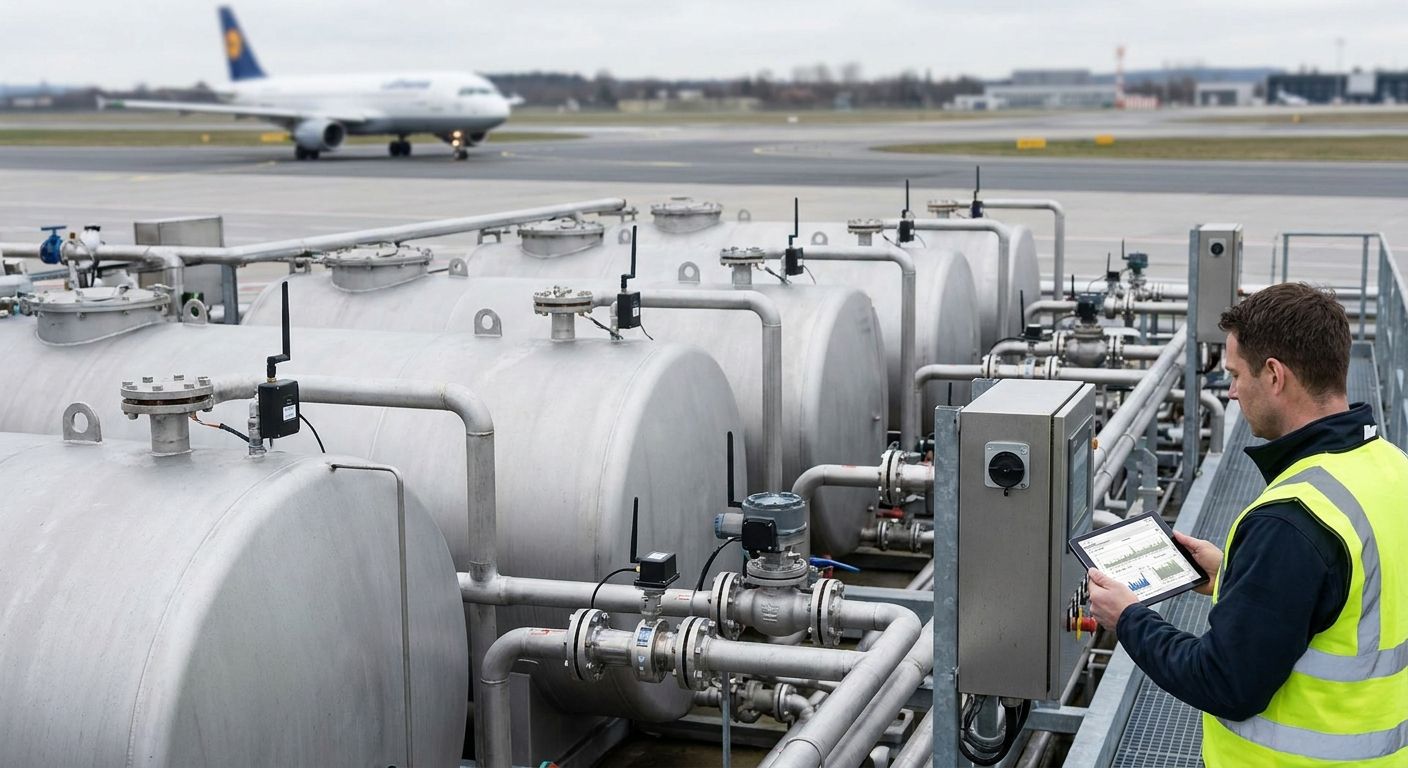
IoT fuel monitoring for airport fuel farms puts tank level, temperature and water-in-fuel readings on one live dashboard, with the aim of catching overfills, contamination and hydrant pit leaks before they ground a flight or show up as a finding on an FAA inspection. A typical fuel farm runs several Jet A-1 or avgas tanks, a hydrant pit network and a fleet of refuelers feeding aircraft around the clock, so one missed alarm at 3 a.m. can shut down a ramp instead of just one building.
- IoT fuel monitoring for airport fuel farms puts tank level, temperature and water probe data on one dashboard instead of paper logs.
- API 2350 requires an overfill alarm independent of the primary gauge; wireless level sensors plus a rules engine deliver that without new wiring.
- Kilo's Free tier covers up to 5 devices at 0 EUR; Starter runs 25 EUR per month for up to 25 devices, roughly one small fuel farm.
- Water bottom checks under ATA Spec 103 and JIG standards still need a human dip test; sensors add the continuous readings between checks.
- Mioty handles dense steel tank farms better than plain LoRaWAN because its telegram splitting survives the interference metal structures cause.
Why airport fuel farms need iot fuel monitoring
A fuel farm is not a warehouse with a thermostat. It stores a flammable liquid classified under NFPA 30 and handled under NFPA 407, the Standard for Aircraft Fuel Servicing, and every gallon that moves through a hydrant pit or into a refueler has to trace back to a quality release record under ATA Spec 103 and JIG fuel-handling standards.
FAA Advisory Circular 150/5230-4B covers aircraft fuel storage, handling and dispensing on certificated airports, and 14 CFR Part 139 ties fuel safety into the airport's operating certificate. None of that goes away with better sensors. What changes is how fast a fuel farm supervisor finds out a tank is climbing toward its high-high level, or that a hydrant pit line has started losing pressure overnight, instead of finding out on the morning walk-down.
The stakes are asymmetric. A missed overfill means an environmental spill report and possibly a fine. A missed water-in-fuel reading means contaminated Jet A-1 reaching an aircraft. A dashboard that shows tank level, temperature and pressure next to each other, with an alarm history attached, is what most of these audits are actually asking for by 2026 standards.
How to set up iot fuel monitoring for an airport fuel farm
Map every tank, hydrant pit and refueler before you instrument anything
Start with an inventory, not a sensor order. Skipping this step is the single biggest reason fuel farm IoT projects stall at the second tank.
- List every storage tank with capacity, product (Jet A-1, avgas, diesel for ground service equipment) and age
- Note hydrant pit locations and the lateral lines feeding them
- Record every refueler truck and its typical fill point on the ramp
- Catalog existing gauges: float, mechanical, or manual stick
- Flag which tanks already have power and network access nearby
Install tank level and temperature sensors on each storage tank
The manual baseline is hydrostatic tank gauging or stick gauging against API MPMS-compliant strap tables, and that stays the backup method even after automation goes in.
For continuous readings, radar or ultrasonic level sensors rated for Class I, Division 1 hazardous locations under NFPA 70 Article 500 report into a device management platform over LoRaWAN or mioty. Mioty's telegram splitting holds up better than plain LoRaWAN inside dense steel tank farms, where berms and tank walls attenuate signal. Each sensor gets its own digital twin inside Kilo Cloud, the Kilo IoT Platform's device layer, so a fuel farm manager sees tank identity, product type and last reading in one place. Sensors and gateways ship worldwide through Kilo Electronics, Kilo's hardware partner; the platform itself doesn't manufacture the devices.
- Choose sensors rated for the hazardous location classification of the tank farm
- Pair level sensors with a temperature probe on tanks storing avgas, which is more temperature-sensitive than Jet A-1
- Confirm strap table data matches the physical tank before the first reading goes live
- Use mioty over plain LoRaWAN where tanks sit inside metal-clad structures
Set overfill and low-level alarms with escalation for after-hours coverage
API 2350, Overfill Prevention for Storage Tanks in Petroleum Facilities, calls for a high-level alarm that is independent of the primary gauge, not a second reading off the same instrument. This is where a rules engine earns its place.
Kilo's alarm system runs five severity tiers with multi-step escalation chains across email, SMS and push, plus quiet hours and a centralized inbox for shift handoff. A high-high overfill alarm should never sit inside quiet hours; that setting is for the low-priority notices, not the ones tied to API 2350 compliance.
- Set separate high-level and high-high-level thresholds per tank
- Build an escalation chain: shift supervisor, then fuel farm manager, then airport operations center
- Exclude high-high severity alarms from quiet hours entirely
- Route every acknowledgement into the centralized inbox for the shift log
Monitor water bottoms and fuel quality checkpoints
Water contamination in Jet A-1 is a flame-out risk, not a paperwork issue, which is why ATA Spec 103 and JIG standards both require scheduled water bottom checks with test paste at every tank and hydrant pit sump.
Sensors don't replace that dip test in 2026, but an MQTT connector can pull readings from an existing water-in-fuel probe or a filter-separator's differential pressure gauge into the same dashboard as tank level, so a rising water reading fires an alarm instead of waiting for the next scheduled check.
- Keep the manual water bottom dip test on the same schedule ATA 103 specifies
- Pull filter-separator differential pressure into the platform via MQTT
- Log fuel receipt and quality release certificates alongside tank readings
- Set a threshold rule on any connected water probe so a bad reading raises an alarm the moment it happens
Track hydrant pit pressure and fuel line conditions
A sustained pressure drop across a hydrant lateral is the kind of thing a walk-down catches hours late. A pressure sensor reporting continuously, paired with a CEL rule that watches the rate of change rather than a single static threshold, catches it sooner without claiming to be anything more than a threshold alarm.
- Set the rule on pressure drop rate, not a single fixed low-pressure number
- Require a second confirmed reading before escalating a possible-leak alarm, to cut false positives
- Keep manual bonding and grounding continuity checks required under NFPA 407 on their existing schedule
- Log every scheduled walk-down against a checklist inside the same system
Build a live dashboard and digital twin of the fuel farm
Once sensors are reporting, the dashboard is what a fuel farm supervisor actually looks at each shift. Kilo supports map, chart, gauge and image floor-plan widgets, plus a live 3D digital building twin with sensors bound to real objects on the site.
- Place a gauge widget per tank showing current level against capacity
- Use the map widget to show hydrant pit locations across the ramp
- Bind each tank's digital twin to its actual capacity and product type
- Use the built-in AI assistant to draft a new alarm or rule in plain language when a tank connector goes live, with the assistant confirming before anything deploys and staying scoped to the signed-in user's permissions
Keep an audit trail for FAA, IATA and ATA 103 inspections
A fuel farm inspection asks for tank history, alarm history and who acknowledged what. Paper logs make that slow. An immutable audit trail, scoped API keys and ABAC access control make it a query instead of a filing-cabinet search.
- Export tank reading history for the FAA Part 139 inspection window in question
- Tie every alarm acknowledgement to the person who confirmed it, not just the system
- Restrict who can edit an alarm rule using scoped, role-based access
- Pull data into an existing compliance dashboard through the REST or gRPC API if the airport already reports elsewhere
Get fuel farm tank data online
Free tier covers up to 5 tanks, 0 EUR, no card required.
IoT fuel monitoring options for airport fuel farms compared
| Option | Best for | Starting price | Key limitation |
|---|---|---|---|
| Manual stick gauging | Single-tank fixed-base operators | Labor time only, not priced | No continuous reading; API 2350 treats it as backup, not primary |
| Wired ATG/SCADA system | Large hub airports with existing wiring | Not published | Expensive to extend to new tanks or hydrant pits |
| Standalone wireless level sensors, no platform | Single-tank retrofits without a dashboard need | Varies by vendor | No centralized alarm escalation or audit trail |
| Kilo Cloud tank level monitoring system | Multi-tank fuel farms needing one dashboard and audit trail | Free: 0 EUR up to 5 devices; Starter: 25 EUR/month up to 25 devices | Sensors and gateways sourced separately through the hardware partner catalog |
Common iot fuel monitoring mistakes at airport fuel farms
- Treating the primary gauge as the overfill alarm. API 2350 requires an independent high-level switch; skipping it leaves one point of failure between a normal reading and a spill.
- No after-hours escalation chain. An overnight shift with no on-call path leaves a high-high alarm sitting unacknowledged until the morning crew arrives.
- Installing plain LoRaWAN sensors inside a steel-clad tank farm without checking coverage first. Dense metal structures attenuate signal; mioty's telegram splitting is built for that interference, and adding gateways blindly is a slower fix.
- Keeping tank-level data and water-bottom or quality-release logs in separate systems. Inspectors under ATA 103 and JIG standards ask for both together, and two paper trails slow every audit down.
- Leaving quiet hours on for high-severity alarms. Quiet hours exist for low-priority notices, not for a possible overfill or a hydrant pressure alarm at 2 a.m.
FAQ
What is iot fuel monitoring for airport fuel farms?
It's continuous tank level, temperature and water-in-fuel monitoring across a fuel farm's storage tanks and hydrant pits, reported to one dashboard instead of manual logs. It supports the alarm and record-keeping requirements in NFPA 407, API 2350 and ATA Spec 103.
How much does airport fuel farm iot monitoring cost in 2026?
Platform cost depends on device count; Kilo's Free tier covers up to 5 devices at 0 EUR with no card required, and Starter runs 25 EUR per month for up to 25 devices. Sensor and gateway hardware is priced separately through Kilo Electronics.
Is iot tank monitoring required by the FAA?
The FAA doesn't mandate a specific sensor technology, but FAA Advisory Circular 150/5230-4B and 14 CFR Part 139 require documented fuel storage safety and inspection records, which continuous monitoring makes far easier to produce than paper logs.
What sensors do airport fuel farms use for tank level monitoring?
Radar and ultrasonic level sensors rated for Class I, Division 1 hazardous locations under NFPA 70 Article 500 are standard, often paired with a temperature probe and, where available, a water-in-fuel probe connected via MQTT.
How is mioty different from LoRaWAN for fuel farm sensors?
Mioty splits each transmission into telegram fragments sent on different frequencies, which holds up better than plain LoRaWAN inside dense steel tank farms where metal structures cause heavy signal attenuation.
Can iot fuel monitoring detect water contamination in Jet A-1?
A connected water-in-fuel probe or filter-separator differential pressure sensor can feed a threshold alarm, but the manual water bottom dip test required under ATA Spec 103 and JIG standards still runs on its own schedule.
How do overfill alarms work under API 2350?
API 2350 requires a high-level alarm that is independent of the tank's primary gauge, with escalation to a responsible person before the tank reaches its high-high level. A rules engine with multi-step escalation chains implements that without new tank wiring.
Does iot fuel monitoring replace manual stick gauging?
No. Automated sensors add continuous readings between checks, but stick gauging against API MPMS strap tables stays the backup verification method most fuel farms keep in 2026.
How accurate does airport fuel tank monitoring need to be
The accuracy question people ask first is about the wireless protocol. The one that actually causes repeat overfill near-misses is calibration drift after a tank gets relined or repainted internally, which changes the strap table the sensor reads against. A radar sensor reporting perfectly against an outdated strap table is wrong by design, no matter how strong the signal is.
Recalibrate level sensors any time a tank is relined, internally repainted, or its reference strap table changes. That single habit, kept as a standing maintenance item into 2026, fixes more overfill risk than upgrading the sensor itself ever does.