
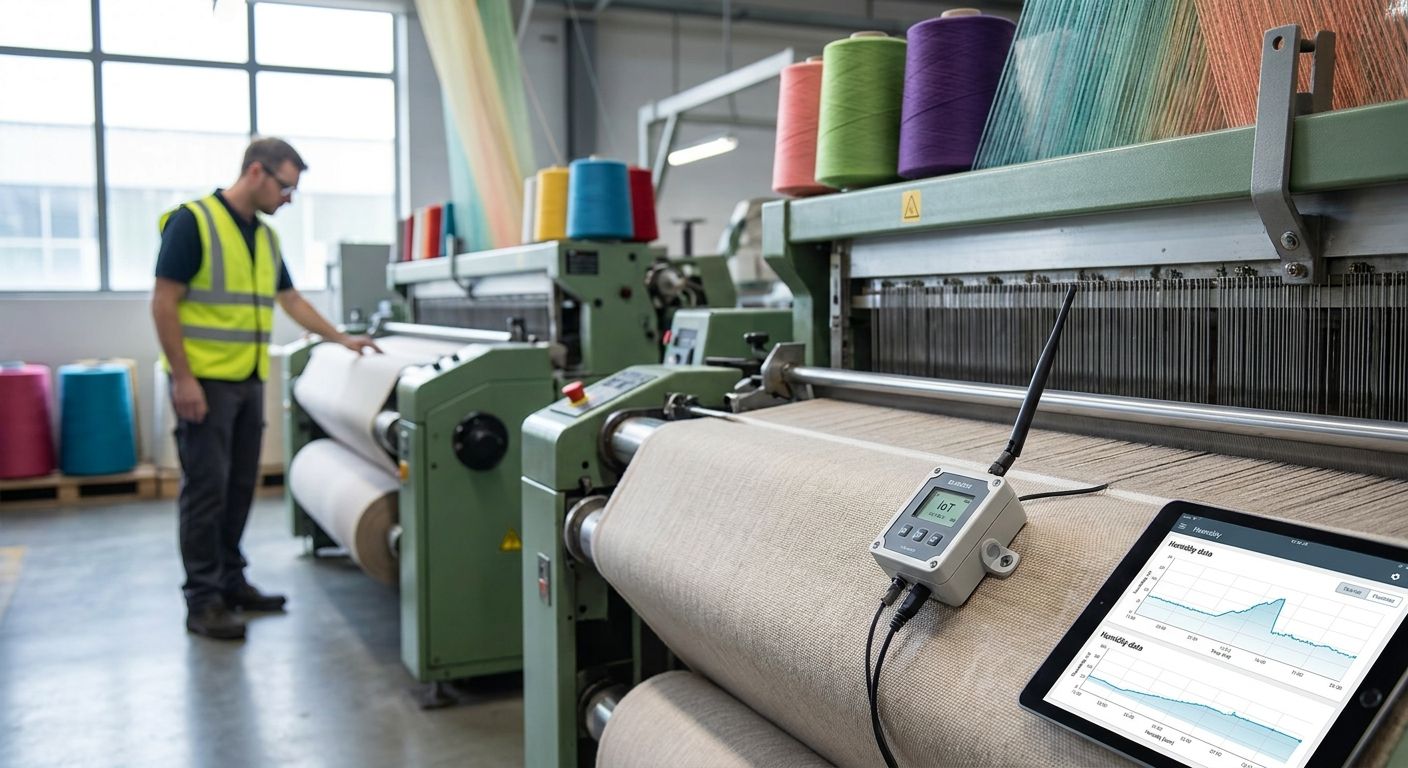
Textile and garment manufacturing humidity monitoring is the continuous tracking of relative humidity and temperature across spinning, weaving, dyeing, cutting and sewing floors with the aim of keeping fiber moisture regain, fabric dimensions and static levels inside the range each process actually needs. A cutting room running at 35% RH and a spinning floor running at 65% RH are not the same monitoring problem. Plants that treat the whole building as one humidity zone are the ones that can't explain a shrinkage complaint six months later.
- ISO 139 sets 65% RH ±4% at 20°C for textile conditioning; garment cutting rooms usually run lower and drier.
- Wireless LoRaWAN and mioty sensors log humidity per zone without rewiring the floor; Kilo's free plan covers up to 5 devices.
- Escalation-based alarms catch a dye house humidity swing before it reaches the cutting floor two buildings away.
- Spot-check hygrometers miss excursions between rounds; only continuous logging builds an audit trail a customer will accept.
How does relative humidity affect textile and garment manufacturing?
Fiber moisture regain is not a cosmetic detail. Cotton, wool and many blends absorb and release moisture with ambient RH, and that changes yarn strength, elongation and the dimensions of a woven or knit fabric before it ever reaches the sewing line. ISO 139:2005 fixes the standard atmosphere for conditioning and testing textiles at 20°C ± 2°C and 65% RH ± 4%, and the US equivalent, ASTM D1776, sets 21°C (70°F) and 65% RH ± 2%. Those numbers exist because mills learned the hard way that fabric tested or cut at the wrong humidity behaves differently on the customer's floor than it did on theirs.
Garment cutting and sewing rooms usually target a lower, drier band than spinning or weaving, both to keep panels dimensionally stable before cutting and to cut static buildup on synthetic-heavy fabrics. Low RH is also a dust and static concern: NFPA 654 addresses combustible particulate control in facilities handling fibrous and particulate materials, and dry air makes static discharge around lint and dust more likely. Plant engineers, dyehouse supervisors and quality managers each care about a different slice of the same humidity curve, which is why zone-by-zone data beats a single building-wide reading every time.
How to set up humidity monitoring in a textile manufacturing plant
Map humidity-sensitive zones across the plant
Start by walking the floor plan before buying anything.
- Spinning and weaving areas, where fiber moisture regain affects yarn strength and shrinkage
- Dye house and wet processing, where steam and drainage cause fast local RH swings
- Finishing and pressing, where heat-set fabrics need a stable, moderate RH
- Cutting and pattern rooms, where fabric needs to relax at a consistent RH before the blade touches it
- Sewing floors, where low RH drives static buildup on synthetic fiber blends
- Fabric and yarn storage, where long-term conditioning protects unopened rolls
Set target humidity and temperature ranges per process
Do this on paper before a single sensor goes up.
- Pull the spec sheet for each fabric or fiber blend running through the plant
- Use ISO 139 or ASTM D1776 as the baseline band for spinning, weaving and any area feeding lab testing
- Set a tighter, drier band for cutting and sewing where dimensional stability and static control matter more than fiber regain
- Write one reference sheet per zone so an operator can check a live reading against a target without asking anyone
Install sensors at each zone, not just at the HVAC return
A sensor mounted at the air handler tells you what the HVAC system thinks it's doing, not what the fabric is actually sitting in.
- Run a handheld hygrometer walk through each zone across different shifts first, to find the swings the HVAC system doesn't register
- Move to permanent temperature and humidity sensors for warehouse monitoring once you know which zones actually need continuous coverage
- Wireless LoRaWAN or mioty sensors skip pulling cable across spinning and weaving floors where machinery and racking already block conduit runs
- Kilo Cloud gives each sensor a digital twin, so a dye house sensor and a warehouse sensor sit on the same dashboard instead of separate software per department
- Kilo Electronics stocks compatible temperature and humidity sensors and ships worldwide if hardware isn't sourced yet
A plant that only tracks average RH per floor will still lose the fight the day one dye vat leaks steam into a corner the average never picked up. That's why monitoring humidity across multiple warehouse zones separately from process-floor zones matters as much for a textile plant as it does for a distribution center.
Automate alarms for humidity excursions
A sensor that only logs data is a records system, not a monitoring system.
- Set a threshold per zone, not one number for the whole building
- Build a multi-step escalation chain so the dyehouse supervisor gets the first alert and the plant engineer gets escalated automatically if it's unresolved after a set number of minutes
- Route alerts by SMS, email or push depending on who's on shift
- Turn quiet hours off for any zone where an overnight swing genuinely damages product
Kilo's alarm system supports five severity tiers and a centralized inbox, so a minor drift in the warehouse doesn't compete for attention with a critical swing in the dye house. Setting up SMS and email alerts for critical sensor thresholds is the difference between catching an excursion in ten minutes and finding it in next week's quality report.
Log humidity data for quality and compliance audits
- Keep raw humidity and temperature history queryable by zone and date range, not just a daily average
- Export the exact excursion window when a customer disputes shrinkage or seam distortion
- Pair humidity logs with production batch numbers so a defect trace-back has a real explanation instead of a guess
- Post logged data out over API to whatever reporting tool the quality team already runs
Correlate humidity trends with defects and downtime
- Compare shrinkage or seam-pucker complaints against the humidity log for the shift and machine involved
- Check static-related sewing line jams against RH dips below the target band
- Track dye lot color variation against dye house humidity swings during that batch
- Flag zones with recurring excursions for HVAC or dehumidifier attention instead of guessing which room is the problem
Scale monitoring to additional floors and sites
- Standardize the sensor layout and threshold template built on the first floor before rolling to the next
- Reuse the same digital twin structure across buildings so a plant manager compares one cutting floor against another on a single dashboard
- Use the built-in AI assistant to draft the same alarm and rule set for a new site's onboarding, confirming each rule before it deploys
- Keep escalation contacts site-specific — the person on the night shift in one plant isn't the person on the night shift in another
What are the options for humidity monitoring in a textile plant?
| Option | Best for | Starting price | Key limitation |
|---|---|---|---|
| Handheld hygrometer / data logger | Spot-checks and single-room audits | Varies by manufacturer | No alerting; data collection is manual and easy to skip |
| Wired BMS/BAS humidity sensors | Facilities already wired for HVAC control | Varies by integrator | Expensive to extend to new zones; rarely alerts a phone directly |
| Standalone humidistat / dehumidifier controller | Local dehumidification control in one room | Varies | Controls one unit only; no logging, no remote visibility |
| Wireless LoRaWAN/mioty sensors (Kilo Cloud) | Continuous, multi-zone monitoring with escalation across a plant | Free: 0 EUR for up to 5 devices, 1 dashboard, 1 rule, no card required; Starter: 25 EUR/month for up to 25 devices | Needs gateway coverage across the building; gateways are unlimited on every tier |
Continuous, zone-by-zone wireless monitoring is the only option on this list that catches an excursion between the moment it starts and the moment someone notices the fabric feels off.
See humidity data across every zone
Set up dashboards and alarms per process floor, free for up to 5 devices.
What mistakes do textile manufacturers make with humidity monitoring?
- Running one humidity target for the whole plant — a spinning floor and a cutting room need different bands, and one alarm threshold satisfies neither.
- Relying on daily hygrometer rounds — a steam leak or a failed dehumidifier can spike and recover between checks, and the fabric damage still happened.
- Mounting sensors at the HVAC return instead of the work zone — that tells you what the air handler thinks, not what the fabric is sitting in.
- Building alarms with no escalation — an alert that only reaches one phone on a busy shift is functionally no alert at all.
- Skipping the audit trail — when a buyer disputes shrinkage or color variation months later, a daily average won't hold up; a logged excursion window will.
FAQ
What is the best humidity range for a textile spinning floor?
ISO 139:2005 sets 65% RH ± 4% at 20°C ± 2°C as the standard conditioning atmosphere for textiles, and ASTM D1776 sets a similar 65% RH ± 2% at 21°C (70°F) for US mills. Most spinning and weaving floors target a band close to this range, while cutting and sewing rooms often run drier for dimensional stability and static control.
Is 65% RH really an industry standard for textile mills?
Yes, but it's a testing and conditioning standard, not a legal requirement. ISO 139 and ASTM D1776 define the atmosphere used to condition and test textile samples so results are comparable between labs, and many mills use it as a practical baseline for spinning and weaving areas.
How does IoT humidity monitoring differ from a handheld hygrometer?
A handheld hygrometer gives you one reading at one moment; continuous IoT sensors log data around the clock and can trigger an alarm the second a zone drifts outside its target band. That difference matters most on off-shifts when nobody is walking the floor with a meter.
What sensors work for iot humidity monitoring in textile manufacturing?
Wireless capacitive humidity and temperature sensors connected over LoRaWAN or mioty are the common choice because they don't require running cable across spinning, weaving or dye house floors where machinery blocks conduit. Kilo Electronics stocks compatible sensors and ships worldwide.
How much does IoT humidity monitoring cost for a textile manufacturer?
Kilo's free plan is 0 EUR for up to 5 devices, 1 dashboard and 1 rule, with no card required and no expiration. The Starter plan is 25 EUR per month for up to 25 devices, and gateways are unlimited on every tier and never count against the device limit.
Can humidity monitoring reduce static electricity on a sewing floor?
Monitoring itself doesn't reduce static, but tracking RH continuously shows exactly when a zone drops into the range where static buildup on synthetic fibers becomes a problem, so a plant can raise humidity or run a dehumidifier before jams start.
Does LoRaWAN work reliably inside a metal-frame textile plant?
LoRaWAN's long range and low-frequency signal penetrate typical industrial construction better than Wi-Fi, though dense machinery and metal racking still require planning gateway placement per zone rather than relying on a single gateway for the whole building.
How do you get alerted if humidity drifts on a night shift?
Configure an escalation chain so the first alert goes to whoever is on shift by SMS, email or push, and a second alert automatically escalates to a plant engineer if it's unresolved after a set number of minutes. Quiet hours can be turned off for any zone where an overnight swing matters.
What's the fastest way to catch a humidity swing before it reaches the cutting floor?
Most plants find out about a humidity problem from a finished-goods complaint, weeks after the fabric that failed ever sat on the cutting table. The zones worth instrumenting first in 2026 aren't the ones with the biggest equipment; they're the ones with the tightest tolerance and the least supervision, typically the dye house and the cutting room. A single escalation-based alarm on those two zones catches more real excursions than a dozen sensors spread evenly across a building that doesn't need even coverage.