
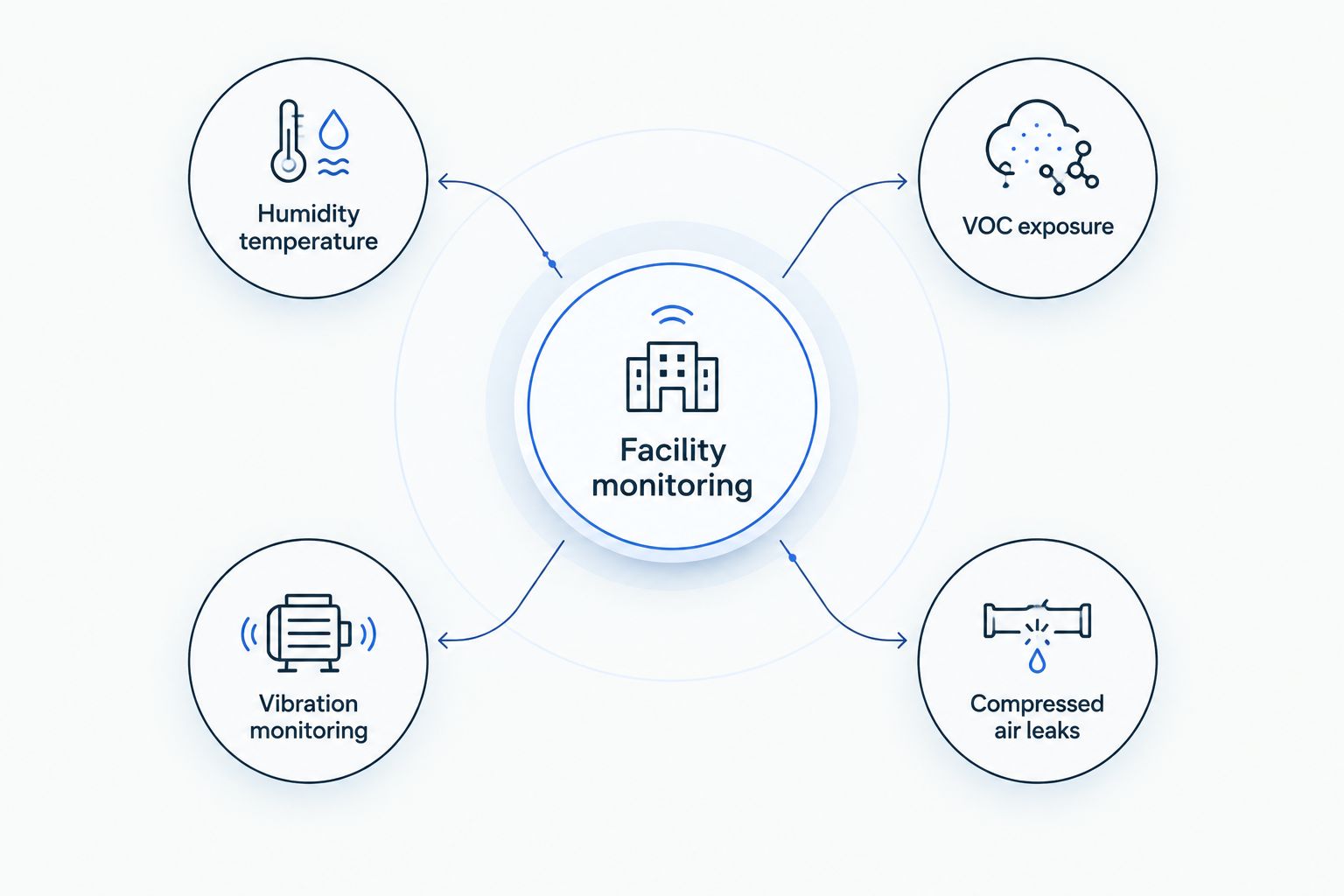
IoT monitoring for print and packaging facilities pairs humidity, VOC, vibration, and compressed-air sensors with an alarm and rules engine, so a plant manager sees a moisture swing on the paper stock or a bearing warming on a die-cutter before it stops a run. Press rooms, corrugators, and finishing lines run tighter tolerances and louder, dirtier environments than a typical warehouse, which is why a generic building sensor kit usually misses the failure modes that actually cost a print or packaging plant money in 2026.
- IoT monitoring for print and packaging facilities means wiring press rooms, paper stock, and compressed air lines into sensors and rules — Kilo Cloud runs humidity, VOC, and vibration alarms from one dashboard.
- ISO 187 sets the standard paper conditioning atmosphere at 23°C and 50% relative humidity; drift outside that band shows up as curl, static, and registration errors.
- OSHA's 8-hour noise limit is 90 dBA under 29 CFR 1910.95 — press and finishing floors are common candidates for citation.
- The U.S. Department of Energy estimates compressed air leaks waste 20-30% of a compressor's output in typical industrial plants.
- Kilo's rules engine and alarm escalation chains replace manual walkthrough logs with alerts that reach the right person by email, SMS, or push.
Why does IoT monitoring matter for print and packaging facilities?
Paper is hygroscopic: it absorbs and releases moisture based on the surrounding air, which is why a stock room sitting at 65% RH prints differently than one held near 50%. Print and packaging plants run tight registration tolerances, multi-color overlays, and solvent or UV-cured inks — all three fail in specific, measurable ways when temperature, humidity, VOC concentration, or line vibration drifts outside a known band. A quality control lead who only checks conditions at shift start misses the 2 a.m. HVAC failure that curls a full skid of stock before the morning run.
Ink houses using solvent-based flexographic or gravure processes fall under the EPA's National Emission Standards for the Printing and Publishing Industry (40 CFR Part 63), which sets recordkeeping requirements for volatile organic compound and hazardous air pollutant emissions. Continuous VOC and air quality compliance monitoring gives an EHS manager a defensible, dated log instead of a once-a-quarter spot check heading into a 2026 audit.

How to set up IoT monitoring for a print and packaging facility
The sequence below applies whether it's a single 2026 pilot in one press room or a five-site print group standardizing on one set of thresholds.
Track humidity and temperature around paper stock and press rooms
Start where paper sits, not just where it prints. Stock rooms, on-press paper carts, and finishing or bindery areas each hold different microclimates, and one hallway sensor won't catch any of them.
- Log RH and temperature at receiving, stock room, and press floor separately with a sling psychrometer or handheld logger.
- Compare readings against the ISO 187 target of 23°C and 50% RH for paper conditioning.
- Track overnight and weekend swings — HVAC setbacks are the most common cause of curl complaints on Monday's first run.
- Note seasonal drift; humidity control that holds in summer often fails in dry winter months when static becomes the bigger problem.
Watch VOC and solvent exposure from inks and coatings
Solvent-based flexo and gravure inks, UV coatings, and cleaning solvents all off-gas VOCs that need tracking for worker exposure and for EPA recordkeeping.
- Log VOC concentration near ink mixing stations and dryers, not just at the building exhaust.
- Keep a manual log of solvent volume used per shift as a cross-check against sensor trend lines.
- Flag any reading that approaches your facility's permit limit before it becomes a compliance event.
- Track dryer and curing oven temperature alongside VOC data — under-cured coatings release solvent later, off the clock.
Monitor vibration on presses, folders, and die-cutters
This is where a manual clipboard stops being enough. Bearing wear on a folder or die-cutter builds over weeks, and a monthly walk-around vibration check on a line running 24/7 will miss the failure window. The Kilo IoT Platform binds a vibration sensor to a digital twin of each machine, so a rising trend on one die-cutter shows up as a trend line, not a single alarm.
- Set a baseline vibration reading during commissioning or right after a planned rebuild.
- Configure a rules engine alert on a percentage rise over baseline, not just an absolute threshold.
- Pair vibration with motor current draw — a current spike alongside rising vibration usually points to a mechanical bind, not just wear.
- Route the alarm to the maintenance lead's phone with an escalation chain if it isn't acknowledged in a set window.
Vibration and current sensors for legacy presses that predate any network gear are available through Kilo Electronics, Kilo's hardware sister company, with worldwide shipping.
Meter compressed air and catch leaks in pneumatic lines
Packaging lines lean on compressed air for feeders, actuators, and blow-off, and the U.S. Department of Energy puts typical leak losses at 20-30% of total compressor output in plants that haven't run a leak survey.
- Run an ultrasonic leak survey during a planned shutdown as the free baseline method.
- Meter compressor run time and output pressure continuously to catch a slow leak between surveys.
- Set an alarm for a pressure drop that doesn't match the production schedule — a drop during downtime usually means a leak, not demand.
- Track compressor duty cycle over time; climbing run time with flat output is the earliest leak signal, ahead of anything on the compressed air leak detection sensors an operator could hear by ear.
Check noise levels against OSHA limits
Press rooms, corrugators, and finishing lines regularly run above OSHA's 90 dBA 8-hour time-weighted average threshold under 29 CFR 1910.95, and hearing conservation programs need documented exposure data, not an annual spot reading.
- Take handheld dosimeter readings at operator positions during a normal shift as the baseline.
- Log continuous sound level near the loudest equipment: folders, corrugators, guillotine cutters.
- Flag sustained readings above the action level so hearing protection zones get reviewed, not assumed.
- Keep a dated record tied to each machine and shift for OSHA documentation.
Replace manual rounds with automated alarms and escalation
Once humidity, VOC, vibration, air, and noise data are flowing, the manual round becomes a backup, not the primary control. Kilo's rules engine runs the thresholds continuously, and its alarm system carries five severity tiers with multi-step escalation, so a minor humidity drift pages a supervisor while a VOC spike near a permit limit pages the EHS manager directly.
- Set quiet hours for low-severity alerts so night shift isn't paged for a one-degree swing.
- Use a centralized alarm inbox instead of scattering alerts across individual emails.
- Let Kilo's built-in AI assistant draft a new rule or alarm in plain language when a new machine or ink line comes online, then review before it deploys.
- Confirm a rule or command change against execution history rather than assuming a deploy took effect — pair this with SMS and email alerts for critical sensor thresholds so the escalation actually reaches someone off-shift.
Which IoT monitoring option fits a print and packaging facility?
Four options show up in most plant manager evaluations for a 2026 budget cycle. None of them is free of tradeoffs.
| Option | Best for | Key limitation |
|---|---|---|
| Manual logbooks and spot checks | A single press room testing the idea before budget approval | Misses overnight, weekend, and between-round excursions |
| Standalone data loggers | Auditing one line or one compliance event | No live alarm — data has to be pulled and read by hand |
| Building management system (BMS) | Facilities already wired for HVAC control | Rarely extends to press-floor vibration or compressed air lines |
| Kilo Cloud | Multi-site print or packaging groups needing humidity, VOC, vibration, and air on one dashboard | Sensors still need onboarding time per site before alarms are live |
A single press room piloting the idea can start with a data logger and a clipboard; a multi-site print group standardizing on compliance data needs a platform that runs the rules automatically.
See print facility monitoring live
Walk through humidity, VOC, and vibration alarms on one dashboard.
What mistakes do print and packaging facilities make with IoT monitoring?
- Treating the stock room and the press floor as one climate zone when they drift independently — a stock room reading of 50% RH tells you nothing about humidity at the feed end of the press.
- Waiting for an EPA or state inspection to start VOC logging instead of building the record before it's requested.
- Skipping the compressed air leak survey because "the compressor sounds fine" — the DOE's 20-30% loss estimate applies to systems that look normal until metered.
- Alarming only on catastrophic vibration events, so a die-cutter bearing trending upward for three weeks never triggers anything until it seizes mid-run.
- Routing every alarm to one supervisor's inbox, so a shift change leaves a VOC spike unacknowledged for hours.
FAQ
What sensors does a print or packaging facility need for IoT monitoring?
Most print and packaging plants start with humidity and temperature sensors near paper stock, VOC sensors near ink and coating stations, vibration sensors on presses and die-cutters, and a compressed air pressure or flow sensor. Noise dosimetry and current sensors on major motors round out a full 2026 deployment.
How does humidity affect commercial printing quality?
Paper absorbs and releases moisture based on ambient humidity, and ISO 187 sets the standard conditioning atmosphere at 23°C and 50% RH for consistent paper behavior. Drift outside that band shows up as curl, static buildup, and color registration errors between print stations.
What OSHA noise limit applies to print and packaging plants?
OSHA's permissible exposure limit is 90 dBA averaged over an 8-hour shift under 29 CFR 1910.95. Press rooms, corrugators, and finishing equipment commonly run near or above that threshold, which is why continuous dosimetry beats an annual spot check.
Is IoT monitoring better than a building management system for a print plant?
A BMS handles HVAC and general building systems well but rarely reaches press-floor vibration, ink-line VOC readings, or compressed air metering. An IoT platform built for industrial sensors, such as Kilo Cloud, extends monitoring to the production floor a BMS wasn't designed to cover.
How much does compressed air leakage cost a packaging plant?
The U.S. Department of Energy estimates leaks waste 20-30% of a compressor's total output in industrial plants that haven't run a leak survey. Continuous pressure and duty-cycle monitoring catches a new leak between scheduled surveys instead of after months of wasted output.
Does IoT monitoring help with EPA VOC compliance for printing?
Continuous VOC sensors near ink mixing and drying stations build the recordkeeping that 40 CFR Part 63 requires for the printing and publishing industry. That record replaces quarterly spot checks with a defensible, dated log.
Can one platform monitor humidity, VOC, vibration, and compressed air together?
Yes — a platform built for multiple sensor types and protocols, such as Kilo Cloud, can run humidity, VOC, vibration, and air pressure rules from one dashboard instead of separate point tools for each. That matters most once a facility runs more than one production line or site.
How fast can a print facility deploy IoT sensors?
Deployment speed depends on how many machines and zones need coverage and whether the site already has wireless sensor infrastructure. A single press room with a handful of sensors onboards faster than a 2026 multi-site rollout covering stock rooms, ink stations, and finishing equipment across several buildings.
What sensor should a print or packaging facility add first?
If budget only covers one sensor type in 2026, put it on humidity and temperature at the paper stock, not at the press. Registration and curl problems trace back to moisture more often than any other single variable, and ISO 187's 23°C / 50% RH target gives a fixed number to alarm against instead of a guess. Vibration and VOC sensors matter, but they protect equipment and compliance — paper conditioning protects the run that's on the press right now.