
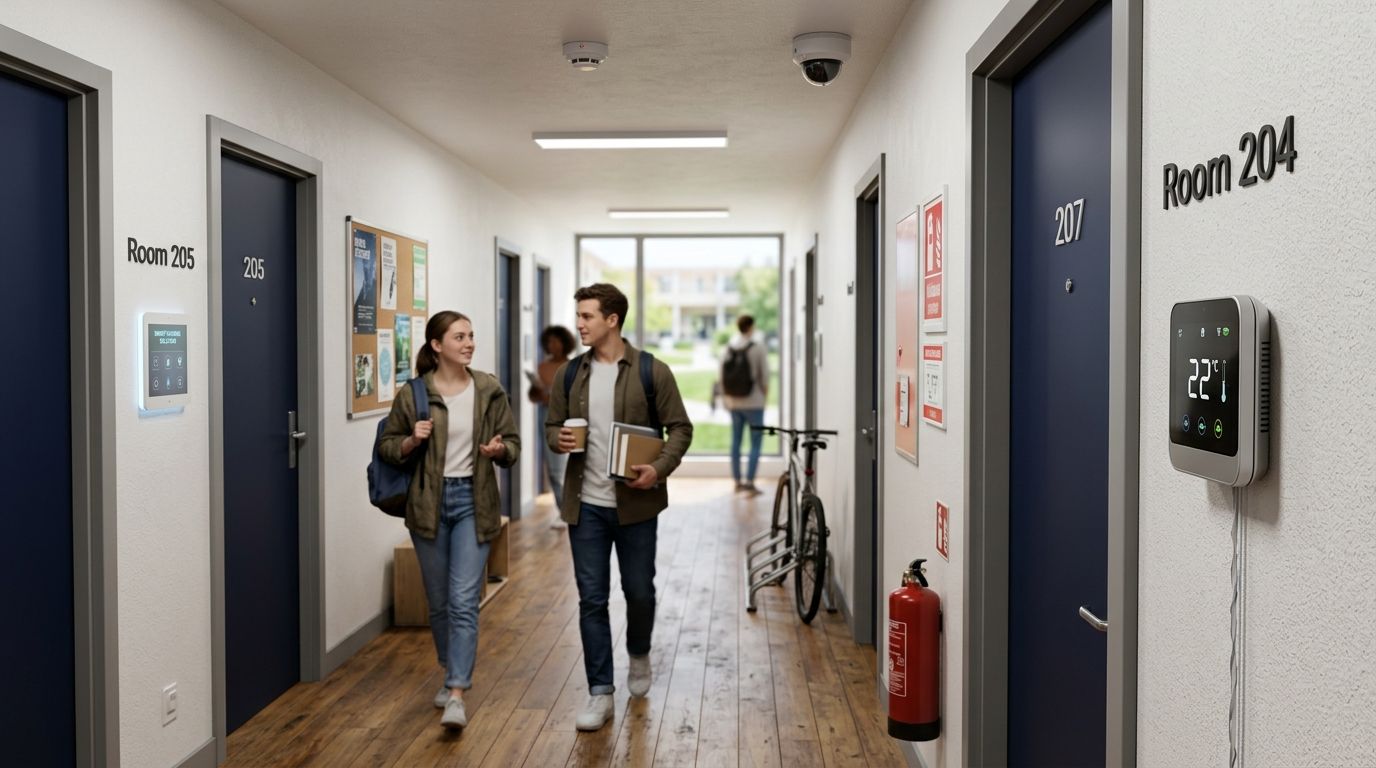
Student housing and dormitory IoT monitoring is the use of wireless sensors and a connected platform to track temperature, humidity, water leaks, air quality, and energy use across residence halls, with the goal of catching a failure before it turns into a flooded basement or a mold complaint. Dorms differ from a typical office floor because occupancy swings hard between semester and break, night staffing is thin, and a burst pipe over winter break can sit unnoticed for weeks if nobody is walking the halls.
- IoT monitoring for student housing dormitories in 2026 tracks water leaks, humidity, CO2 and energy use without full-time overnight staff.
- Water leak sensors near washers and water heaters catch the failures that flood basements over winter break, when nobody is checking.
- ASHRAE 62.1 ties CO2 above roughly 700 ppm over outdoor levels to poor ventilation in lounges and study rooms.
- The Kilo IoT Platform runs LoRaWAN and mioty sensors on one dashboard so a Housing Facilities Manager sees every building, not one at a time.
- Retrofitting a decades-old residence hall works without rewiring because the sensors run on wireless protocols, not conduit.
Why do university dorms need IoT monitoring in 2026?
A dormitory runs on a schedule no office building does. Full occupancy for 15 weeks, then a break where heat gets set back, water heaters keep running, and the only people on site are a skeleton crew of facilities staff. That's the exact window a pipe freezes or a water heater fails and nobody notices until move-in day.
Resident Assistants aren't building engineers, and asking an 20-year-old RA to check every mechanical closet on a walkthrough isn't a monitoring plan — it's a gap. A Director of Residential Life or Housing Facilities Manager overseeing a dozen halls needs the same data an office building manager gets, but calibrated to student housing: laundry rooms running 24 hours, shared bathrooms, unattended breaks, and a maintenance budget that answers to the university, not a landlord.
The monitoring system for university campuses covers the academic-building side of this problem; residence halls need the same sensor coverage extended to laundry rooms, dorm bathrooms, and break-period vacancy that classroom buildings don't deal with.
Install water leak sensors near washers, water heaters and pipe risers
Water damage in multifamily and institutional housing almost always traces back to the same handful of spots. Cover them first.
- Laundry room floor drains and behind washing machines
- Water heater closets and boiler rooms
- Basement pipe risers and chases
- Under-sink areas in shared bathrooms
- Sump pump pits in older buildings
Track humidity and temperature in mechanical rooms and unoccupied wings
EPA guidance puts the target indoor relative humidity range at 30 to 50 percent to limit mold growth — dorms with poor ventilation and heavy shower use in shared bathrooms drift above that fast.
- Mechanical and boiler rooms
- Closed wings during summer session or breaks
- Attic and crawl space access points
- Laundry rooms, where dryer heat and moisture both spike
- Basement storage areas prone to condensation
Monitor CO2 and air quality in common areas and study lounges
ASHRAE 62.1 is the ventilation standard most facilities teams already reference for acceptable indoor air quality, and CO2 concentration is the practical proxy for it.
- Study lounges and common rooms
- Fitness rooms inside residence halls
- Dining areas attached to housing
- Laundry rooms with limited airflow
- Any room converted from storage into resident space
Meter energy use per building or per wing for utility submetering
Housing offices that bill utilities back to a department or track per-building consumption need data broken down below the campus meter.
- HVAC and lighting circuits by wing
- Laundry machine cycles, a heavy and constant draw
- Any EV charging installed near a residence hall
- Shared versus per-resident load where billing separates them
- Seasonal baseline versus break-period consumption
Set up automated alarms that reach the right person, not a logbook
A reading that only lives on a dashboard doesn't stop a flood. It has to reach a phone.
“A frozen pipe bursting over winter break doesn't wait for the RA on duty to notice — the alarm has to reach a phone, not a logbook.”
- Escalation chains that move from on-call facilities staff to a director if unacknowledged
- SMS, email and push delivery, not just an inbox
- Quiet hours for non-critical alerts, full urgency for water and freeze alarms
- Severity tiers that separate a slow drip from an active flood
Map every sensor to a floor plan with a digital building twin
A spreadsheet of sensor IDs means nothing to a new facilities hire in September. A floor-plan view does.
- Bind each sensor to its room or object on a 3D twin
- Browse readings by floor or wing instead of by device list
- Use the twin during move-in and move-out inspections
- Onboard new staff faster with a visual layout instead of a spreadsheet
Retrofit older halls without rewiring or drilling
Most university housing stock predates any sensor network, and running conduit through brick and concrete is the line item that kills a monitoring budget before it starts.
- Wireless sensors over LoRaWAN or mioty pass through brick and concrete without new wiring
- Battery-powered units skip the electrician cost entirely
- Roll out one building at a time instead of a campus-wide rip-and-replace
- Details on wireless retrofit sequencing are in the guide to retrofitting legacy buildings with wireless sensors
What are the monitoring options for dormitories and residence halls?
| Option | Best for | Key limitation |
|---|---|---|
| RA walkthroughs and paper logbooks | Small housing offices with a handful of buildings | No coverage overnight or during breaks, relies on memory |
| Building Automation System tied to HVAC | Campuses with an existing BMS on newer halls | Usually skips laundry rooms, water heaters and older buildings |
| Standalone point sensors with a local app | One known problem area, like a single leaking bathroom | Doesn't scale past a few sensors, no cross-building view |
| Wireless IoT platform such as Kilo | Multi-building housing portfolios needing one dashboard and automated alerts | Requires upfront sensor placement and coverage planning |
A facilities team that has already outgrown paper logbooks can read the case for moving off manual checks entirely, and the mechanics carry over directly from other commercial buildings: the same water leak logic that prevents flooding in an office basement applies to a dorm laundry room.
See every dorm reading on one dashboard
Map leaks, humidity and energy use across residence halls in one view.
What mistakes do universities make with dorm IoT monitoring?
- Sensors only in the newest halls. The 1960s brick building with the oldest plumbing is exactly the one that needs coverage first, not last.
- Alerts routed to an inbox nobody checks at 2 a.m. A threshold breach that sits in email until Monday morning isn't an alarm, it's a record of what already flooded.
- No plan for break-period HVAC setbacks. Dropping heat too far during winter break to save energy without freeze-alarm coverage is how pipes burst in empty buildings.
- Treating installation as a one-time project. Sensors placed during one semester's move-in get forgotten when rooms change use the next year.
- One point of contact for escalation. When the single staff member who gets alerts graduates or changes roles, the alarm chain breaks silently.
FAQ
What is IoT monitoring for student housing and dormitories?
It's a network of wireless sensors, usually LoRaWAN or mioty, tracking temperature, humidity, water leaks, air quality and energy use across residence halls, feeding one dashboard instead of relying on RA walkthroughs. It catches failures like a burst pipe or a mechanical room overheating during periods when buildings are unoccupied, such as winter break.
Why do CO2 levels matter in dorm common areas?
ASHRAE 62.1 treats CO2 concentration roughly 700 ppm above outdoor levels as a signal of inadequate ventilation. Study lounges, fitness rooms and laundry rooms in residence halls often see heavy, sustained occupancy with limited airflow, which pushes CO2 up fast compared to a typical office.
Can IoT sensors detect water leaks before they flood a dorm basement?
Yes, water leak sensors placed near washing machines, water heaters and pipe risers detect moisture at the source and trigger an alarm before the leak spreads. That coverage matters most during breaks, when a slow leak in an unoccupied wing can run for days before anyone notices.
Is IoT monitoring different for dorms than for regular commercial buildings?
The sensor types overlap with any commercial building, but the occupancy pattern doesn't: dorms swing between full occupancy and near-total vacancy every few months. Alarm escalation has to account for reduced break-period staffing in a way a typical office building doesn't need to plan for.
Do wireless sensors work in older, brick residence halls?
Wireless protocols like LoRaWAN and mioty pass through brick and concrete without new wiring, which is why older halls are usually the easiest retrofit candidates, not the hardest. Battery-powered units also skip the electrician cost that made older buildings expensive to instrument in the past.
How does energy submetering work in dormitories with shared utilities?
Submetering breaks consumption down by building, wing, or circuit below the campus-level utility meter, separating shared HVAC and lighting load from resident-driven usage like laundry machines. That data supports internal billing between a housing department and the university, or simple year-over-year efficiency tracking.
What happens when a dorm alarm triggers during winter break with no staff on site?
An escalation chain routes the alert past the first on-call contact if it isn't acknowledged, moving up to a facilities director or second on-call staffer. Multi-step escalation with SMS, email and push delivery is what keeps a break-period leak from sitting unaddressed for the length of the break.
What's the best IoT platform for university residence halls?
The right platform depends on how many buildings need coverage and whether an existing BMS already handles HVAC; a wireless platform that adds leak, humidity, CO2 and energy sensors on top of that is generally the fastest path for a multi-building housing portfolio. Look for built-in LoRaWAN and mioty support, since that avoids deploying a separate network server per protocol.
What's the most overlooked sensor placement in student housing?
Laundry rooms. They run washers and dryers close to continuously during the semester, sit on the same water lines that flood basements, and generate the humidity spikes that push relative humidity past the EPA's 50 percent mold-risk threshold — yet they're the room most walkthrough checklists skip because nobody assumes the laundry room is where the building fails. It usually is.
Kilo Electronics carries pre-configured temperature, humidity, water leak and CO2 sensors with worldwide shipping for housing teams building out coverage building by building, and the Kilo IoT Platform runs the LoRaWAN, mioty and MQTT connectivity, dashboards, and alarm escalation on top of whichever sensors get deployed first.