
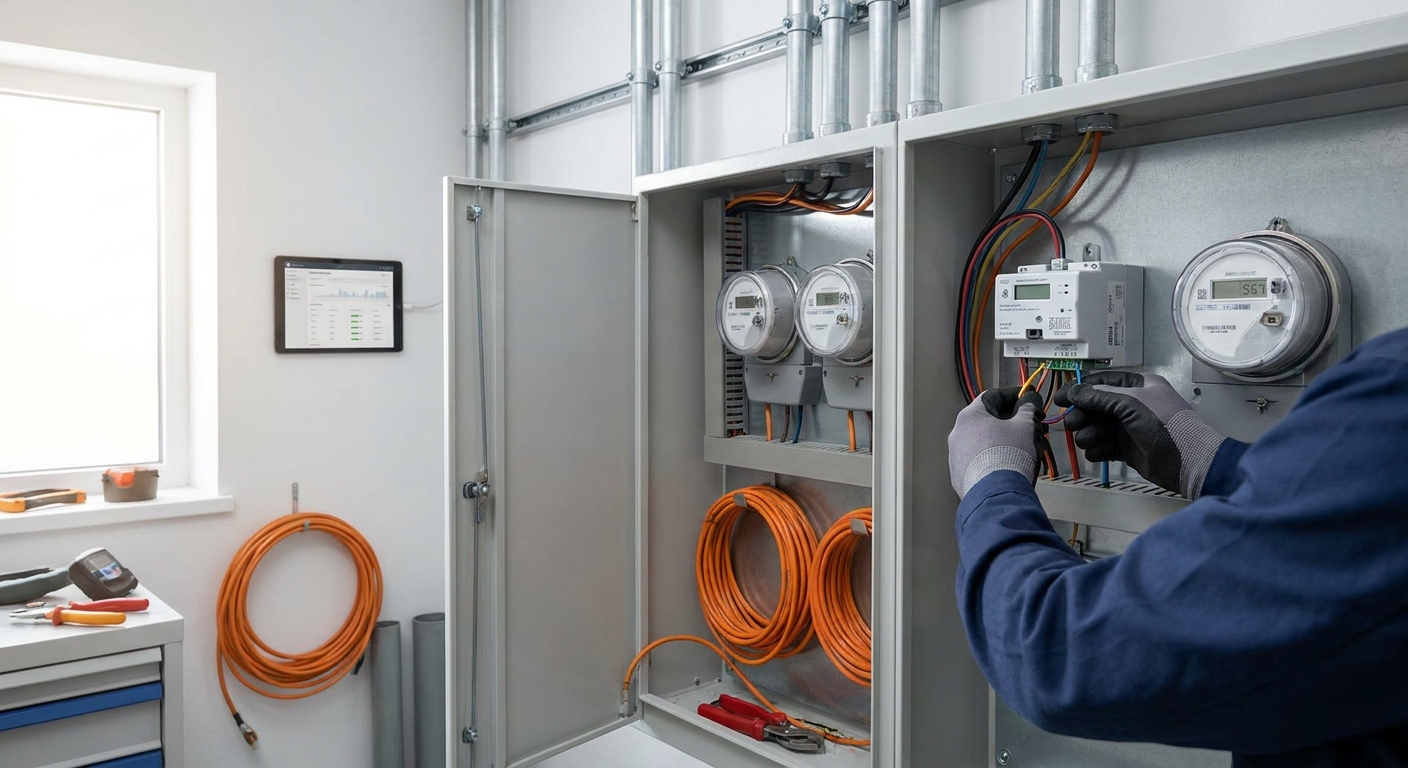
Submetering turns one master utility bill into itemized invoices per tenant, and doing it with wireless IoT sensors instead of a hardwired building management system cuts install cost and downtime for occupied buildings. This guide covers the meters, protocols, and rules-engine logic you need to build an IoT energy submetering system that produces billing-grade data a tenant can't successfully dispute.
- Building an IoT energy submetering system needs ANSI C12.20 Class 0.5 meters plus a wireless gateway, not a rewired BMS.
- LoRaWAN or mioty pulse counters read existing panels without cutting into live electrical gear, which is the fastest occupied-building retrofit.
- ASHRAE 90.1-2022 requires metering of individual end uses in many commercial buildings over 25,000 square feet.
- A CEL-based rules engine can turn hourly kWh reads into per-tenant monthly totals your billing system invoices from.
- Meters rated below Class 1.0 accuracy create disputes fast; don't put a Class 2.0 device on a tenant bill.
Why Commercial Buildings Are Moving to IoT Energy Submetering
A single master meter tells you what the whole building used. It tells you nothing about which tenant ran their HVAC at 60 degrees all August. Submetering closes that gap, and it's no longer optional in every jurisdiction: ASHRAE 90.1-2022, Section 8.4.3, requires metering of individual energy end uses for a range of commercial building types, and cities including New York (Local Law 84) require annual benchmarking through EPA's ENERGY STAR Portfolio Manager for buildings over 25,000 square feet.
Property managers used to solve this with a hardwired BMS: conduit runs, a licensed electrician for every panel, and weeks of downtime in an occupied building. Wireless IoT changes the math. A pulse counter or Modbus-to-radio bridge clips onto the existing meter, reports over LoRaWAN or mioty, and lands in a cloud platform without opening a wall. That's the version this guide walks through.
What You Need to Build an IoT Energy Submetering System
- Pulse-output or Modbus RS-485 electric meters at each tenant panel, rated Class 0.5 or better under ANSI C12.20 if the data will appear on an invoice
- A wireless pulse counter or Modbus-to-LoRaWAN/mioty converter per meter location
- A LoRaWAN or mioty gateway with coverage confirmed at the farthest meter (basements and electrical rooms are the usual dead zones)
- An IoT cloud platform for device management, dashboards, rules and alarms — a built-in network server means you skip standing up a separate ChirpStack or TTN instance
- A licensed electrician for the initial CT clamp or panel connection, even though the reporting hardware itself is wireless
- 2 to 5 days per building for install and commissioning, depending on panel count and gateway coverage
- Optional water and gas pulse meters if tenant bills cover more than electricity
For a small pilot, a handful of tenant panels fit inside Kilo's free tier, which covers up to 5 devices and 1 dashboard with no card required and no expiration. Scaling past a single floor moves to the Starter plan at 25 EUR per month for up to 25 devices; gateways don't count against either tier's device limit.
How to Build an IoT Energy Submetering System, Step by Step
1. Audit every tenant panel and meter point
Walk the electrical rooms and list every subpanel that needs its own meter, along with the CT ratio and voltage configuration. Missing a subpanel here means a tenant gets billed for a neighbor's HVAC load later. Expected outcome: a panel schedule with one line per billable tenant space. Common mistake: treating a shared-use panel (lobby lighting, elevator) as tenant-billable when it should stay on the landlord's side of the ledger.
2. Pick metering hardware by accuracy class, not price
Revenue-grade billing needs ANSI C12.20 Class 0.5 or Class 0.2 meters; many building-automation submeter kits are only rated Class 1.0 or 2.0, which several state utility commissions won't accept for tenant billing. Confirm the accuracy class on the datasheet before ordering, not after installation. Expected outcome: a meter spec sheet you can hand to a utility regulator if a tenant challenges a bill.
3. Choose the wireless protocol for each install site
LoRaWAN works well for standard steel-and-drywall commercial buildings; mioty's telegram-splitting transmission method, defined by the mioty Alliance, is built for the dense concrete and rebar of basements and parking structures where a single LoRaWAN packet can get lost. MQTT is the right fit when meters already sit behind a PLC or building automation gateway that speaks Modbus. Pick per building, not per company policy.
4. Install and commission gateways and pulse counters
Mount the gateway centrally, ideally on a top floor or roof access point, and confirm signal strength at the farthest meter before closing up the electrical room. Connecting Modbus meters into a cloud dashboard is the same commissioning pattern whether the meter feeds a PLC or reports directly. Common mistake: commissioning gateways before the meters are wired, so the first real signal test happens after the electrician has left the building.
5. Connect every meter to the cloud platform
Once a device joins the network server, it needs a digital twin in the platform with the panel ID, tenant name, and CT ratio attached — this is what turns a raw pulse count into a labeled kWh reading tied to a lease. Kilo's REST and gRPC APIs also let a property management system pull the same readings for a tenant portal. Expected outcome: live interval data on a dashboard within minutes of the meter's first uplink.
6. Build the rules engine that totals kWh per tenant
Use a CEL-based rule to aggregate interval reads into a monthly kWh total per tenant, and version the rule so a rate change doesn't require rebuilding the logic from scratch. Kilo's visual rules engine supports one-click deploy and rollback, plus step-through debugging against a test payload, so you can validate a billing formula before it touches a real invoice. Common mistake: hardcoding a flat rate into the rule instead of referencing a rate table that changes with the utility's tariff.
7. Set alarms for meter faults and consumption spikes
A meter that stops reporting for 24 hours shouldn't surface as a missing line on next month's bill — it should trigger an alarm the same day. Configure a severity tier and an escalation chain so a stalled meter reaches the facilities lead, not just an inbox nobody checks. Expected outcome: a fault caught within hours instead of discovered at billing close.
8. Validate submetered totals against the master meter
Sum every tenant submeter reading plus common-area load for the billing period and compare it to the master utility meter for the same window. A gap larger than a few percent usually means a CT ratio is misconfigured or a panel was missed in step 1. Do this every billing cycle for at least the first three months, then quarterly once the numbers hold steady.
See the submetering setup live
Walk through device onboarding, rules and alarms on the Kilo IoT Platform.
Common Problems With IoT Energy Submetering for Tenant Billing
Pulse counts don't match the utility bill. Check the CT ratio and pulse multiplier configured on the device against the meter's nameplate — a mismatched multiplier is the most common cause of a submetered total that's off by a clean factor of 10 or 100.
A basement gateway can't hear half the meters. Concrete and rebar attenuate LoRaWAN signal fast; move affected meters to a mioty gateway, whose telegram-splitting design is built for that environment, or add a second gateway closer to the dead zone.
Interval data has gaps. A battery-powered pulse counter with an aggressive reporting interval drains fast and drops off; extend the interval or check that the device wasn't installed in a location colder than its rated operating range.
A tenant disputes their bill. Pull the interval readings for that meter and billing period alongside the rule version that was live at the time — the readings and the logic that produced them settle most disputes without a site visit.
Alarms fire every time a meter resets. Set quiet hours and a minimum duration threshold on the alarm rule so a two-second reboot blip doesn't page the on-call facilities engineer at 3 a.m.
A new tenant panel gets added mid-lease. Treat it as a standard device onboarding task — one new digital twin, one panel ID, one line added to the existing rule rather than a rebuild of the whole billing logic.
Tools and Platforms for IoT Energy Submetering Deployments
Beyond the meters and gateways, three categories of software decide whether this project stays maintainable past year one:
- A network server that doesn't require separate infrastructure. Kilo's built-in LoRaWAN and mioty network server removes the need to run ChirpStack, TTN, or a mioty service center alongside the application layer.
- A dashboard that a non-technical property manager can read. Widgets for charts, gauges, and floor-plan pins matter more than raw API access when the audience is a leasing office, not an engineer.
- A rules engine with rollback. Billing logic changes every time a utility adjusts its tariff, and a rule you can't safely roll back is a rule you'll eventually break in production.
Buildings running an energy audit before committing to submetering hardware tend to size the gateway count correctly the first time, instead of discovering coverage gaps after the meters are already mounted.
What to Do After Your Energy Submetering System Goes Live
Once billing data is flowing and validated against the master meter, the next move is usually a digital twin of the full building tied to the same energy data, so facilities staff can see consumption by floor or zone instead of just by tenant. That's a separate build from tenant billing, but it reuses every meter and gateway already in place.
FAQ
What is IoT energy submetering?
IoT energy submetering is measuring individual tenant or zone electricity use with wireless meters that report to a cloud platform, instead of relying on one master utility meter for the whole building. It lets a landlord bill each tenant for actual consumption rather than splitting the master bill by square footage.
How accurate does a submeter need to be for tenant billing?
For revenue-grade tenant billing, a meter should meet ANSI C12.20 Class 0.5 or Class 0.2 accuracy. Many building-automation submeter kits are only rated Class 1.0 or 2.0, which some state utility commissions won't accept on an invoice.
Is LoRaWAN or mioty better for tenant submetering?
LoRaWAN works well in standard commercial construction, while mioty's telegram-splitting design handles dense concrete and basements better. Pick per building based on where the electrical rooms and panels sit, not as a blanket policy.
Do I need an electrician to install IoT submeters?
Yes, a licensed electrician needs to make the initial CT clamp or panel connection even though the reporting hardware itself is wireless. After that connection, adding or swapping the wireless reporting device doesn't require re-entering the panel.
Can I add submetering to an existing building without rewiring?
Yes, wireless pulse counters and Modbus-to-radio bridges clip onto existing meters without conduit runs, which is the main advantage over a hardwired BMS retrofit. The building stays occupied and operational during the install.
What happens if a tenant disputes their energy bill?
Pull the interval readings for that meter and billing period, plus the rule version that was live at the time. Most disputes resolve once the tenant sees the interval data and the logic that produced the figure.
How long does it take to deploy an IoT energy submetering system?
A single building typically takes 2 to 5 days for install and commissioning, depending on the number of panels and gateway coverage. Validation against the master meter should continue for the first three billing cycles before trusting the numbers unattended.
Does ASHRAE 90.1 require submetering for commercial buildings?
ASHRAE 90.1-2022, Section 8.4.3, requires metering of individual energy end uses for a range of commercial building types, commonly triggered around 25,000 square feet. Check your local adopted code edition, since jurisdictions lag the national standard by a few years.
What Most Landlords Get Wrong About Energy Submetering Accuracy
Most disputes trace back to one detail nobody checks at install: the meter's accuracy class. A Class 2.0 device and a Class 0.5 device can sit on the same panel and report different numbers under identical load, and only one of them holds up if a tenant takes a bill to a utility commission. Confirm the accuracy class on the datasheet, not the marketing page, before a single meter goes on a wall in 2026.