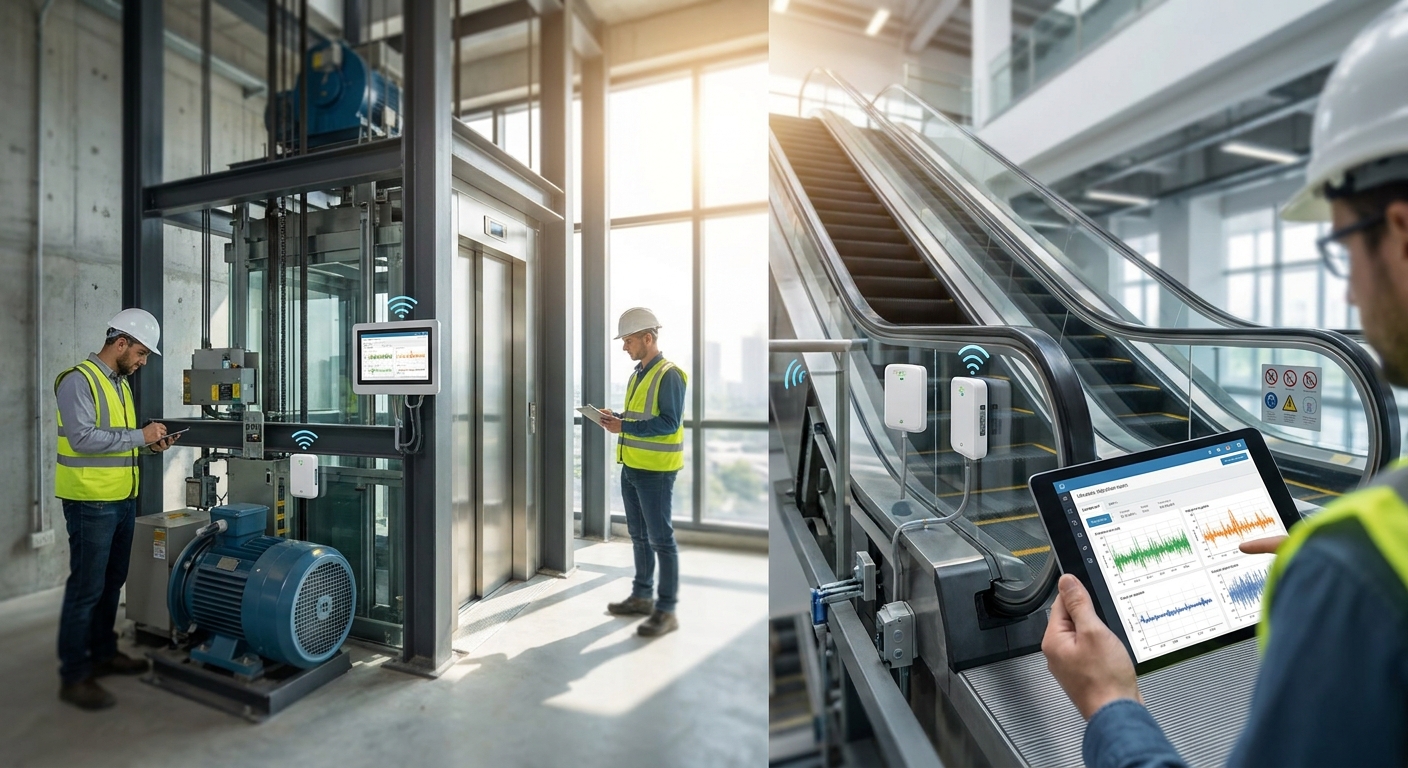
Elevator and escalator vibration monitoring puts continuous IoT sensing on machine rooms, hoistway rails, and step chains so facilities teams catch bearing wear, gearbox slip, and chain slack before an ASME A17.1 inspection turns into an unplanned car outage. This guide breaks down what a working setup for iot vibration monitoring for elevators and escalators needs in 2026, who should own the decision, and which connectivity and alarm approach fits a single building versus a multi-site portfolio.
- LoRaWAN tri-axial vibration sensors paired with a rules engine catch bearing and gearbox drift before a car goes down - Buy for single-building machine rooms.
- mioty-based sensors handle dense elevator banks and thick steel shafts better than standard LoRaWAN - Consider for high-rise or multi-car cores.
- Predictive maintenance alerting on vibration trend, not raw thresholds, cuts false alarms from normal door-cycle noise.
- Skip vibration sensors that only report a single overall RMS number with no frequency band data - they miss chain slap and bearing wear until it's loud.
- A building-wide digital twin overlay makes sense once you're past 3-4 elevator or escalator units on one site.
Why this matters
An elevator that fails inspection or strands a car mid-shaft is a liability event, not just a maintenance ticket. Vibration is the earliest signal you get on a rotating machine - motors, gearboxes, sheaves, and escalator step chains all start vibrating differently weeks before they make noise a technician can hear on a walkthrough.
ASME A17.1 governs elevator safety code in the US, and most jurisdictions still lean on scheduled maintenance visits rather than continuous condition data. That gap is where vibration monitoring earns its keep in 2026: it turns a monthly or quarterly inspection into a dataset you can act on daily. ISO 10816-3 gives a reference point too - many machines in this class move from Zone B into Zone C somewhere around 7.1 mm/s RMS velocity, and that's the kind of number a rules engine can watch for you continuously instead of waiting for the next site visit.
Who this is for
This is written for facilities managers, building engineers, and property management companies running elevators and escalators across one or more sites who need condition data between code-mandated inspections. It's also relevant to elevator service contractors and system integrators specifying monitoring hardware for a client's building portfolio. If you're running more than a handful of units, the case for continuous vibration data over reactive service calls is stronger every year - facility monitoring for property management companies covers the multi-site side of that decision if elevators are one system among several you're tracking.
What to look for in vibration monitoring for elevators and escalators
Tri-axial sampling, not a single overall number
A sensor that outputs one RMS velocity figure tells you something's wrong after it's already wrong. You want tri-axial accelerometers sampling the frequency band where bearing wear and chain slap actually show up - typically somewhere in the 2 Hz to 1 kHz range for this class of rotating machinery - so the platform can separate a worn bearing from a loose bracket.
Mounting that survives a machine room retrofit
Elevator machine rooms and escalator pit access are tight, hot, and often shared with other equipment. Sensors need to bolt to the bedplate or motor housing without a rewire, and escalator sensors need to survive vibration from the step chain and handrail drive without working loose over months of continuous cycling.
Connectivity that gets through steel
Hoistways and machine rooms are steel boxes. Standard LoRaWAN gateways can struggle with the attenuation, which is why mioty's telegram-splitting approach holds up better in dense, high-rise, or multi-shaft cores - it was built for exactly this kind of RF-hostile environment. Pick the radio technology based on the building's steel density, not on habit.
Alarm logic tied to failure modes, not raw thresholds
A door-cycle vibration spike and a bearing failure both move the needle on a raw threshold alarm. What matters is trend and frequency signature - is vibration at the bearing's characteristic frequency climbing week over week - not a single number crossing a line. How to build automated alarms for equipment vibration anomalies walks through setting that up so alerts mean something instead of getting muted after the third false positive.
Integration with your existing maintenance workflow
Vibration data that lives in its own app never gets acted on. It needs to land where your team already works - a dashboard, a CMMS ticket, or a text alert to the on-call technician - or the sensors are just expensive paperweights bolted to a bedplate.
Battery life that matches your service cycle
Machine room access isn't always simple, especially in occupied high-rises. A sensor that needs a battery swap every few months creates its own maintenance burden. Multi-year battery life on the reporting interval you actually need matters more than a flashy sample rate you never use.
Top picks for elevator and escalator vibration monitoring
The baseline pick - LoRaWAN vibration sensors with a rules engine
For a single building or a handful of cars, tri-axial LoRaWAN sensors on the machine bedplate feeding a rules engine that watches for trend, not just threshold, is the setup most sites should start with. It catches the two failure modes that cause the most unplanned downtime: bearing wear and belt or chain tension loss. Buy if you're running fewer than a dozen units on one site and want alerts flowing to your team within days of setup - the alarm-building reference above is the place to get that alert logic right the first time.
The wildcard - mioty sensors for dense, steel-heavy cores
High-rise buildings with multiple elevator shafts in one steel core are where standard LoRaWAN starts losing packets. mioty's split-telegram transmission was designed for exactly this kind of dense, RF-hostile industrial environment, and it holds up in machine rooms buried behind three floors of concrete and rebar. Consider this over standard LoRaWAN once you're past 4-6 shafts on one core or you've had gateway placement headaches - best sensors for mioty-based industrial monitoring breaks down where mioty earns its keep versus LoRaWAN.
The efficiency play - predictive maintenance alerting on trend data
Instead of alarming on a static vibration threshold, this setup tracks the rate of change on specific frequency bands over 2026's maintenance calendar and flags equipment drifting toward failure weeks out, not the day it happens. It's the difference between a scheduled repair and an emergency callout. Buy if unplanned elevator downtime is costing you tenant complaints or SLA penalties - predictive maintenance alerts for industrial equipment covers the setup for rotating machinery generally, and elevator gearboxes and motors fit the same model.
The building-wide view - digital twin overlay
Once vibration monitoring is running on more than a handful of units, a digital twin view that shows every elevator and escalator's health state on a floor plan or building model becomes genuinely useful for reporting to ownership or insurance. It's overkill for one or two units and adds setup time you don't need yet. Consider it once your elevator and escalator fleet is one part of a larger building monitoring rollout, not the whole project.
Map your elevator monitoring setup
See how Kilo IoT connects vibration sensors, alarms, and dashboards for your buildings.
What to avoid
- Single-axis sensors marketed as vibration monitoring. They miss the lateral and axial wear patterns that show up on elevator sheaves and escalator drive shafts long before radial vibration climbs.
- Threshold-only alarms with no baseline period. Every machine has a different resting vibration signature; an alarm set on day one without a two-to-four week baseline will either fire constantly or never fire until it's too late.
- Sensors that need line-of-sight connectivity. Machine rooms and hoistways are the worst possible environment for that - if the spec sheet assumes open-air range, it wasn't built for this application.
Verdict comparison
| Setup | Connectivity | Best for | Verdict |
|---|---|---|---|
| LoRaWAN sensors + rules engine | LoRaWAN | Single building, under a dozen units | Buy |
| mioty-based sensors | mioty | Dense multi-shaft steel cores | Consider |
| Predictive maintenance alerting | LoRaWAN or mioty | Portfolios chasing SLA and downtime costs | Buy |
| Digital twin overlay | Platform layer | Multi-unit sites needing portfolio reporting | Consider |
FAQ
What is IoT vibration monitoring for elevators and escalators?
It's continuous sensing on elevator machine rooms and escalator drive components using accelerometers connected over LoRaWAN, mioty, or cellular, feeding a rules engine that flags bearing wear, gearbox drift, or chain slack before failure. It fills the gap between scheduled ASME A17.1 inspections with day-to-day condition data.
Is LoRaWAN or mioty better for elevator machine rooms?
LoRaWAN works well for single buildings or lower-density cores. mioty's telegram-splitting handles dense, multi-shaft, steel-heavy environments better because it was designed for exactly that kind of RF interference, common in high-rise elevator cores.
Can vibration sensors predict elevator brake or door failures?
Vibration sensing is strongest on rotating machinery - motors, gearboxes, sheaves - where wear shows up as a frequency shift weeks in advance. Door and brake mechanisms benefit more from cycle counting and current draw monitoring alongside vibration data.
Do escalators need different sensors than elevators?
The same tri-axial accelerometer technology works for both, but mounting differs. Escalators need sensors rated for continuous cycling on the step chain and handrail drive, while elevator sensors typically mount on the machine bedplate or motor housing.
How often should vibration data be sampled on elevator equipment?
Continuous trend sampling with alerts on frequency-band drift works better than periodic snapshot readings. A reporting interval in the minutes range, tuned in your rules engine, catches gradual bearing wear without flooding your team with noise.
What does ASME A17.1 require for condition monitoring?
ASME A17.1 sets safety and inspection code requirements for elevators, primarily around scheduled maintenance and testing, not continuous sensor monitoring. Vibration monitoring supplements that code cycle rather than replacing it, giving you data between required inspections.
How much does elevator vibration monitoring cost in 2026?
Cost depends on sensor count, connectivity type, and how many units you're covering, so it varies by deployment. Check current sensor and platform pricing directly rather than relying on a flat industry number.
Can a digital twin show elevator health across a whole building?
Yes, once vibration and other sensor data are flowing into a platform, a digital twin view can overlay elevator and escalator health state on a floor plan for portfolio-level reporting. It's most useful once you're monitoring more than a few units on one site.
One last thing
The detail most facilities teams miss in 2026: escalator step chain wear almost always shows up as a vibration signature at the drive sprocket's rotational frequency weeks before the chain audibly slaps or skips a step. If your alarm logic only watches overall RMS velocity, that early signature gets averaged out and buried in normal ridership noise - the whole reason frequency-band alarming beats a single threshold number.