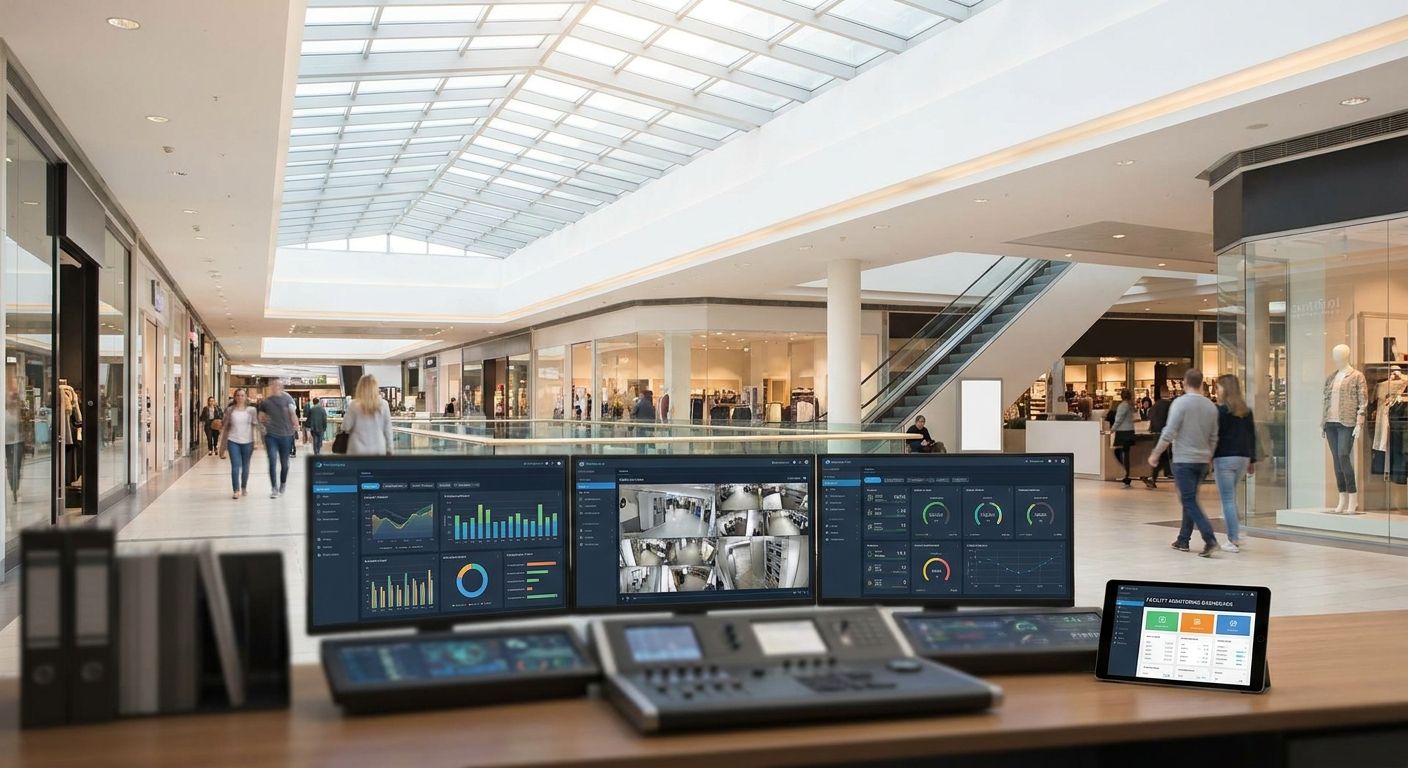
A shopping mall runs dozens of mechanical systems at once — food court refrigeration, common-area HVAC, elevators, water lines, parking garage ventilation, tenant submeters — and most of them sit outside the building's main BMS. A facility monitoring system for shopping malls has to cover all of it from one dashboard, not just the mechanical room the original BMS was wired for.
- Wireless sensor networks on an AI-first cloud platform beat paper logs and app-only point sensors for a facility monitoring system for shopping malls in 2026.
- LoRaWAN and mioty cover multi-acre common areas and parking structures without new wiring runs through tenant leases.
- A rules engine with multi-step alarm escalation catches HVAC drift and leaks before tenants file complaints, not after.
- Cellular-only sensor networks work for scattered outparcels but add per-device carrier costs a single-site mall doesn't need.
- Paper walkthroughs and single-zone point sensors are a Skip for any property over one wing.
What counts as a facility monitoring system for shopping malls?
Malls are a harder monitoring problem than a single office building. Common areas span multiple wings, food courts run refrigeration on a different schedule than the rest of the property, parking structures need CO monitoring for enclosed garages, and every anchor tenant runs its own HVAC that the property manager doesn't control but still gets blamed for. A real facility monitoring system for shopping malls and retail centers has to unify sensor data from all of those zones into one place, apply rules to it, and escalate the right alarm to the right person — chief engineer for a chiller fault, tenant coordinator for a leak behind a demised wall.
The ranking below compares monitoring approaches, not brand names against each other. Each one gets judged on four things a mall operations director actually cares about in 2026: common-area coverage without new wiring, how fast an alarm reaches a real person, whether it scales across multiple properties, and whether it works with the legacy BMS already bolted to the mechanical room.
How mall monitoring approaches stack up in 2026
1. Paper walkthroughs and clipboard logs — the audit trail nobody trusts. Engineers still do hourly rounds in a lot of enclosed malls built before 2000, logging chiller pressure and freezer temps by hand every 2-4 hours. The gap between rounds is exactly where a compressor short-cycle or a walk-in cooler door left ajar does its damage. There's no timestamped record an insurer or a tenant's attorney will accept after a spoilage claim. Verdict: Skip for any property beyond one small strip.
2. Standalone point sensors with app-only alerts — the single-zone blind spot. A handful of Wi-Fi temperature pucks in the food court refrigeration line solve one problem well but don't talk to anything else. No shared rules engine, no escalation chain, no way to see the parking garage IAQ reading next to the chiller alarm in the same view. Property managers running this setup end up with five different vendor apps and zero unified alarm history. Verdict: Hold — fine as a stopgap, not a system.
3. Building-wide BMS with no wireless expansion — locked to the mechanical room. Most enclosed malls built in the 1980s-2000s run a BACnet or Modbus BMS that covers central HVAC and little else. Extending it into tenant spaces, parking structures, or a second building on the same lot usually means new conduit runs and a change order the property doesn't have budget for. Retrofitting those legacy buildings with wireless sensors is the more common 2026 fix — see the guide on how to retrofit legacy buildings with wireless IoT sensors for the actual mechanics of doing it without touching the existing BMS wiring. Verdict: Hold on its own, Consider once paired with a wireless overlay.
4. Cellular multi-carrier sensor networks — connectivity without a home base. Cellular sensors skip gateway installation and work well for a mall's scattered outparcels or a second property across town, but every device carries an ongoing carrier subscription and the network itself doesn't give you rules, dashboards, or alarms — that still has to sit on a separate platform layered on top. Verdict: Consider for outbuildings and remote pad sites, not for the core common areas.
5. Wireless sensor network on a centralized AI-first cloud platform — one dashboard, every common area. LoRaWAN and mioty sensors run for years on a battery, punch through concrete and steel that block Wi-Fi, and cover a multi-acre footprint from a handful of gateways instead of a wiring closet per wing. Kilo Cloud is the worked example here: its built-in LoRaWAN and mioty network server means there's no separate network server to stand up, an MQTT connector pulls in anything the BMS or an energy meter already publishes, and a digital twin binds each sensor to its physical location in a live 3D building model. Chillers, walk-in coolers, restroom water lines, parking garage IAQ, and tenant submeters all land in the same rules engine. Verdict: this is the approach malls moving off paper logs in 2026 are converging on.
Facility monitoring system comparison for shopping malls
| Approach | Common-area coverage | Retrofit effort | Alarm escalation | Multi-site scale |
|---|---|---|---|---|
| Paper walkthroughs | Manual, gaps between rounds | None | None | None |
| Point sensors, app-only | Single zone | Low, per-sensor | App notification only | Poor |
| BMS only, no wireless | Mechanical room | High, new wiring | Basic threshold | Poor |
| Cellular multi-carrier | Wide, per-device cost | Low | Depends on separate platform | Good |
| Wireless network + cloud platform | Whole property | Low, battery sensors | Multi-step, five severity tiers | Strong |
Where to source a facility monitoring system for shopping malls
- Sensors and gateways come from Kilo Electronics, the hardware side of the Kilo business, with worldwide shipping — pick sensors for the specific failure mode (freezer door contact, water leak rope, vibration on an escalator motor) rather than a generic multi-sensor bundle.
- The platform should already have a rules engine and alarm escalation built in, not bolted on later — check whether it supports the HVAC energy management use case directly, since HVAC is usually the single largest line item on a mall's utility bill.
- Leak detection specifically deserves its own line item in any RFP — a burst line behind a demised wall in a mall corridor can run for hours before a customer notices. The mechanics of catching it early are covered in how to monitor water leaks in commercial buildings before damage spreads to tenant spaces.
The ASHRAE 62.1 ventilation standard sets minimum outdoor air rates for retail spaces, and it's a reasonable baseline to check parking garage and food court IAQ readings against. NFPA 70B governs preventive maintenance intervals on the electrical equipment feeding chillers and elevators, and EPA's Energy Star Portfolio Manager lets a mall benchmark common-area energy use against comparable retail properties — none of that requires guessing at a number, just pulling the standard and comparing readings against it.
“A monitoring system that only covers the mechanical room is a BMS with a nicer dashboard, not a facility monitoring system.”
See the shopping mall monitoring setup
Compare dashboards, alarms and sensor coverage for common areas and food courts.
FAQ
What's the best facility monitoring system for shopping malls in 2026?
A wireless sensor network — LoRaWAN or mioty — feeding a centralized cloud platform with a rules engine and alarm escalation covers a mall's common areas, food court refrigeration, and parking structures better than a BMS-only setup or standalone point sensors. It scales across multiple properties without new wiring runs.
Is LoRaWAN better than a cellular sensor network for a mall?
LoRaWAN sensors run for years on battery and don't carry a per-device carrier subscription, which matters when a mall is monitoring hundreds of zones across one property. Cellular sensors make more sense for scattered outparcels or a second site with no gateway coverage.
How much does an IoT facility monitoring platform cost for a mall?
Kilo Cloud runs a free plan for up to 5 devices at 0 EUR with no card required, and a Starter plan at 25 EUR per month for up to 25 devices. Gateways are unlimited on every tier and never count against the device cap.
Can a facility monitoring system work with an existing BMS?
Yes — an MQTT connector pulls readings from any publishing BMS, PLC, or energy meter into the same platform as the wireless sensors, so the legacy BMS doesn't get replaced, just extended.
What sensors matter most for a shopping mall?
Temperature and humidity sensors on food court refrigeration, water leak sensors on restroom and corridor lines, vibration sensors on elevators and escalators, and IAQ sensors in enclosed parking garages cover the highest-cost failure modes.
How fast should a leak or temperature alarm reach staff?
A multi-step escalation chain should notify the on-duty engineer first and escalate to a manager if it's not acknowledged within a set window, across email, SMS, and push — not just a single app notification that gets missed.
Does a mall need a digital twin?
A live 3D building twin with sensors bound to their physical location makes it faster for engineers to find which cooler or which HVAC unit triggered an alarm, especially across a multi-wing property where zone names alone are confusing.
What's the difference between mioty and LoRaWAN for a mall deployment?
Both are low-power wide-area protocols suited to thick concrete and steel construction; mioty adds stronger interference resistance for dense RF environments, which matters in a mall packed with Wi-Fi access points and tenant electronics.
What's the most overlooked feature in shopping mall monitoring systems?
Most mall RFPs specify sensor count and dashboard screenshots and skip the escalation chain entirely. A temperature alarm that only pings one person's phone at 2 a.m. is functionally the same as no alarm — the fix is a rules engine with version control and step-through debugging on a test payload, so the escalation logic gets checked before it's live, not after a walk-in cooler spoils a food court vendor's inventory over a holiday weekend.
Malls run by a single management company across several properties should also look at how the platform handles multi-site retail chain monitoring — one dashboard per property doesn't scale once a regional operations director is covering six malls instead of one.