
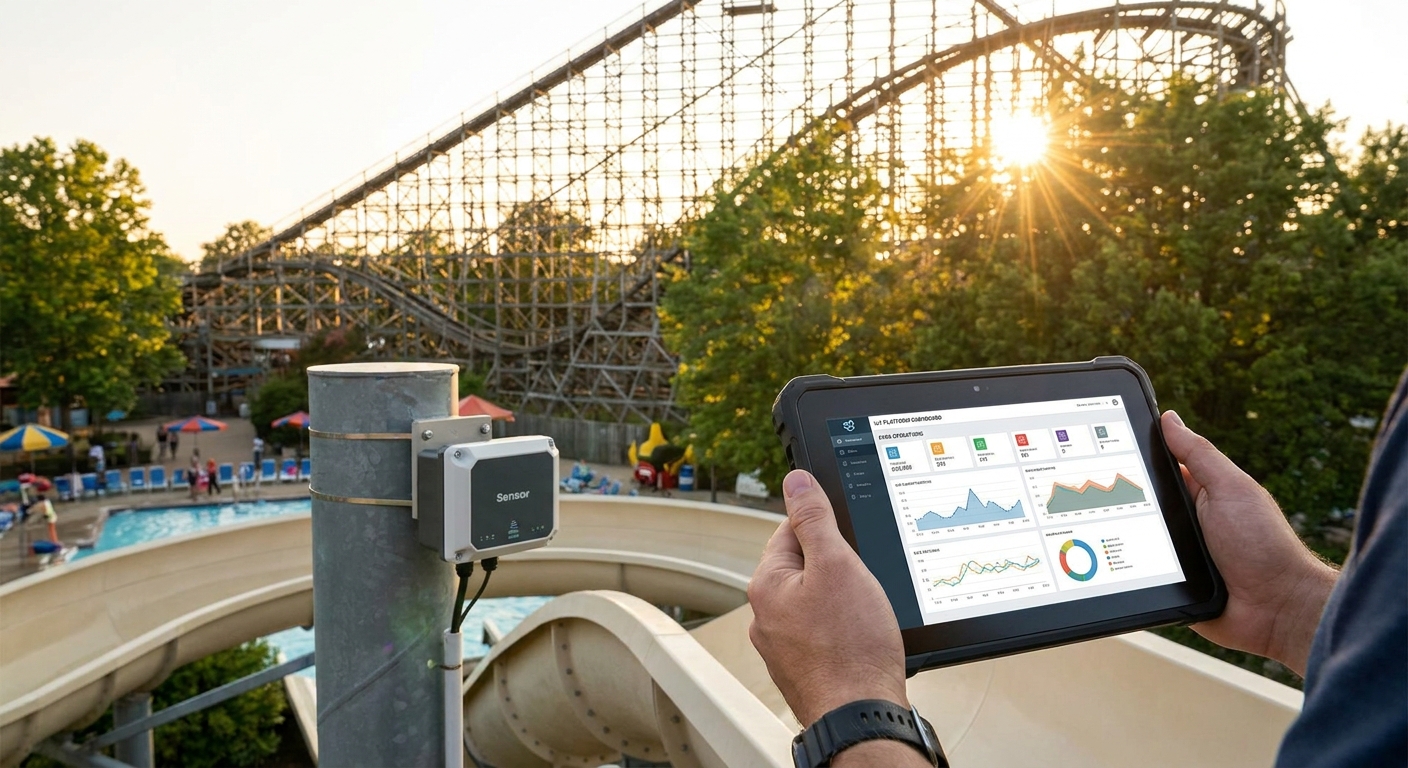
Amusement parks and water parks run rides, pumps, chillers, and food service lines across dozens of acres, usually with a skeleton crew watching all of it once the season starts — the right IoT platform turns scattered sensor readings into an alarm someone actually sees before a ride goes down or a pool fails a health inspection.
- The best IoT platform for amusement parks in 2026 pairs LoRaWAN and mioty for outdoor range instead of relying on cellular alone.
- CDC's Model Aquatic Health Code sets a 1 ppm minimum free chlorine residual for pools and 3 ppm for spas.
- Vibration monitoring on wave pool and filtration pumps catches bearing wear before a pump seizes mid-season.
- Cold storage alarms on concession walk-ins matter as much as ride telemetry for a park's bottom line.
- A rules engine with multi-step alarm escalation fits parks running 24/7 during operating season with rotating seasonal staff.
What does an IoT platform need to handle at an amusement or water park?
A theme park is really four facilities stacked on one property: a mechanical ride yard, a water treatment plant, a food service operation, and outdoor grounds spread across acres of asphalt and landscaping. A facility monitoring system for amusement parks and water parks has to pull vibration, temperature, water chemistry, and tank level data into one dashboard instead of forcing an operations manager to check five separate vendor apps between ride checks.
Most of that data already exists somewhere — a pool controller logs chlorine readings, a BMS tracks chiller run time, a walk-in cooler has a thermostat. The gap is almost never the sensor. It's getting that reading into a system that fires an alarm to the right phone at 2 a.m. instead of sitting in a log nobody opens until Monday.
How do you evaluate an IoT platform for amusement parks and water parks?
Four things separate a platform that works at a park from one that only works in a single building: wireless range across an open-air campus, the ability to ingest chemical and mechanical data through more than one protocol, an alarm system built for tiered severity, and a way to onboard or retire sensors between seasons without rebuilding the whole deployment. Everything below maps back to one of those four.
How does vibration monitoring reduce unplanned ride and pump downtime?
ASTM F770, the standard practice for ownership, operation, maintenance, and inspection of amusement rides and devices, expects operators to keep documented, ongoing inspection records for mechanical systems. A vibration sensor mounted on a lift motor or wave pool pump bearing gives you that documentation automatically instead of a clipboard round every shift.
Set a CEL threshold on RMS velocity, and a rules engine fires a tiered alarm the moment the reading crosses baseline — no waiting for a technician to notice a whine at 6 a.m. before gates open. OSHA's lockout/tagout standard, 29 CFR 1910.147, still governs how a technician isolates the machine for repair; the sensor just tells you which asset needs that procedure first, and when. Skip vibration coverage entirely and you find out about bearing wear when the wave pool pump seizes on a Saturday in July 2026 — the exact day it can least afford to be down.
“An alarm system that treats a low balance tank the same as a warm freezer trains staff to ignore everything.”
How do you monitor pool and water chemistry for CDC compliance?
CDC's Model Aquatic Health Code sets a 1 ppm minimum free chlorine residual for pools and 3 ppm for spas, and most state health departments inspect against those thresholds during the 2026 season. Water parks already run automated chemical controllers that dose chlorine and adjust pH — the gap is usually getting that reading into a dashboard someone checks overnight instead of the day shift.
A controller publishing over MQTT connects straight into a platform's MQTT connector, and a rule can escalate a low-chlorine reading through email, SMS, and a push alert to the on-call water treatment operator before it becomes a closure order. For indoor water parks, ASHRAE's natatorium design guidance recommends keeping room air temperature 2°F to 4°F above water temperature to control evaporation and condensation on structural steel — a mismatch there shows up as fogged glass and rusted trusses years before anyone notices the humidity log was off.
How do you track concession and food storage cold chain at a theme park?
FDA's Food Code sets 41°F (5°C) as the maximum temperature for cold holding of potentially hazardous food, and a park running a dozen concession stands plus a central kitchen has that many walk-in coolers to keep under that line through a Texas or Florida summer. A temperature sensor in each unit reporting every few minutes, with an alarm the moment a door is left open or a compressor fails, replaces the twice-a-day paper log that catches the problem only after the product has already turned.
Multi-step escalation matters here too. The first alert should hit the kitchen lead, and if nobody acknowledges it within a set window, it escalates to the operations manager on shift — not sit in an inbox until the next log check.
What connectivity works across a large outdoor park campus?
Amusement parks pack metal-frame rides, chain-link fencing, water features, and thousands of phones producing 2.4 GHz noise into a space that runs 20 to 200 acres. That's a rough RF environment for anything with short range. LoRaWAN gateways cover a kilometer or more line-of-sight and pass through open-air structures better than Wi-Fi or Bluetooth mesh, which is why most facility teams use it as the backbone when planning LoRaWAN coverage for a large campus instead of trenching Ethernet under a midway.
mioty adds telegram splitting, spreading each transmission across multiple frequencies and time slots — useful against the interference load of a packed rides area running dozens of other radios. The Kilo IoT Platform runs a built-in LoRaWAN and mioty network server, so a park doesn't need to stand up a separate network server just to get sensors talking to Kilo Cloud.
How should safety alarms escalate at an amusement park?
A wave pool balance tank running low and a walk-in freezer drifting warm are not the same emergency, and an alarm system that treats them identically trains staff to ignore everything. Kilo's alarm system supports five severity tiers and multi-step escalation chains, so a low-level balance tank reading can page the pool operator immediately while a slow freezer drift emails the kitchen lead first and escalates to a manager only after it goes unacknowledged.
Seasonal parks lose staff every off-season and rehire every spring. A rules engine built for industrial IoT alarms with version control and one-click rollback lets a facilities lead update thresholds once and redeploy across every ride and mechanical room, instead of retraining every new hire on a spreadsheet of setpoints each March.
What should an amusement park's IoT platform monitor by area?
| Area | Failure mode if unmonitored | Standard or reference | What to check in a platform |
|---|---|---|---|
| Ride and pump mechanicals | Bearing seizure, unplanned ride shutdown | ASTM F770 inspection requirements | Vibration sensor support, CEL threshold rules |
| Pool and spa water chemistry | Chlorine drop below health code minimum | CDC Model Aquatic Health Code | MQTT ingestion from chemical controllers |
| Concession cold storage | Food held above safe temperature | FDA Food Code, 41°F cold holding | Door-open and compressor-fail alarms |
| Indoor natatorium climate | Condensation, structural corrosion | ASHRAE natatorium design guidance | Zone-level humidity and temperature view |
| Outdoor sensor connectivity | Dead zones across a large campus | N/A | Built-in LoRaWAN and mioty network server |
How do you start deploying IoT monitoring at a park?
- Start with systems tied to safety and compliance first — pool chemistry and ride vibration — before adding nice-to-have dashboards for parking or foot traffic.
- Confirm the sensor catalog covers vibration, MQTT-based water quality ingestion, and tank level before committing; a partner catalog beats building custom firmware in-house.
- Test the full alarm escalation chain with the real on-call rotation before opening day, not after the first missed alert of the season.
See the platform behind the guide
Check device limits, dashboards, and rules on the free Kilo plan.
FAQ
What's the best IoT platform for amusement parks in 2026?
The best IoT platform for amusement parks in 2026 combines long-range wireless connectivity with a tiered alarm system, since parks need to cover mechanical rides, pool chemistry, and cold storage from one dashboard. Kilo runs a built-in LoRaWAN and mioty network server plus an MQTT connector, so it can ingest all three without stitching together separate vendor tools.
How much free chlorine does CDC require in a water park pool?
CDC's Model Aquatic Health Code sets a minimum free chlorine residual of 1 ppm for pools and 3 ppm for spas. Most state health departments inspect against these thresholds, and continuous monitoring catches a drop before an inspector does.
Can LoRaWAN cover an entire amusement park campus?
Yes — LoRaWAN gateways typically reach a kilometer or more line-of-sight, which covers most park footprints with a handful of gateways. Metal ride structures and dense crowds reduce range indoors or near steel, so gateway placement still needs planning around the layout.
Is mioty better than LoRaWAN for amusement parks?
Neither is strictly better; mioty's telegram splitting adds resilience in RF-noisy areas like a packed rides zone, while LoRaWAN has the larger device ecosystem. A platform running both protocols on one network server lets a park use whichever fits a given area.
What temperature should concession cold storage stay at?
FDA's Food Code requires cold holding at 41°F (5°C) or below for potentially hazardous food. A door-open or compressor-fail alarm tied to that threshold catches a failing walk-in before product loss.
How do amusement parks monitor ride vibration?
A vibration sensor mounted on a motor or bearing reports RMS velocity, and a threshold rule fires an alarm when the reading exceeds a set baseline. This supports the documented inspection records ASTM F770 expects operators to keep.
Do amusement parks need a digital twin?
A digital twin helps when a park has enough sensors spread across enough buildings and attractions that a flat list of device names stops being useful. A live 3D view with sensors bound to specific rides or pumps makes it faster to find which physical asset triggered an alarm.
How does alarm escalation work for park safety events?
Multi-step escalation sends the first alert to the person closest to the problem, then escalates through additional contacts if nobody acknowledges it within a set window. Five severity tiers let a low-level balance tank alert page immediately while a minor temperature drift only emails.
What's the one sensor most parks add only after a pump failure?
Wave pool and filtration systems rely on balance tanks that keep centrifugal pumps primed. Let one run dry and a pump can suffer bearing and seal damage in under a minute of dry running — a basic mechanical fact, not a platform feature, but one most parks only wire a level sensor for after it happens once. A tank level alarm on that single point is one of the cheapest additions a park makes going into the 2026 season, and usually the first one anyone asks for after the first failure.