
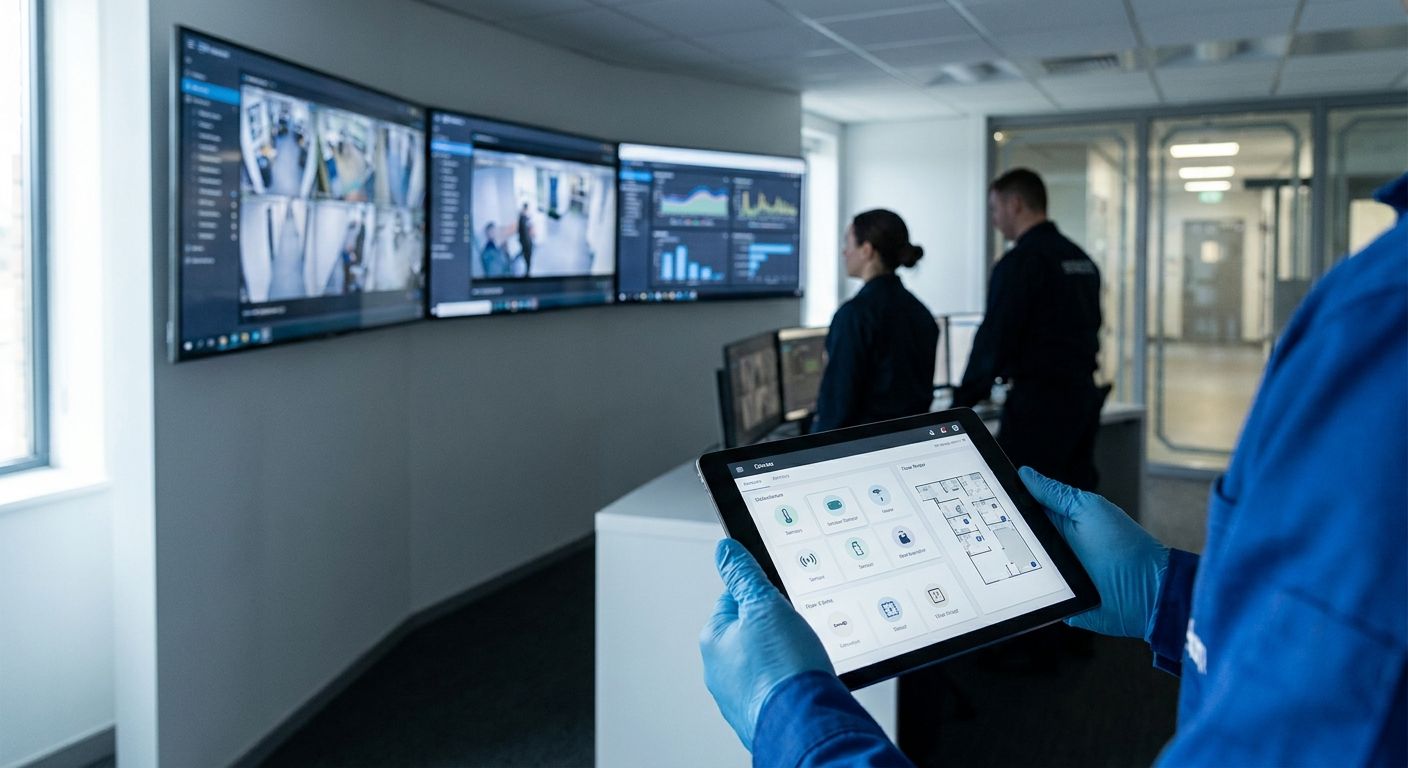
Correctional facilities run kitchens, medical units, HVAC plants and secure housing blocks inside buildings designed to keep signals out as much as people in, so an IoT platform for correctional facilities has to solve connectivity, alarm escalation and access control at the same time, not just report a temperature.
- The best IoT platform for correctional facilities pairs LoRaWAN or mioty with a rules engine that escalates, not just alerts.
- FDA Food Code sets 41°F (5°C) as the cold-holding limit correctional kitchens must maintain.
- A built-in LoRaWAN and mioty network server removes the need for a separate network server per site.
- On-premise deployment and role-based access control matter more here than in a typical warehouse.
- A digital building twin turns a cell block floor plan into a live map control room staff can actually read.
What to look for in an IoT platform for correctional facilities
A correctional facility isn't a distribution center with better locks. Housing units, intake, medical, food service and mechanical rooms all sit inside the same perimeter, each with its own compliance pressure and its own reason a sensor reading matters. NFPA 101, the Life Safety Code, carves out separate chapters for new and existing detention and correctional occupancies specifically because fire, smoke and egress rules work differently when doors don't open the way they do in an office. The facility monitoring system built for correctional facilities has to account for that from day one, not bolt it on later.
Five things separate a platform that fits a jail or prison from one that just happens to have sensors available.
Wireless connectivity that penetrates concrete and steel
Cell blocks are built from reinforced concrete and steel doors on purpose, and that construction is exactly what kills weak RF signals. LoRaWAN covers a facility campus from a single gateway in most layouts, but dense interior zones with multiple steel doors between a sensor and the gateway need a stronger link budget. mioty's telegram splitting technique breaks a message into sub-packets sent across different frequencies and times, which is what gives it the extra margin to get through construction that would otherwise force a facility into a mesh of repeaters.
Alarm escalation built for a control room, not an inbox
A temperature spike in a medical unit refrigerator or a door sensor that stops reporting needs to reach the right person in minutes, at any hour, regardless of who's on shift. Kilo Cloud's alarms run five severity tiers with multi-step escalation chains across email, SMS and push, plus a centralized inbox so a shift supervisor sees everything active at once instead of hunting through separate notification streams. The rules engine behind those alarms is built visually with CEL expressions and version control, so a facility can change an escalation path without waiting on a vendor ticket, and roll it back the same way if the change doesn't work.
Digital twin mapping of housing units and secure zones
A spreadsheet of sensor IDs doesn't help an officer who needs to know which pod has a temperature problem right now. A live 3D digital building twin with sensors bound to objects on the model turns that spreadsheet into a floor plan control room staff can read at a glance, pod by pod, door by door.
Role-based access control across custody, medical and maintenance staff
Custody staff, medical staff, maintenance contractors and facility administrators all need different slices of the same data, and none of them should see more than their role requires. Attribute-based access control (ABAC) with a multi-tenant structure lets a facility scope what a maintenance contractor can see against what a warden's office can see, on the same platform, without separate logins for separate systems.
On-premise or private cloud deployment for sensitive facility data
Most commercial buildings don't think twice about a cloud dashboard. A correctional facility's IT and security leadership usually does, and on-premise deployment is worth confirming before a platform gets shortlisted, not after a contract is signed.
How LoRaWAN and mioty connectivity work inside a correctional facility
Most IoT platforms make a facility stand up a separate LoRaWAN network server, then connect that server to the platform as a second piece of infrastructure to patch and maintain. Kilo Cloud runs a built-in LoRaWAN and mioty network server, so gateways connect straight to the platform with nothing extra to deploy or keep patched. That matters more in a secured facility, where every additional system is another thing IT has to justify and maintain access controls around.
For sites already running a Modbus PLC, an existing BMS, or an energy meter, the MQTT connector pulls that data in without ripping out equipment a facility already paid for and already trusts. Retrofitting a legacy housing unit built decades before wireless sensors existed follows a similar pattern to retrofitting any older building, and the same wireless-sensor approach used to bring older commercial buildings online applies here.
What does an IoT platform for correctional facilities cost
Kilo's free tier runs at 0 EUR for up to 5 devices and 1 dashboard with 1 rule, no card required, and it doesn't expire or convert into a trial. That's enough to pilot a single housing unit or a kitchen cold-storage line before committing budget. Starter runs 25 EUR per month for up to 25 devices, which covers a small wing or a single support building. Gateways are unlimited on every tier and never count against the device limit, which matters in a facility spreading sensors across multiple buildings behind the same perimeter.
Before a 2026 capital request goes in, it's worth running the math on what a deployment actually needs to justify against maintenance labor and compliance risk rather than against a vague efficiency promise.
LoRaWAN vs mioty vs MQTT for correctional facility sensor networks
| Protocol | Best use in a correctional facility | Range and penetration | Power profile |
|---|---|---|---|
| LoRaWAN | Cell block door and temperature sensors, wide campus coverage | Star topology, one gateway typically covers a facility site | Battery sensors, multi-year service life |
| mioty | Dense sensor counts behind reinforced concrete and steel doors | Telegram splitting extends link budget through heavy construction | Battery sensors, multi-year service life |
| MQTT | Connecting an existing BMS, PLC or energy meter already installed | Wired or Ethernet backbone, no RF penetration concern | Continuous power, no battery constraint |
“If a housing unit's door sensor can't reach a control room in minutes, the network underneath it doesn't matter.”
See the platform on your facility
Start on the free tier and map one housing unit before scaling.
Where to source sensors and gateways for a correctional facility deployment
Kilo doesn't manufacture hardware. Sensors and gateways for a deployment come through Kilo Electronics, the hardware side of the business, which ships pre-configured devices worldwide. A facility can also connect existing publishing devices over MQTT if it already owns compatible hardware, which is usually the cheaper starting point for a first pilot in 2026 before a full sensor order goes out.
FAQ
What's the best IoT platform for correctional facilities?
The strongest fit combines LoRaWAN or mioty connectivity that penetrates concrete and steel with an alarm escalation system built for a control room, not a single inbox. Kilo Cloud runs a built-in LoRaWAN and mioty network server plus five-tier alarm escalation, which covers both requirements without stitching together separate systems.
Does LoRaWAN work inside concrete cell blocks?
Yes, in most layouts a single gateway covers a facility campus, though dense interior zones with multiple steel doors between a sensor and gateway can strain the link budget. That's where mioty's telegram splitting becomes the better fit for the toughest interior spots.
Is mioty better than LoRaWAN for secure facilities?
Mioty isn't universally better, it's better suited to dense sensor deployments behind heavy reinforced construction because its telegram splitting extends the effective link budget. LoRaWAN remains the simpler, cheaper option for open campus coverage where signal path isn't the constraint.
How much does an IoT platform cost for a correctional facility?
Kilo's free tier costs 0 EUR for up to 5 devices with 1 dashboard and 1 rule and never expires, enough to pilot one wing. Starter runs 25 EUR per month for up to 25 devices, with gateways unlimited on every tier.
Can an IoT platform integrate with an existing BMS in a jail or prison?
Yes, an MQTT connector pulls data from any publishing device, PLC, energy meter or BMS a facility already has installed. That means existing building equipment doesn't have to be replaced to bring it onto a monitoring dashboard.
What temperature does correctional facility food storage need to meet?
The FDA Food Code sets 41°F (5°C) as the cold-holding limit for time/temperature-controlled food, which applies to correctional kitchen and cold storage the same way it applies to any commercial food service operation.
Does a correctional facility IoT platform need to be on-premise?
It depends on the facility's IT and security policy, but on-premise deployment should be confirmed as an option before a platform is shortlisted. Facilities with strict data residency rules often require it as a condition of approval.
How do alarm escalations work in a correctional facility control room?
Alarms run through severity tiers with multi-step escalation chains across email, SMS and push, landing in a centralized inbox so nothing gets missed on a shift change. Kilo Cloud runs five severity tiers with a visual rules engine controlling exactly when and to whom each alarm escalates.
Final considerations before choosing an IoT platform for correctional facilities
NFPA 101's detention and correctional occupancy chapters exist because standard building code egress assumptions don't hold when doors lock from the outside, and that single fact changes what "alarm" needs to mean on a platform used inside a facility. A rules engine with version control and rollback isn't a nice-to-have there, it's the difference between documenting a compliance change and guessing what the escalation path looked like six months ago. Facilities planning 2026 upgrades should treat that audit trail as a requirement, not an afterthought.