
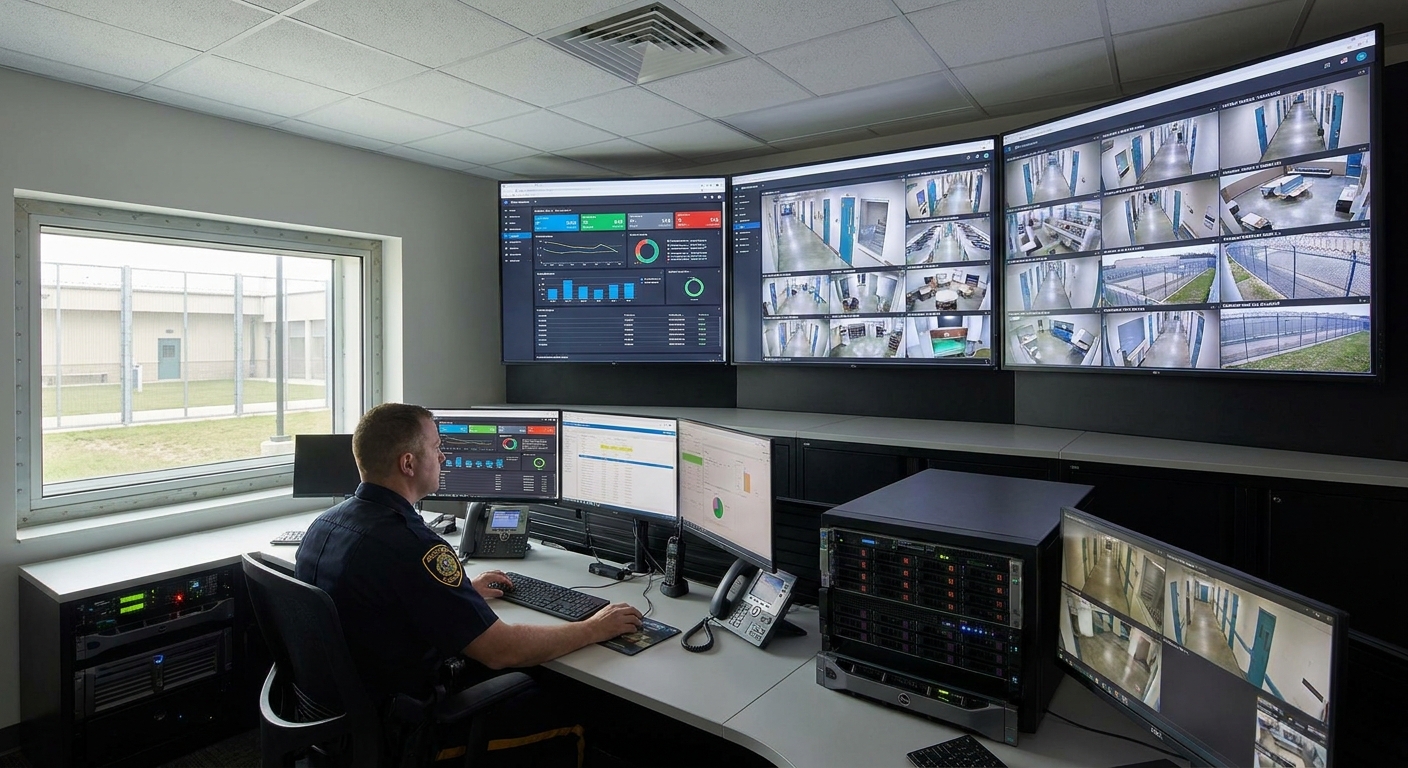
A facility monitoring system for correctional facilities has to work through 18 to 24 inches of poured concrete, catch a kitchen cooler drift before a state inspector does, and flag a generator that didn't start during an outage — not just log numbers nobody opens.
- Correctional buildings need LoRaWAN or mioty sensors, not WiFi, to punch through concrete cell blocks and rebar.
- Kitchen and medical cold storage need alarms tied to the FDA's 41F holding limit, checked continuously in 2026, not on a paper log.
- Generator and power monitoring catches a failed transfer switch before the next shift finds out.
- A tuned rules engine with escalation tiers beats a dashboard that pages staff for every 2-degree swing.
- Audit-ready exports, not screenshots, are what make a facility monitoring system for correctional facilities worth the line item.
Why this matters
Most correctional facilities weren't built for sensors. A county jail from 1978 or a state prison with 12-inch rebar-reinforced walls kills standard WiFi and cellular signal a few rooms in. That's the first problem, and it's why wireless retrofit sensor networks matter more here than in almost any other building type — you're not rewiring a facility that's operating 24/7 with inmates inside it.
The second problem is staff bandwidth. Facilities teams inside correctional institutions are stretched, turnover is high, and an alarm system that pages someone for every minor blip gets ignored within a month. When that happens, the alarm that actually matters — a cooler holding food above 41F for two hours, or backup power that never came on — gets missed along with the noise.
A state DOC audit or an ACA accreditation review in 2026 doesn't accept "we think it was fine." It wants a timestamped record. That's the gap a real facility monitoring system closes.
Who this is for
This is written for facilities directors at county jails, operations managers running multiple sites for a state Department of Corrections, and engineers tasked with retrofitting a decades-old prison without touching the building's electrical or structural systems. It's also relevant to private operators managing a portfolio of facilities where one dashboard needs to show every site's status at once, not five separate logins.
If you're evaluating a facility monitoring system for correctional facilities for the first time, the buying decision usually comes down to five things: signal penetration, compliance thresholds, power visibility, alarm discipline, and reporting format.
What to look for in a facility monitoring system for correctional facilities
Wireless range that survives concrete and rebar
Standard WiFi sensors drop off after one or two concrete walls. LoRaWAN gateways typically cover 2-3 km through dense structures and much farther line-of-sight, and mioty's telegram-splitting approach holds up in RF environments where LoRaWAN struggles with interference from metal doors and security systems. For a cell block built with poured concrete and rebar, this isn't a nice-to-have — it's the difference between a working deployment and a pile of unreachable sensors.
Cold-chain thresholds tied to food and medical compliance
Correctional kitchens feed hundreds to thousands of people daily, and medical units hold refrigerated medication. Both need alarms tied to real thresholds — the FDA's 41F cold-holding limit is the standard reference point — not a chart someone glances at once a shift.
Backup power and generator visibility
A correctional facility losing power isn't just an inconvenience; it's a security and safety event. Knowing whether a generator started, how much fuel it has, and how long it's been running matters more here than in a warehouse or office building.
Alarm rules that don't wear staff out
If every 2-degree fluctuation triggers a page, staff mute the app within weeks. A rules engine with escalation tiers — warn at one threshold, escalate to a supervisor at the next, page maintenance on-call after that — keeps alarms credible.
Multi-site reporting built for audits
A single facility can get by with a live dashboard. A DOC system with 20, 40, or 100 facilities needs exportable, timestamped history that survives an inspector asking "prove it" six months later.
Where to start the deployment
The foundation — wireless sensor backbone. Skip consumer WiFi and Bluetooth sensors; they die at the first concrete wall. A LoRaWAN or mioty backbone gets you sensor coverage across a facility without running new cable through occupied cell blocks. Buy.
The compliance layer — kitchen and medical cold storage. Walk-in coolers, freezers, and medication refrigerators need continuous temperature logging with alarms tied to the 41F threshold, not spot checks. Monitoring for commercial kitchen walk-in coolers and freezers covers the setup most facilities need first. Buy.
The outage insurance — generator and power monitoring. A generator that fails to start during a blackout is a liability event, not a maintenance ticket. Fuel monitoring for diesel generators tracks fuel level and runtime so a failed transfer isn't discovered after the fact. Buy.
The fatigue fix — alarm rules and escalation tiers. Set thresholds that separate a 2-degree drift from an actual failure, and route each severity to the right person instead of everyone. Consider if your current setup pages the same person for everything — that's the tell you need this.
The audit trail — multi-site compliance dashboard. One view across every facility in a system, with exportable history instead of a live-only screen. Buy if you manage more than one site; Consider for a single facility where a simpler log might do.
What to avoid
- Consumer WiFi or Bluetooth sensors marketed as "industrial." They work fine in a demo and drop signal the moment they're behind a second concrete wall.
- A building management system with no configurable alarm tiers. If every alert has the same urgency, staff will eventually ignore all of them, including the one that matters.
- A dashboard with no export function. Live data looks good in a sales call. An auditor wants a CSV or report with timestamps going back months, not a screen you have to photograph.
Verdict comparison
| Deployment area | Key spec | 2026 verdict |
|---|---|---|
| Wireless backbone | Reaches through 18-24 inch concrete without rewiring | Buy |
| Kitchen/medical cold storage | Alarms tied to 41F FDA threshold | Buy |
| Generator/power monitoring | Tracks fuel level and runtime in real time | Buy |
| Alarm rules engine | Escalation tiers cut false-alarm fatigue | Consider |
| Multi-site compliance dashboard | Exportable, timestamped audit history | Buy |
See Kilo IoT on your facility layout
Check how the platform handles retrofit sensors, alarms, and compliance exports.
FAQ
What is a facility monitoring system for correctional facilities?
It's a sensor and software setup that tracks conditions like cold storage temperature, generator status, and humidity across a jail or prison, with alarms and audit-ready reports. Kilo IoT builds this on LoRaWAN and mioty connectivity so sensors work through concrete cell blocks.
Does WiFi work for sensor monitoring inside a prison?
WiFi struggles past one or two concrete walls in most correctional buildings. LoRaWAN and mioty are built for this kind of penetration and are the standard choice for retrofitting older correctional facilities in 2026.
What temperature should a correctional facility kitchen cooler hold?
The FDA's cold-holding reference is 41F or below for food safety. A monitoring system should alarm if a cooler holds above that threshold for more than a few minutes, not just log the reading.
How does generator monitoring help a correctional facility?
It confirms a backup generator started during an outage and tracks fuel level and runtime, so a failed transfer switch is caught immediately instead of discovered during the next shift change.
Is mioty better than LoRaWAN for correctional buildings?
Mioty's telegram-splitting method holds up well in RF-dense environments with metal doors and security equipment, which can interfere with LoRaWAN signal. Both are viable; the right choice depends on the specific building's construction and existing RF noise.
How much does a facility monitoring system cost for a correctional facility?
Cost depends on the number of sensors, sites, and connectivity type needed. Check current platform and hardware pricing directly rather than relying on a flat industry number, since deployments range from a single building to a statewide DOC system.
Can one dashboard cover multiple correctional facilities in a state system?
Yes — a multi-site facility monitoring dashboard shows status across every location from one login and exports audit-ready history per site, which is standard for DOC-level oversight in 2026.
What causes alarm fatigue in correctional facility monitoring?
Alarm fatigue happens when every minor fluctuation triggers the same urgent page as a real failure. A rules engine with escalation tiers — warning, then supervisor alert, then on-call page — keeps alerts credible so staff don't start ignoring them.
One last thing
The deployments that fail in correctional facilities almost never fail because of the sensors. They fail because someone mapped gateway placement on a blueprint instead of walking the actual cell block, and the rebar in a stairwell wall killed signal nobody tested for. Walk the site before you finalize the gateway count — it's the cheapest step in the whole project and the one most often skipped.