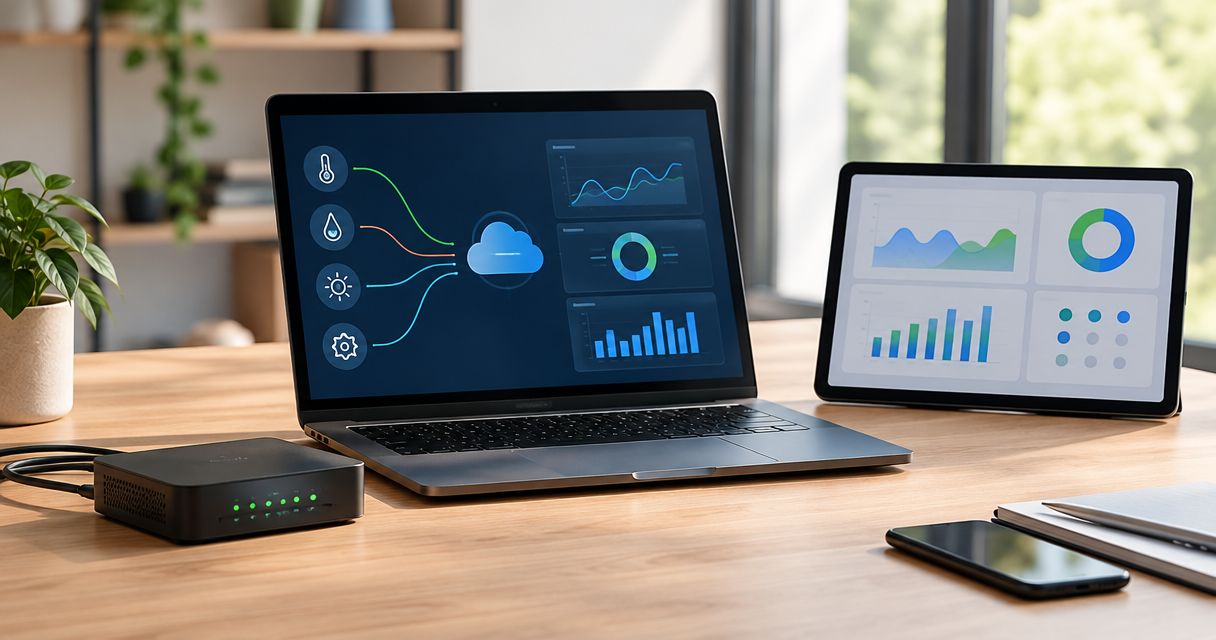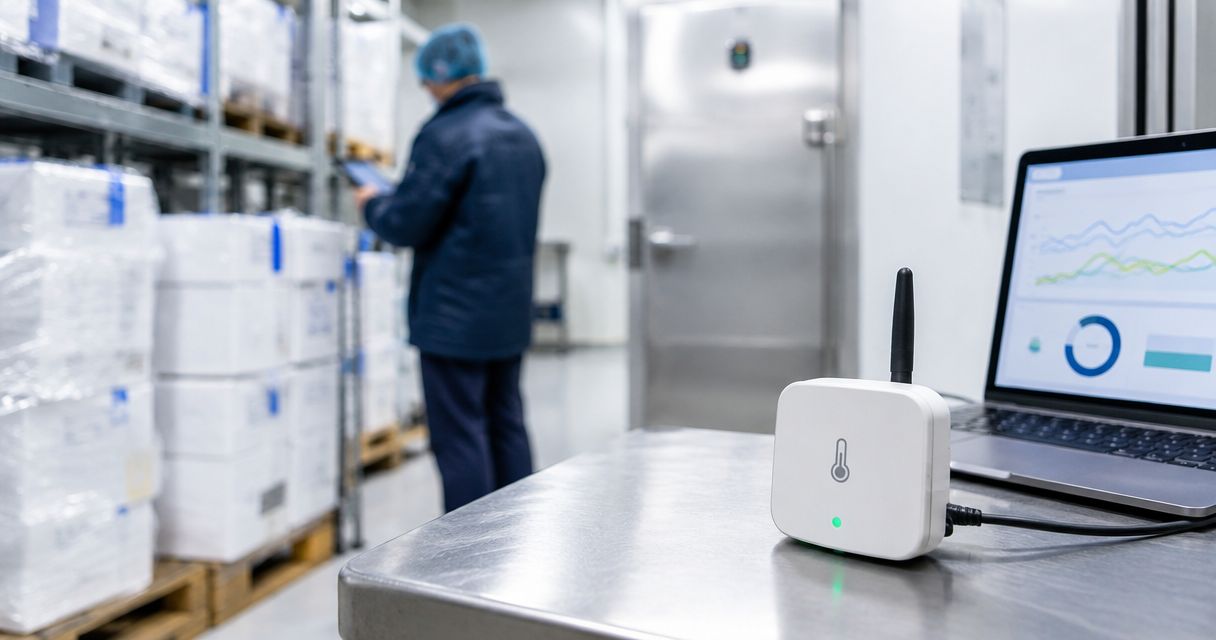
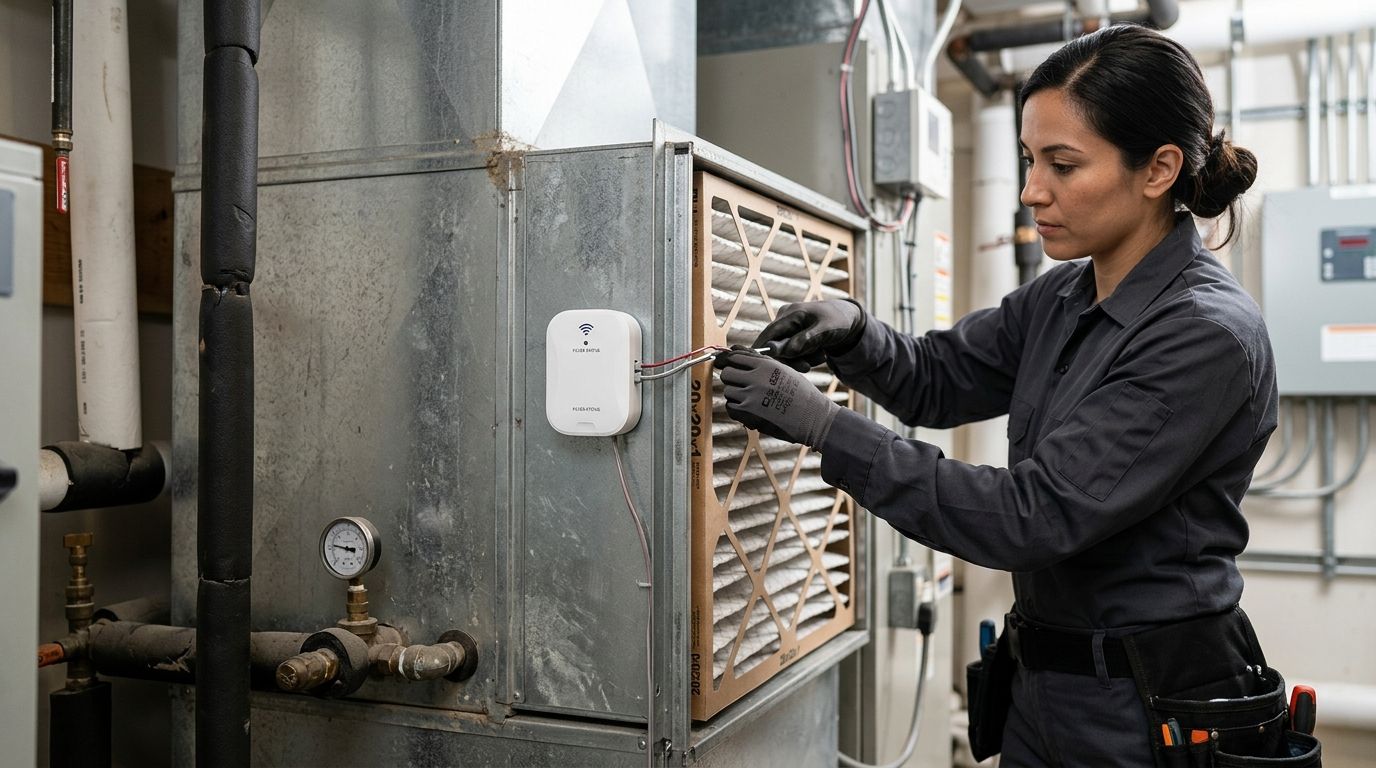
A clogged HVAC filter doesn't announce itself until static pressure climbs, airflow drops, and someone on the third floor complains it's too warm. IoT sensor HVAC filter replacement monitoring closes that gap by measuring the filter's actual condition — pressure drop, motor load, or downstream air quality — and firing an alarm before the unit starts working harder than it should.
Best overall: differential pressure (dP) sensors mounted across the filter bank, reporting over MQTT or LoRaWAN. Best for retrofits without duct penetration: current transformer (CT) sensors clamped on the blower motor. Best for air handling units where airflow verification matters: thermal or vane airflow sensors. Best for air-quality-sensitive spaces: downstream PM2.5 particulate sensors. Best budget option: runtime-hour pulse counters tied to a replacement schedule.
- Differential pressure sensors are the most direct iot sensor hvac filter replacement option — they measure the actual pressure drop across the filter media.
- Current sensors on the blower motor work as a retrofit-friendly proxy but don't measure filter condition directly.
- The US Department of Energy states a clean filter can cut air conditioner energy use by 5-15% versus a clogged one.
- Kilo ingests any of these sensor types over MQTT or LoRaWAN and fires a CEL rule alarm before pressure crosses a set threshold.
How much does a dirty HVAC filter really cost in energy and airflow?
The US Department of Energy's Energy Saver program states that replacing a dirty air filter can lower an air conditioner's energy consumption by 5% to 15%. That's not a rounding error on a building with a dozen rooftop units running through a Chicago summer or a Phoenix August in 2026.
The mechanism is simple: as a filter loads up with dust, static pressure across it rises, the blower has to work harder to push the same volume of air, and the compressor runs longer to hit setpoint. Left unmonitored, this creeps for weeks before anyone notices comfort complaints or a spike on the utility bill. A facilities team tracking this manually through a HVAC energy management platform usually finds the filter problem only after the energy trend has already been climbing for a month.
ASHRAE 52.2 is the standard most commercial filters are rated against — MERV 8 through MERV 13 covers the bulk of office and light-industrial HVAC systems, with higher MERV ratings trapping finer particulate at the cost of a steeper pressure drop curve as they load. That tradeoff is exactly why pressure-based monitoring matters more as MERV rating goes up.
What makes a good IoT sensor for HVAC filter replacement monitoring?
- Measurement range matched to the media — a 0-1 or 0-5 inch water column range, not a general-purpose 0-100 psi transducer built for something else
- Wireless uplink that fits the existing network — LoRaWAN, mioty, or MQTT, so a new sensor doesn't need its own dedicated wiring run
- Battery or power source suited to a mechanical room — heat, vibration, and dust all shorten sensor life if the enclosure and battery chemistry aren't rated for it
- A threshold tied to the actual filter spec — MERV 13 filters load differently than MERV 8, so the alarm point should reflect the media installed, not a generic default
- History and export for audits — a pressure trend log matters when a warranty claim or an energy audit asks for evidence, not just a current reading
- API or dashboard compatibility — the sensor data should land somewhere a technician actually looks, not a standalone app nobody opens
IoT sensors for HVAC filter replacement monitoring at a glance
| Sensor type | Best for | Standout feature | Key limitation |
|---|---|---|---|
| Differential pressure (dP) sensor | Overall filter replacement monitoring | Direct measurement of pressure drop across the filter | Needs two tap points and periodic calibration |
| Current/power (CT clamp) sensor | Retrofits without duct penetration | Clamps onto existing motor wiring, no ductwork cutting | Indirect proxy — reads motor load, not filter condition |
| Airflow (thermal/vane) sensor | Air handling units where CFM verification matters | Measures actual volumetric airflow, not just pressure | Higher cost and more complex commissioning |
| Downstream PM2.5 sensor | Air-quality-sensitive spaces (offices, cleanrooms) | Confirms filtration efficiency, not just clog status | Doesn't flag early clogging before particulate passes through |
| Runtime-hour pulse counter | Budget, simple scheduled replacement programs | Lowest cost, ties directly to a maintenance calendar | No feedback on actual filter load — pure schedule |
1. Differential pressure sensors: best iot sensor for HVAC filter replacement overall
A dP sensor sits across the filter bank with two tap points — one upstream, one downstream — and reports the pressure difference as the filter loads with dust. That reading maps directly to ASHRAE 52.2 filter ratings: most manufacturers publish a maximum recommended pressure drop before replacement, typically in the 0.5 to 1.0 inch water column range depending on MERV rating.
Over MQTT or LoRaWAN, that reading lands on a Kilo dashboard gauge widget, and a CEL rule in the visual rules engine fires an alarm the moment pressure crosses the threshold set for that specific filter — say 0.8 inches for a MERV 13. The alarm can escalate through Kilo's multi-step chain to a facilities tech's phone before the unit starts short-cycling. Setting up that threshold is covered in how to configure SMS and email alerts for critical sensor thresholds.
Differential pressure sensor pros:
- Measures the actual failure mode directly, not a proxy
- Threshold maps cleanly to manufacturer spec sheets
- Works the same whether the filter is MERV 8 or MERV 13
Differential pressure sensor cons:
- Requires physical tap points into the duct or filter housing
- Needs recalibration on a schedule, typically annually
Best for: any building where filter replacement is currently done on a fixed calendar instead of actual condition. Verdict: buy if you can get access to install tap points.
2. Current/power sensors: best iot sensor for HVAC filter monitoring retrofits
A CT clamp sensor reads amperage draw on the supply fan motor. As static pressure rises from a loading filter, motor current shifts — though the direction depends on whether the fan is constant-volume or variable-frequency-drive controlled, so the baseline has to be established per unit before the trend means anything.
This is the sensor of choice when cutting into ductwork isn't an option — leased space, a listed historic building, or a unit nobody wants downtime for. Kilo's MQTT connector accepts current sensor data from almost any publishing device or energy meter without a proprietary gateway, which matters for teams retrofitting older mechanical rooms. More on that approach in best IoT current sensors for equipment power monitoring.
Current sensor pros:
- No duct penetration required
- Clamps on in under an hour per unit
- Doubles as a general motor-health signal beyond filters
Current sensor cons:
- Indirect — reads motor load, not filter condition
- Needs a calibrated baseline per unit before alerts mean anything
- Voltage fluctuations can muddy the trend
Best for: buildings where you can't touch the ductwork. Verdict: buy as a fallback when dP sensors aren't installable; hold if you need a precise replacement trigger.
3. Airflow sensors: best iot sensor for HVAC filter monitoring on air handling units
Thermal mass or vane anemometer sensors measure actual volumetric airflow (CFM) through a duct rather than inferring it from pressure or current. On larger air handling units serving critical spaces — labs, data halls, operating rooms — verifying that delivered airflow hasn't dropped below design spec matters more than knowing pressure alone.
A falling CFM reading paired with a rising dP reading is the clearest possible signal of filter loading, and running both sensors on the same unit gives a cross-check that neither one provides alone.
Airflow sensor pros:
- Measures the outcome that actually matters — delivered air volume
- Cross-checks a pressure-only reading for higher-stakes spaces
- Useful beyond filter monitoring, for balancing and commissioning
Airflow sensor cons:
- Higher hardware and installation cost than a simple dP transducer
- More complex commissioning to get an accurate baseline
Best for: critical air handling units where airflow verification is a compliance requirement, not a nice-to-have. Verdict: buy for critical spaces; skip for a standard office rooftop unit where a dP sensor covers the need.
4. Downstream particulate sensors: best iot sensor for HVAC filter monitoring in air-quality-sensitive spaces
A PM2.5 sensor placed downstream of the filter reads what's actually getting through, which is a different question than how loaded the filter is. In an office, cleanroom, or lab, rising downstream particulate counts confirm the filter media itself is failing or bypassing, not just approaching its pressure limit.
This pairs naturally with broader indoor air quality monitoring — many teams running IoT indoor air quality monitoring for corporate offices already have PM2.5 sensors deployed and can reuse that same data stream as a filter-integrity check.
Particulate sensor pros:
- Confirms actual filtration performance, not an assumption
- Doubles as an occupant-facing air quality metric
- Catches media failure that a pressure reading alone would miss
Particulate sensor cons:
- Doesn't catch early-stage clogging — particulate only rises once the filter is already compromised
- Higher unit cost than a basic pressure transducer
Best for: offices, cleanrooms, and healthcare spaces where occupant air quality is the actual concern. Verdict: buy for air-quality-sensitive buildings; hold for a mechanical room nobody occupies.
5. Runtime-hour sensors: best budget iot sensor for HVAC filter replacement scheduling
A pulse counter on the fan contactor tracks blower runtime hours, and a rule fires a reminder once accumulated hours cross a preset number — say 2,000 hours for a standard pleated filter. It's the cheapest option on this list and requires no calibration against filter specs at all.
The tradeoff is obvious: two units running identical hours in different environments — one in a dusty warehouse, one in a clean office — load their filters at completely different rates. Runtime hours schedule the swap; they don't measure whether the swap is actually needed yet.
Runtime sensor pros:
- Lowest cost and simplest install of any option here
- No baseline calibration needed
- Easy to roll out across dozens of units fast
Runtime sensor cons:
- Ignores actual dust load and environment
- Leads to both wasted early swaps and missed late ones
Best for: portfolios standardizing a simple preventive schedule across many units with no budget for per-unit sensors. Verdict: buy for a first pass across a large portfolio; skip once budget allows for dP sensors on the units that matter most.
“Once pressure drop climbs past the manufacturer's threshold on a MERV 13 filter, the compressor is already paying for it — the alarm should fire before the energy bill does.”
How were these HVAC filter sensors ranked?
Each sensor type was weighed against the criteria above: measurement directness, wireless compatibility, install effort, and whether the reading maps to a real replacement decision rather than a guess. Differential pressure sensors rank first because they measure the actual failure mode; current and runtime sensors rank lower because they're proxies, useful mainly where a direct measurement isn't feasible.
Sensors don't have to be sourced from a single vendor — Kilo's protocol-agnostic MQTT and LoRaWAN ingestion accepts pressure transducers, CT clamps, airflow meters, and particulate sensors from different manufacturers on one dashboard. Pre-configured sensors for any of these use cases, including differential pressure transducers built for HVAC filter applications, are available with worldwide shipping through Kilo Electronics, Kilo's hardware sister company.
Which iot sensor should you use for HVAC filter replacement monitoring?
Start with a differential pressure sensor on any unit where you can access the filter housing — it's the only option on this list that measures the condition you actually care about. Add current sensors where ductwork access isn't possible, and layer particulate sensors into spaces where occupant air quality already matters in 2026 building operations.
Runtime-hour counters are a reasonable stopgap for a large portfolio rolling out monitoring in phases, but they should be treated as a bridge to pressure-based monitoring, not the end state.
Set up filter alarms on your HVAC units
Connect pressure, current, or particulate sensors and get alerted before a clog costs energy.
FAQ
What's the best iot sensor for HVAC filter replacement monitoring?
A differential pressure (dP) sensor across the filter bank is the best overall choice for 2026 deployments because it measures the actual pressure drop the filter is causing, rather than inferring it from motor current or a fixed schedule.
Is a current sensor better than a pressure sensor for filter monitoring?
No — a current sensor is a proxy for motor load, not a direct filter reading. It's the better choice only when duct access for a pressure sensor isn't possible.
How much does a dirty filter increase HVAC energy use?
The US Department of Energy's Energy Saver program states replacing a dirty filter can cut an air conditioner's energy consumption by 5% to 15%, depending on how clogged the filter had become.
What pressure drop means a commercial filter needs replacing?
Most manufacturers recommend replacement once static pressure drop reaches roughly 0.5 to 1.0 inch of water column, with higher-MERV filters typically rated toward the higher end of that range.
Can IoT filter sensors integrate with an existing building dashboard?
Yes — sensors reporting over MQTT or LoRaWAN can feed into a platform like Kilo alongside other building data, with dashboard widgets and a rules engine handling the alarm logic.
Do IoT filter sensors need cellular connectivity?
No. Most commercial deployments use LoRaWAN or mioty for the sensor uplink and a wired or Wi-Fi gateway for backhaul, which avoids per-sensor cellular costs entirely.
How often should commercial HVAC filters actually be replaced?
It depends on filter loading, not a universal calendar — a pressure-based sensor reading tells you when a specific unit's filter has reached its manufacturer-rated replacement point, which varies by MERV rating and building dust load.
Can an alarm fire automatically when a filter clogs?
Kilo's rules engine can evaluate a pressure reading against a set threshold and trigger a multi-step alarm escalation to the right technician, but the action is a notification and escalation, not an automatic shutoff.
What's the one filter-monitoring mistake facility teams keep making?
Treating every unit on the same replacement calendar regardless of its actual environment. A rooftop unit over a loading dock loads its filter far faster than one serving a clean office suite, and a fixed 90-day schedule either wastes filters on the office unit or leaves the loading-dock unit running clogged for weeks. A pressure threshold tied to the actual filter spec, not the calendar, catches both cases correctly in 2026 and beyond.