Picking an iot soil sensor for golf course turf comes down to matching sensor type to depth, coverage, and radio range, not grabbing the first probe a distributor pitches. This guide ranks six sensor approaches that actually hold up across an 18-hole layout in 2026, and tells you exactly which holes, greens, or budget stage each one fits.
- Capacitive multi-depth probes win for green-by-green irrigation scheduling in 2026.
- LoRaWAN soil sensors cover a full 18-hole course off one or two gateways without cellular plans.
- mioty soil sensors hold a link under cart paths and tree canopy where LoRaWAN drops packets.
- Pairing a weather station with soil sensors turns raw moisture readings into an evapotranspiration-based watering plan.
- Kilo ingests LoRaWAN, mioty and MQTT sensor payloads into one dashboard and rules engine instead of three separate apps.
Why golf courses are switching to iot soil sensors for turf management
USGA putting green specifications call for a fast-draining, sand-based rootzone mix, and that same mix dries unevenly across a green depending on slope, shade, and traffic. A single hand-probe reading in the morning tells a superintendent one number for one spot; it says nothing about the shaded edge of 14 green or the sun-baked approach on 3. Courses irrigating with reclaimed or effluent water have a second problem on top of that: salt buildup in the rootzone stresses turfgrass in ways a moisture reading alone won't catch, which is why electrical conductivity (EC) sensing matters as much as volumetric water content.
An iot soil sensor for golf course turf fixes both problems by putting continuous, multi-point readings in front of the irrigation tech instead of one walk-the-course number per day. The comparison below ranks the six sensor approaches worth deploying in 2026, in the order a course should actually consider them.
What makes the best iot soil sensor for golf course turf management
- Depth resolution — root-zone readings at multiple depths, not just the surface inch, since greens and fairways root differently
- EC or salinity sensing — required on any course irrigating with reclaimed or effluent water
- Comms range — coverage across dispersed holes without needing a gateway on every green
- Battery life — a full season without a mid-summer unit changeout during peak irrigation demand
- Ingress protection — survives mower decks, aerification, and irrigation head spray
- Data path — feeds a dashboard and rules engine the grounds crew actually opens, not a standalone app nobody checks
Best iot soil sensors for golf course turf management at a glance
| Sensor type | Best for | Standout feature | Key limitation |
|---|---|---|---|
| Capacitive multi-depth probe | Green-by-green irrigation scheduling | Multiple depths from one install | Fixed point, one location per probe |
| LoRaWAN soil sensor | Whole-course network coverage | Low duty cycle radio, long battery life | Trees and terrain can create dead zones |
| mioty soil sensor | Cart paths and dense tree cover | Telegram splitting holds a link through obstructions | Fewer manufacturers build mioty soil probes |
| Weather station + soil sensor | Evapotranspiration-based watering | Adds wind, solar radiation, humidity to the moisture reading | Useless without a soil sensor feed on the same dashboard |
| Battery-powered wireless sensor | Remote holes with no grid power | No trenching or conduit run needed | Recurring battery swap schedule |
| Starter kit bundle | Piloting one green before full rollout | Low commitment, proves coverage first | Doesn't answer coverage for other terrain types |
1. Capacitive multi-depth soil probes: best for green-by-green irrigation scheduling
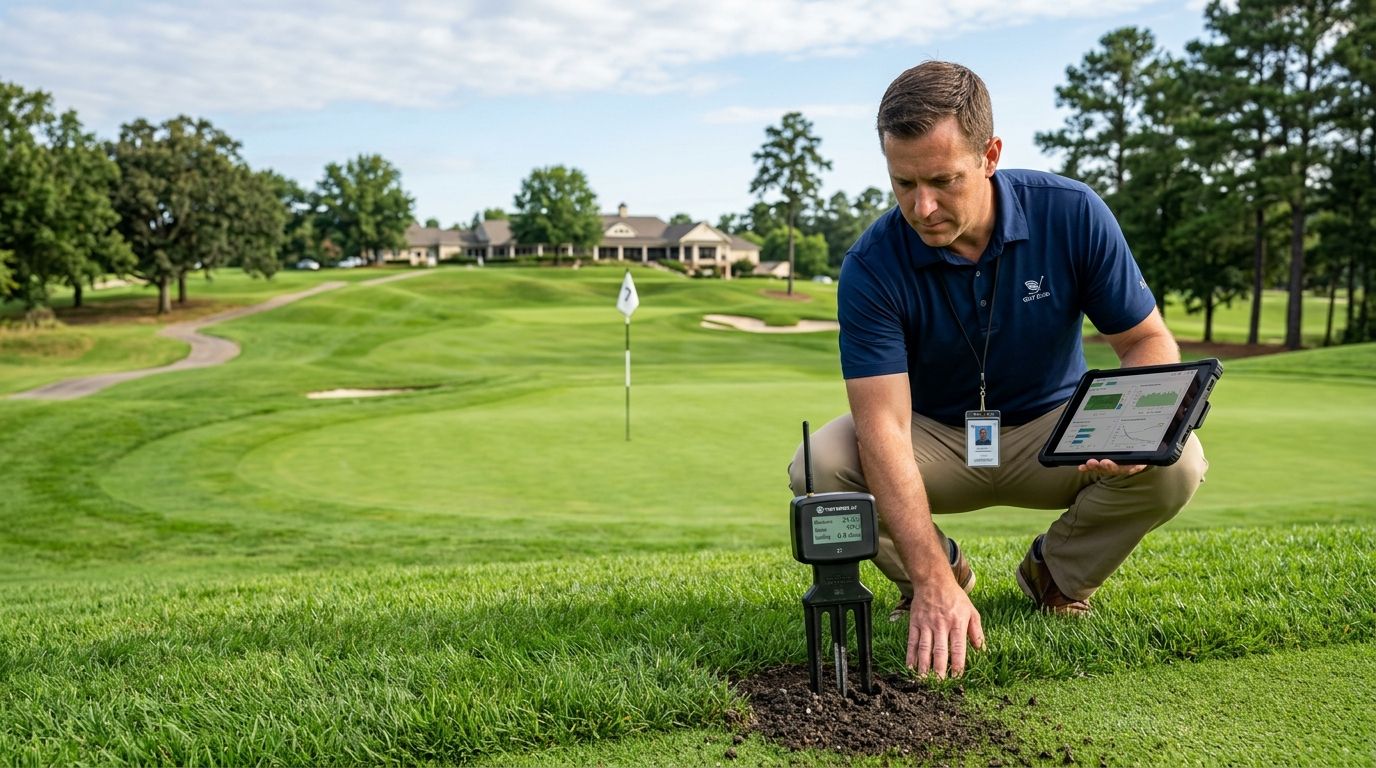
A capacitive (FDR) probe reads volumetric water content at two or three depths in a single shaft, usually bundled with temperature and sometimes an EC element. That gives a superintendent root-zone moisture at the depths turfgrass actually roots into, without a hand-probe walk every morning.
Capacitive probe pros:
- Multi-depth data from one install point
- Can add EC sensing for courses on reclaimed irrigation water
- Readings feed straight into a same-day irrigation cycle decision
Capacitive probe cons:
- Represents one location per install, not the whole green
- Elements need periodic calibration checks over a season
- Pulling the probe for aerification means reinstalling and reconfirming placement
Verdict: Buy for representative moisture data on your highest-value greens.
2. LoRaWAN soil moisture sensors: best for whole-course network deployments
LoRaWAN nodes transmit over the sub-GHz band — 868 MHz in the EU, 915 MHz in the US — to one or two gateways instead of needing a cellular connection per sensor. That's the difference between wiring 40 sensors individually and covering fairways, rough, and the driving range off a single network.
LoRaWAN sensor pros:
- One or two gateways can realistically cover an 18-hole layout depending on terrain
- Low duty cycle radio means battery life measured in years, not months
- No per-sensor cellular data plan to manage
LoRaWAN sensor cons:
- Dense trees, clubhouses, or hilly terrain create dead zones that need a second gateway
- Still needs a platform on the back end to turn raw payloads into an irrigation decision
Verdict: Buy as the default for course-wide soil sensor rollouts.
3. mioty soil sensors: best for sensors under cart paths and dense tree cover
mioty (ETSI TS 103 357) uses telegram splitting — one transmission spread across many short bursts on different frequencies — which gives it an edge holding a link through obstructions that would knock out a single continuous LoRaWAN packet. That matters on holes with thick tree lines or sensors buried near cart path infrastructure.
mioty sensor pros:
- Better link margin through canopy and buried placements than a single-packet radio
- KiloCenter, an open-source self-hosted mioty service center, exists for courses that want to run their own network
mioty sensor cons:
- Fewer manufacturers build mioty soil probes compared to LoRaWAN
- Overkill on open, tree-light holes where LoRaWAN already holds a clean signal
Verdict: Buy only for the specific holes where LoRaWAN testing shows dropped packets; skip it as a course-wide default.
4. IoT weather stations paired with soil sensors: best for evapotranspiration-based irrigation modeling
A weather station adds wind speed, solar radiation, humidity, and rainfall on top of soil moisture — the inputs an evapotranspiration (ET) model needs to estimate how much water turf actually loses on a given day, rather than watering on a fixed schedule regardless of weather.
Weather station pros:
- Turns a bare moisture number into an actual watering recommendation
- Catches localized rain events a regional forecast misses
Weather station cons:
- One more device to site, power, and maintain
- ET math is guesswork without a soil sensor feed on the same dashboard
Verdict: Buy alongside soil sensors, not as a replacement for them.
5. Battery-powered wireless soil sensors: best for remote holes with no grid power
Same core moisture, temperature, and EC sensing, built around a sealed battery pack instead of a wired power drop — aimed at back-nine holes, driving ranges, or practice greens far from an electrical panel.
Battery-powered sensor pros:
- No trenching or conduit run required to get a sensor into the ground
- Works on temporary greens and renovation zones
Battery-powered sensor cons:
- Battery swaps become a recurring grounds crew task on a fixed schedule
- Cold early-spring mornings can shorten battery life faster than a wired unit sees
Verdict: Buy anywhere a power drop isn't practical; hold where power is already nearby.
6. Starter kit soil sensor bundles: best for piloting one green before a full rollout
A small bundle — one gateway plus a handful of sensors — sized to test a single green or fairway zone before committing budget to whole-course coverage for the 2026 season.
Starter kit pros:
- Proves out gateway placement and network coverage on real turf before ordering for all 18 holes
- Low commitment if the pilot shows a different sensor type is needed
Starter kit cons:
- Doesn't answer coverage questions for holes with different terrain than the pilot site
- Skipping the pilot and ordering full coverage risks discovering dead zones after install
Verdict: Buy first if this is a course's first iot soil sensor deployment.
How this ranking was built
Each sensor type above was scored against the six criteria from the earlier section — depth resolution, EC sensing, comms range, battery life, ingress protection, and data path — rather than against a single "best overall" pick, because a golf course's greens, fairways, and remote holes genuinely need different sensor approaches.
Which iot soil sensor should a golf course pick for turf management
For most 18-hole layouts heading into the 2026 season, start with capacitive multi-depth probes on greens and LoRaWAN nodes across fairways and rough, add mioty only where a coverage test shows dropped packets, and layer in a weather station once soil data is already flowing so the ET math has something to work from.
“A moisture reading with no location context is a number nobody trusts; a moisture reading pinned to the actual spot on 7 fairway is a decision.”
Route all of it — soil moisture, weather, and golf course equipment and grounds crew tracking — into one dashboard instead of three separate logins. Kilo ingests LoRaWAN, mioty, and MQTT payloads into the same Kilo Cloud dashboard, and a digital twin lets a superintendent pin each sensor to its real location on the course map, so a drop on 7 fairway shows up where 7 fairway actually is. A CEL rule can fire an alarm when a 4-inch rootzone reading on 18 green crosses a set threshold, escalate it to the irrigation tech's phone with a five-tier severity chain, and log the response instead of relying on a paper walk. Kilo's built-in AI assistant can onboard a new soil sensor and draft that alarm rule in a plain-language conversation, scoped to the signed-in user's permissions, confirming before anything actually fires. For courses running mioty in dense tree cover, the mioty sensors for underground and shielded environments approach applies directly to buried cart-path placements. Sensor hardware across any of the categories above ships through Kilo Electronics, the hardware side that supplies LoRaWAN and mioty devices worldwide, so sourcing hardware and running the software doesn't require two separate vendors.
See soil sensor data in one dashboard
Connect LoRaWAN or mioty soil sensors and build your first alarm rule.
FAQ
What is the best iot soil sensor for golf course turf in 2026?
Capacitive multi-depth probes are the best choice for greens, since they read root-zone moisture at several depths from one install point. LoRaWAN sensors are the better choice for whole-course coverage across fairways and rough.
Do golf courses need LoRaWAN or mioty for soil sensors?
LoRaWAN works for most open holes and covers a full 18-hole layout off one or two gateways. mioty is worth adding only where trees, cart-path burial, or terrain cause LoRaWAN packets to drop.
How deep should a soil moisture sensor go on a putting green?
USGA putting green specifications call for a sand-based, fast-draining rootzone, so sensors are typically placed at multiple depths within the top few inches where turfgrass roots. A single-depth reading misses how unevenly a sand-based green dries.
Can iot soil sensors monitor salinity from reclaimed irrigation water?
Yes, capacitive probes with an added EC element measure electrical conductivity alongside moisture, which flags salt buildup from reclaimed or effluent irrigation water before it stresses turf.
How long do battery-powered soil sensors last on a golf course?
LoRaWAN and mioty soil sensors run on a low duty cycle radio, which typically gives battery life measured in years rather than months. Cold early-spring conditions can shorten that window faster than a mild climate would.
Is a weather station necessary alongside soil sensors?
A weather station isn't required, but it turns a bare moisture reading into an evapotranspiration-based watering recommendation. Without a soil sensor feed on the same dashboard, weather data alone can't tell you how much to actually irrigate.
How much data does an 18-hole course generate from soil sensors?
Volume depends on sensor count and reporting interval, which varies by deployment, but the practical answer is that raw sensor payloads only matter once they're routed into a dashboard and rules engine a grounds crew checks daily.
Can one platform manage soil sensors and grounds crew equipment tracking together?
Yes. A protocol-agnostic IoT platform can ingest soil sensor data over LoRaWAN or mioty and equipment location data over the same or a separate connector, putting both on one dashboard instead of two separate systems.
What most grounds crews get wrong about soil sensor placement
The most common mistake is installing one "representative" sensor per green and assuming it speaks for the whole surface. Greens dry unevenly — shaded north sides, sun-baked approaches, high-traffic collar areas — and a single point reading averages all of that away. Courses that instead bind two or three sensors per green to their actual position on a digital twin catch the dry pocket before it shows up as a brown patch, not after.