
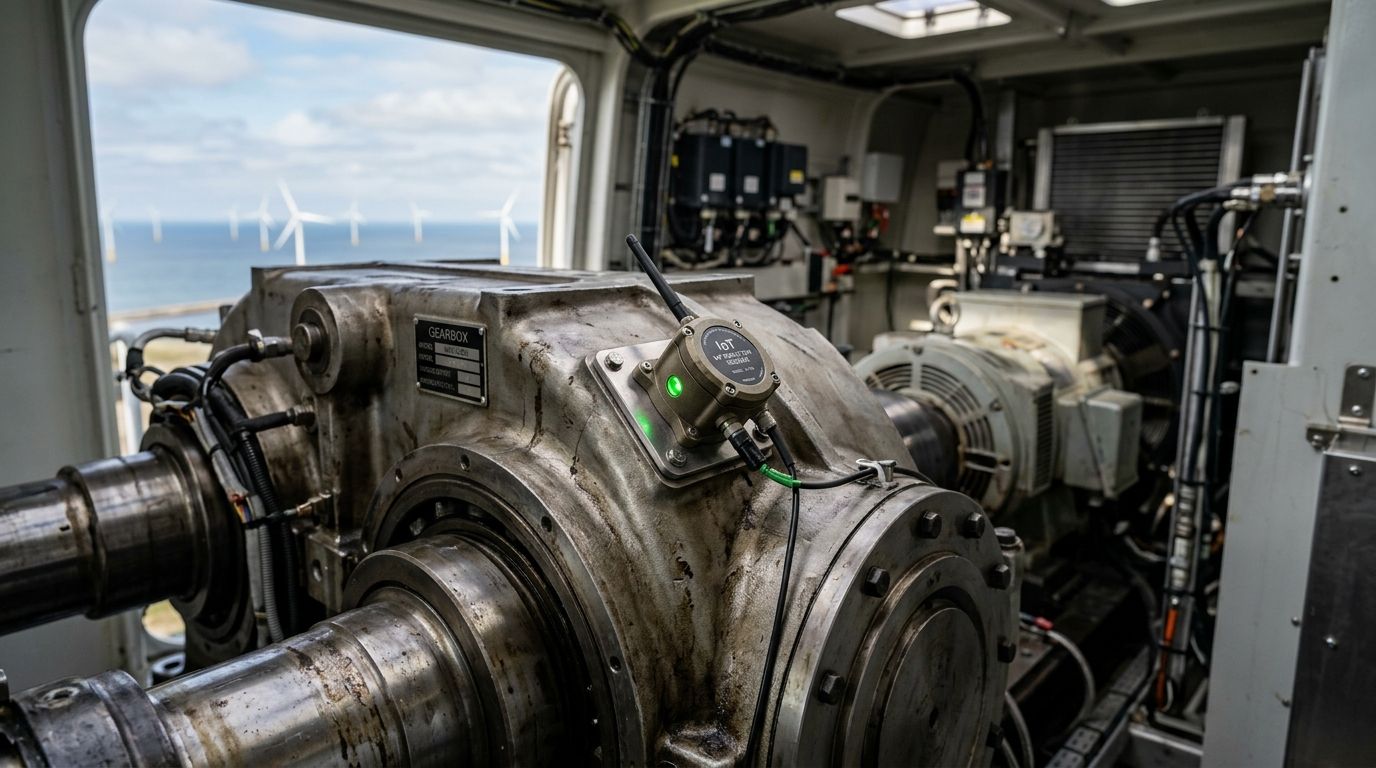
Wind turbine gearboxes fail before their rated life more often than owners want, and vibration data is the earliest signal operations teams get. This guide ranks the IoT vibration sensor options actually used on gearboxes today — wireless LoRaWAN nodes, mioty sensors, wired piezoelectric accelerometers, OEM condition monitoring systems, and battery-powered remote units — so you can pick the right one for your wind farm's gearbox monitoring program in 2026.
- Wireless LoRaWAN triaxial MEMS sensors win for retrofitting an existing wind farm without rewiring the nacelle.
- Mioty-based iot vibration sensor wind turbine gearbox units hold up best inside steel nacelles and shielded drivetrain housings.
- Wired piezoelectric accelerometers still lead for gear mesh fault detection above a few kHz on high-speed stages.
- Battery-powered wireless sensors are the only realistic option for remote, off-grid turbine sites without site power.
- An IoT platform with a rules engine turns raw vibration readings into escalating alarms instead of a chart nobody watches.
Why gearbox vibration monitoring matters for wind turbine reliability
The National Renewable Energy Laboratory's Gearbox Reliability Collaborative has documented for years that wind turbine gearboxes routinely fail well before their 20-year design life, and gearbox replacement is one of the most expensive unplanned events a wind farm operator faces. Vibration is the leading indicator most operators trust because gear mesh, bearing, and shaft faults all show up as amplitude or frequency shifts before a gearbox seizes.
ISO 10816-21:2015 defines the vibration severity zones specifically for wind turbine drivetrains, and IEC 61400-25 standardizes how that condition data gets communicated across a plant. Getting a reliable iot vibration sensor wind turbine gearbox deployment in place is less about picking one magic sensor and more about matching sensor type to nacelle access, connectivity, and how the data reaches a renewable energy site monitoring platform that can act on it.
What makes a good IoT vibration sensor for wind turbine gearbox monitoring
- Frequency range — gear mesh and bearing defect frequencies on high-speed shafts often run into the multi-kHz range, so the sensor's sampling bandwidth has to cover it, not just low-frequency imbalance.
- Mounting location and axis count — triaxial sensors on the gearbox housing near the intermediate and high-speed stage bearings catch more fault modes than a single-axis unit bolted anywhere convenient.
- Connectivity through steel — nacelles are grounded steel enclosures, which attenuate radio signals differently than an open warehouse floor.
- Power source — hardwired 24V nacelle power versus battery life inside a sensor that's hard to reach without a technician climbing the tower.
- Alarm logic, not just data logging — a sensor that reports RMS velocity is only useful if something downstream compares it to ISO 10816-21 zones and escalates.
- Integration path — MQTT, LoRaWAN, or mioty uplink into a platform that can trend, alarm, and export the data for a reliability engineer.
Vibration sensor options for wind turbine gearbox monitoring at a glance
| Sensor type | Best for | Standout feature | Key limitation |
|---|---|---|---|
| Wireless LoRaWAN MEMS vibration node | Retrofitting existing wind farms | No new cable runs into the nacelle | Lower frequency ceiling than wired piezo units |
| Mioty vibration sensor | Steel nacelle and shielded gearbox housings | Telegram splitting holds up under RF interference | Fewer OEM sensor SKUs on the market than LoRaWAN |
| Wired piezoelectric accelerometer | Gear mesh fault detection on high-speed stages | Frequency response into the multi-kHz range | Requires cable runs and a wired I/O gateway |
| OEM condition monitoring system (CMS) | New-build turbines with factory instrumentation | Pre-integrated with SCADA at commissioning | Locked to the OEM's software and export format |
| Battery-powered wireless vibration + temperature sensor | Remote or off-grid turbine sites | Runs for years without nacelle power access | Lower sample rate to conserve battery |
1. Wireless LoRaWAN MEMS vibration sensors: best for retrofitting existing wind farms
A wireless triaxial MEMS accelerometer clamps or bolts onto the gearbox housing and reports RMS velocity, acceleration, and crest factor over a LoRaWAN uplink, usually every few minutes to hourly depending on the alarm state. For a fleet of turbines commissioned before condition monitoring was standard, this is the fastest way to add gearbox coverage without opening up the nacelle wiring.
Wireless LoRaWAN vibration sensor pros:
- No cable runs into the nacelle or up the tower
- Fast to add across a whole wind farm in a single rollout
- Works alongside gateways already deployed for other turbine sensors
Wireless LoRaWAN vibration sensor cons:
- Sample rates and frequency bandwidth are lower than a dedicated wired piezo system
- Battery replacement inside a nacelle still requires a technician visit
Best for: retrofit programs across an existing wind farm fleet. Verdict: Buy for sites that need broad gearbox coverage fast and can accept a lower-frequency ceiling than a wired system.
2. Mioty vibration sensors: best for steel nacelle and shielded drivetrain housings
Mioty's telegram splitting spreads each uplink across multiple sub-packets and frequencies, which gives it an edge in RF-dense or partially shielded environments — exactly the situation inside a grounded steel nacelle with a gearbox, generator, and converter cabinet all close together. For turbines where LoRaWAN packet loss has been an issue, mioty sensors are worth testing on the same gearbox mounting points, and the same reasoning applies to mioty sensors for underground and shielded environments more broadly.
Mioty vibration sensor pros:
- Better resilience to interference inside metal enclosures
- Long uplink range works well for spread-out turbine strings
- Lower packet loss than LoRaWAN in RF-congested nacelles
Mioty vibration sensor cons:
- Fewer accelerometer product lines available than the LoRaWAN ecosystem
- Requires a mioty-capable network server or gateway
Best for: turbines where LoRaWAN uplinks have been unreliable from inside the nacelle. Verdict: Consider if packet loss on existing wireless sensors is a documented problem.
3. Wired piezoelectric accelerometers: best for gear mesh fault detection on high-speed stages
Piezoelectric accelerometers wired directly into a data acquisition unit remain the reference standard for catching gear mesh and bearing defect frequencies that run into the kHz range on high-speed gearbox stages. This is the sensor type most condition monitoring engineers reach for when a fault has already been flagged and needs a detailed spectral diagnosis, not just a threshold alarm.
Wired piezoelectric accelerometer pros:
- Widest frequency response of any option on this list
- No battery to replace, no wireless link to drop
- Established diagnostic technique with decades of published gear fault signatures
Wired piezoelectric accelerometer cons:
- Cable runs into the gearbox area add installation cost and time
- Needs a wired gateway or data acquisition unit on-site
Best for: detailed diagnostics once a suspect gearbox has been flagged. Verdict: Buy for any turbine already scheduled for a deeper vibration analysis pass.
4. OEM condition monitoring systems: best for new-build turbines with factory instrumentation
Major gearbox and drivetrain OEMs ship turbines with a condition monitoring system pre-installed and wired at the factory, tied into the turbine's own SCADA controller. This is the lowest-friction option at commissioning because there's no retrofit decision to make — the sensors and the software are already part of the delivered asset.
OEM CMS pros:
- Factory-calibrated and pre-integrated with turbine SCADA
- No retrofit engineering required at commissioning
- Vendor typically supports the specific gearbox model's known fault signatures
OEM CMS cons:
- Locked into the OEM's proprietary software and export formats
- Harder to bring readings into a single cross-vendor dashboard for a mixed fleet
Best for: newly commissioned turbines from a single OEM. Verdict: Consider if the fleet is homogeneous; Skip as a standalone choice if the wind farm mixes turbine brands and needs one dashboard.
5. Battery-powered wireless vibration sensors: best for remote or off-grid turbine sites
Some turbine sites — ridge-line installations, offshore substructures, or early-stage wind farms without full grid backhaul — don't have reliable nacelle power available to a retrofit sensor. A battery-powered wireless vibration and temperature combo sensor, the same category covered in battery-powered wireless sensors for off-grid sites, trades some sample-rate resolution for multi-year runtime without a technician touching it.
Battery-powered vibration sensor pros:
- Deploys anywhere without pulling nacelle power
- Multi-year battery life reduces truck rolls to remote turbines
- Combines temperature and vibration in one unit
Battery-powered vibration sensor cons:
- Lower sampling frequency to conserve battery life
- Not a substitute for high-frequency gear mesh diagnostics
Best for: remote and off-grid turbine locations where truck rolls are expensive. Verdict: Buy for sites where access cost outweighs the resolution trade-off.
How to choose between these vibration sensor types for your wind farm
Match the sensor to the question you're actually trying to answer. If the goal is broad early-warning coverage across a fleet, wireless LoRaWAN or mioty sensors get gearboxes instrumented fast. If the goal is confirming a specific fault already suspected from an alarm, a wired piezoelectric accelerometer gives the frequency resolution to read the gear mesh spectrum.
The same logic applies to any large rotating asset, not just gearboxes — the criteria mirror what's covered for vibration monitoring on industrial pumps and motors: connectivity through the enclosure, frequency range against the known fault frequencies, and whether the data reaches someone who can act on it.
How an IoT platform connects gearbox vibration sensors to alarms and dashboards
A sensor reading is only useful once it's compared against a threshold and routed to the right person. Kilo ingests vibration data over MQTT from wired accelerometer gateways and over its built-in LoRaWAN and mioty network servers from wireless sensors, so a mixed fleet of sensor types lands in one dashboard instead of three vendor portals.
Inside Kilo, a CEL-based rule can compare incoming RMS velocity against ISO 10816-21 zone boundaries per turbine, and when a reading crosses into an alarm zone it escalates through Kilo's multi-step alarm chain — email, SMS, or push, with quiet hours so a minor overnight excursion doesn't page an engineer at 3am. The same rules engine that handles gearbox thresholds is the one covered in automated alarms for equipment vibration anomalies, and it applies whether the underlying sensor is LoRaWAN, mioty, or a wired MQTT feed. Kilo's digital twin also lets an operations team bind each gearbox sensor to its turbine in a site-wide view, so a vibration alarm on turbine 14 shows up exactly where turbine 14 sits on the layout, not as a row in a spreadsheet.
Sensors themselves aren't something Kilo manufactures — that side of a deployment runs through Kilo Electronics, Kilo's sister hardware company, which ships accelerometer and combo sensor hardware worldwide for teams that need the physical devices alongside the platform.
See gearbox vibration alarms on one dashboard
Bring LoRaWAN, mioty, and wired sensor feeds into a single wind farm view.
Which vibration sensor should you pick for wind turbine gearbox monitoring?
For most wind farms retrofitting an existing fleet in 2026, a wireless LoRaWAN triaxial vibration sensor is the default starting point — it gets every gearbox instrumented without a wiring project. Add mioty sensors where nacelle interference is a documented problem, bring in a wired piezoelectric accelerometer once a specific gearbox needs a detailed spectral diagnosis, and reach for a battery-powered unit on any turbine site where technician access is the real cost driver.
FAQ
What is the best IoT vibration sensor for wind turbine gearbox monitoring?
A wireless LoRaWAN triaxial MEMS vibration sensor is the best starting point for retrofitting an existing wind farm because it requires no new cable runs into the nacelle. Mioty sensors are a stronger fit where the steel nacelle causes wireless interference, and wired piezoelectric accelerometers remain the reference choice for detailed gear mesh fault diagnosis.
How often should gearbox vibration data be sampled on a wind turbine?
Sampling frequency depends on the fault type being monitored — general trending can run hourly, but detecting gear mesh and bearing defect frequencies requires sampling fast enough to resolve frequencies into the multi-kHz range. ISO 10816-21 defines the severity zones used to judge whether a reading is a concern.
Is mioty better than LoRaWAN for turbine nacelle vibration sensors?
Mioty's telegram splitting gives it better resilience inside RF-congested or shielded steel enclosures, which can matter inside a nacelle packed with a generator, converter, and gearbox. LoRaWAN has a wider sensor product ecosystem, so the right choice depends on whether interference has actually been a problem on that specific turbine.
Do wireless vibration sensors work as well as wired condition monitoring systems for gearboxes?
Wireless sensors are strong for broad early-warning coverage but generally have a lower frequency ceiling than wired piezoelectric accelerometers. Wired systems remain the standard for detailed gear mesh fault diagnosis once a wireless sensor has flagged an anomaly.
What vibration frequency range matters for gearbox fault detection?
Gear mesh and bearing defect frequencies on high-speed gearbox stages can extend into the multi-kHz range, well above the range needed for simple imbalance detection. Sensor bandwidth needs to cover the specific gear mesh frequency and its harmonics for the gearbox in question.
Can IoT vibration sensors replace SCADA-based condition monitoring on a turbine?
IoT vibration sensors can supplement or extend SCADA-based condition monitoring, particularly on turbines that were commissioned without factory-installed CMS. IEC 61400-25 standardizes how that condition data communicates across a plant so it can sit alongside existing SCADA feeds rather than replace them outright.
What standard governs wind turbine gearbox vibration monitoring?
ISO 10816-21:2015 defines the vibration severity evaluation zones specifically for wind turbine drivetrains, while IEC 61400-25 covers the communication protocols for monitoring and control data across a wind power plant.
How much does a wind turbine gearbox failure cost an operator?
Gearbox replacement is consistently cited by the NREL Gearbox Reliability Collaborative as one of the most expensive unplanned maintenance events a wind farm operator faces, which is why early vibration-based detection is a priority over reactive repair.
The failure mode most gearbox vibration programs still miss
Most gearbox monitoring setups catch a rising vibration trend and stop there — they rarely correlate it against gearbox oil temperature or generator load at the same timestamp. A gear mesh anomaly that only shows up under high load looks like noise if the vibration reading is viewed in isolation, which is why pairing vibration alarms with load and temperature context on the same dashboard catches faults that a vibration-only threshold misses in 2026 deployments.