IoT monitoring for commercial coffee roasting facilities means sensors and automated rules that track roaster and afterburner temperatures, chaff dust levels, gas lines, and green bean storage conditions in real time, so a burner drifting off profile or a stuck cooling tray gets flagged before it turns into an over-roasted batch, a chaff fire, or a failed audit. A roasting floor runs hotter, dustier, and on a tighter clock than most food production environments, which is why a single roast-chamber probe isn't enough — the compliance and safety exposure sits in the storage room, the dust collector, and the gas line just as much as it sits in the drum.
- IoT monitoring for coffee roasting facilities tracks roaster temperature, chaff dust, and gas lines against NFPA 61 fire risk.
- Kilo's rules engine can alarm when a burner runs hot or a cooling tray stalls past its target window.
- FDA's FSMA preventive controls rule, in effect since 2016, expects documented temperature and time records, not paper logs.
- Green coffee stored above roughly 68F or 60% relative humidity stales long before a cupping session catches it.
- Continuous sensors catch the overnight excursions that spot-check thermometers miss entirely in 2026 roasting operations.
Why does IoT monitoring matter for coffee roasting facilities?
A commercial roaster runs a drum between roughly 370F and 540F depending on roast level, per National Coffee Association guidance, and that heat sits a few feet from a paper-thin layer of chaff — the papery skin that flakes off green beans during roasting. NFPA 61, the Standard for the Prevention of Fires and Dust Explosions in Agricultural and Food Processing Facilities, exists because that dust is combustible. A collection bin that fills faster than the sweep schedule is a real ignition risk, not a theoretical one.
Food safety adds a second layer. Since 2016, the FDA's Preventive Controls for Human Food rule under FSMA has required covered food facilities to document critical control points such as temperature and time rather than eyeball them. An industrial IoT platform for food and beverage manufacturers covers the same ground for roasters: continuous, timestamped records instead of a clipboard someone fills in at the end of shift.
Green bean storage is the third pressure point. Specialty Coffee Association guidance points to storing green coffee below roughly 68F (20C) with relative humidity in the 50-60% band to slow staling. Miss that window for a week in 2026 and nobody notices until a batch cups flat.
How to set up IoT monitoring for a coffee roasting facility
Build this in layers. Start with the roast chamber, work outward to storage, dust, gas, and finally tie every zone into one dashboard.
Instrument the roaster and afterburner
Most roasters already track bean mass and exhaust temperature through the roaster's own control software. That data is good for profile repeatability and stops at the drum.
- Log manual thermocouple readings at set intervals as a baseline
- Pull roast-curve data from the roaster's built-in profiling software
- Add an independent probe near the burner, separate from the roaster's own sensor
- Track afterburner or catalytic oxidizer temperature continuously
- Set alarm thresholds tied to your target roast profile, not just a fixed maximum
Track green bean and packaged storage conditions
Fire risk gets the attention, but a slow humidity drift in the green bean warehouse costs more product over a year.
- Spot-check temperature and humidity with a handheld meter on rounds
- Log readings in a shared spreadsheet by shift
- Place a fixed logger in the warehouse and download data weekly
- Run a continuous temperature and humidity sensor with a threshold alarm
- Keep finished-bag storage and green bean storage as separate zones on the dashboard so one drifting zone doesn't mask the other
Kilo enters here as the faster path once you have outgrown spreadsheets. A continuous sensor feeding a rule that fires when the warehouse crosses 68F or 60% relative humidity catches the drift the same week it starts, not the month a cupping session flags stale beans. Sensors and gateways for this are available from Kilo Electronics at kiloelectronics.com with worldwide shipping.
Monitor combustible chaff dust buildup
NFPA 61 exists because chaff is fuel sitting next to a heat source. Treat the collection bin as a compliance point, not a housekeeping chore.
- Run chaff sweeps on a fixed daily schedule
- Check dust collection bin fill level visually each shift
- Log bin changes on paper or in a shared log
- Add a level sensor on the collection bin tied to a fill threshold instead of a clock
- Route that alarm to whoever owns fire safety on the floor, not only the roast master
Watch compressed air and gas lines
Roasters run on gas or propane burners, and many use compressed air for cooling trays and pneumatic bean handling. A slow leak in either wastes energy, and on the gas side it is a hazard.
- Run manual soap-bubble checks on fittings during routine maintenance
- Walk listening rounds for audible hissing near valves and regulators
- Track compressor run time and pressure drop by hand
- Add continuous pressure and flow sensors on compressed air lines — best IoT sensors for compressed air leak detection covers sensor selection
- Add independent gas or CO detection near burners, separate from the roaster's built-in shutoff
Set alarms for cooling tray and quench malfunctions
The cooling tray is where a batch stops roasting. A stuck damper or a dead cooling fan lets carryover heat keep cooking beans past target, and it is easy to miss on a busy line.
- Time cool-down manually with a stopwatch on spot checks
- Record cool-down duration in the roast log by hand
- Add a thermocouple on the cooling tray itself, not just the drum
- Build a rule that alarms when cool-down time exceeds your target window — how to set up SMS and email alerts for critical IoT sensor thresholds shows the escalation pattern
- Send the first alarm to the shift lead, with escalation to a manager after a set delay
Centralize data across roasting lines or sites
A single-roaster shop survives on spreadsheets. A roaster running two or three lines, or several sites, does not.
- Consolidate logs from each line into one shared drive weekly
- Standardize the log template across lines so shift data compares cleanly
- Build one dashboard per roasting line showing temperature, dust bin level, and storage humidity together
- Run a single multi-site view so ownership can compare lines without walking each floor
- Set role-based permissions so QA sees compliance data, maintenance sees equipment alarms, and ownership sees both
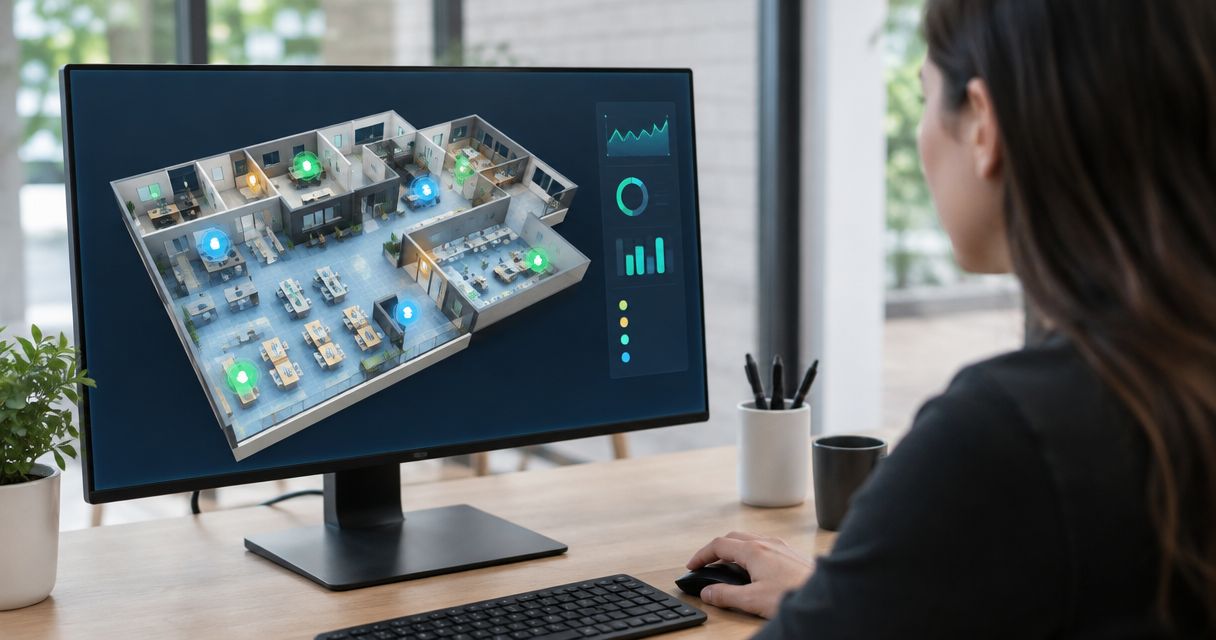
Kilo's live 3D digital building twin binds sensors to objects on a floor plan, so a dust bin alarm and a storage humidity flag appear on the same screen as the roaster temperature trend. The built-in AI assistant can draft that alarm rule from a plain-language description, scoped to the signed-in user's permissions and confirming before anything consequential deploys. The visual rules engine keeps version history, so a threshold change that produces nuisance alarms rolls back in one click.
See the roasting floor in one dashboard
Map roaster, storage, and dust sensors into a single view. Free tier, no card required.
What are the best monitoring options for a coffee roasting facility?
| Option | Best for | Key limitation |
|---|---|---|
| Paper logs and spot-check thermometers | A single small roaster starting documented checks | No continuous record; misses overnight and off-shift excursions |
| Roaster profiling software | Roast curve repeatability and cupping notes | Built around the roast itself, not facility-wide dust, gas, or storage conditions |
| Standalone data loggers per zone | One-off compliance checks on a single warehouse or cooler | Data sits in separate devices with no shared alarm rules across the floor |
| Kilo IoT Platform | Roasters running multiple lines or sites that need roaster, storage, dust, and gas data in one rules engine | Requires sensor and gateway installation across the roasting floor before it pays off |
On pricing, Kilo's free tier covers up to 5 devices, 1 dashboard, and 1 rule at 0 EUR with no card and no expiry; Starter is 25 EUR per month for up to 25 devices. Gateways are unlimited on every tier and never count toward the device total, which matters when a roasting floor needs a second gateway to punch through steel and concrete.
What mistakes do coffee roasters make with facility monitoring?
- Treating the roaster's built-in probe as the whole compliance record. It covers the drum, not the green bean warehouse or the packaging room where FSMA-relevant excursions also happen.
- Sweeping chaff bins on a fixed schedule instead of a fill threshold. A heavy production day overflows the bin between scheduled sweeps.
- Logging cooling tray times on paper. A stuck damper that lets a batch coast past its cool-down window never surfaces until the next cupping.
- Skipping independent gas or CO detection near burners. Relying only on the roaster's own shutoff misses slow leaks in adjacent piping.
- Storing green beans and finished bags in one humidity zone. A moisture problem in one masks a quality drop in the other until batches start cupping flat.
FAQ
What is IoT monitoring for coffee roasting facilities?
It is a system of sensors and automated rules that continuously track roaster temperature, chaff dust levels, gas lines, and green bean or finished product storage conditions. It replaces manual spot checks with a documented, timestamped record.
Is IoT monitoring required for FSMA compliance in coffee roasting?
No specific technology is mandated. FSMA's Preventive Controls for Human Food rule, in effect since 2016, requires documented critical control points such as temperature and time, and continuous sensors make that documentation far more reliable than paper logs.
What temperature does a commercial coffee roaster run at?
Roasting typically runs between 370F and 540F depending on roast level, according to National Coffee Association guidance. Your exact profile depends on origin and target roast, which is why an alarm threshold tied to your profile beats a single fixed number.
How does IoT monitoring reduce chaff and dust fire risk?
A level sensor on the dust collection bin tied to a fill threshold catches a bin filling faster than expected on a heavy production day, instead of waiting for the next scheduled sweep. NFPA 61 covers combustible dust risk specifically for agricultural and food processing facilities.
Can IoT monitoring replace roast profiling software?
No. Profiling software tracks the roast curve for repeatability and cupping notes, while facility IoT monitoring covers dust, gas, storage, and equipment health across the whole floor. Most roasters run both.
Does IoT monitoring work across multiple roasting sites?
Yes. A platform like Kilo consolidates multiple roasting lines or sites into one dashboard with shared alarm rules and role-based permissions, which is the point where spreadsheets and standalone loggers stop scaling.
What sensors matter most in a coffee roasting facility?
Roaster and afterburner temperature, dust collection bin level, compressed air pressure and flow, gas or CO detection near burners, and green bean storage temperature and humidity. Those five cover the main risk points in a 2026 roasting operation.
How much does an IoT monitoring platform cost for a roastery?
Kilo's free tier is 0 EUR for up to 5 devices, 1 dashboard, and 1 rule with no card required and no expiry. Starter is 25 EUR per month for up to 25 devices, and gateways never count toward the device limit on any tier.
What do most roasters overlook in facility monitoring?
The overlooked exposure is not fire or spoilage — it is air quality during flavored coffee production. NIOSH has published criteria and exposure guidance for diacetyl and 2,3-pentanedione, compounds released during roasting and grinding and concentrated further in flavoring operations, and most roasteries have zero continuous monitoring on it. Kilo's MQTT connector accepts data from any publishing third-party air quality sensor, so that reading lands on the same 2026 dashboard as your roaster temperature and dust bin level instead of living in a binder nobody opens until an OSHA visit.