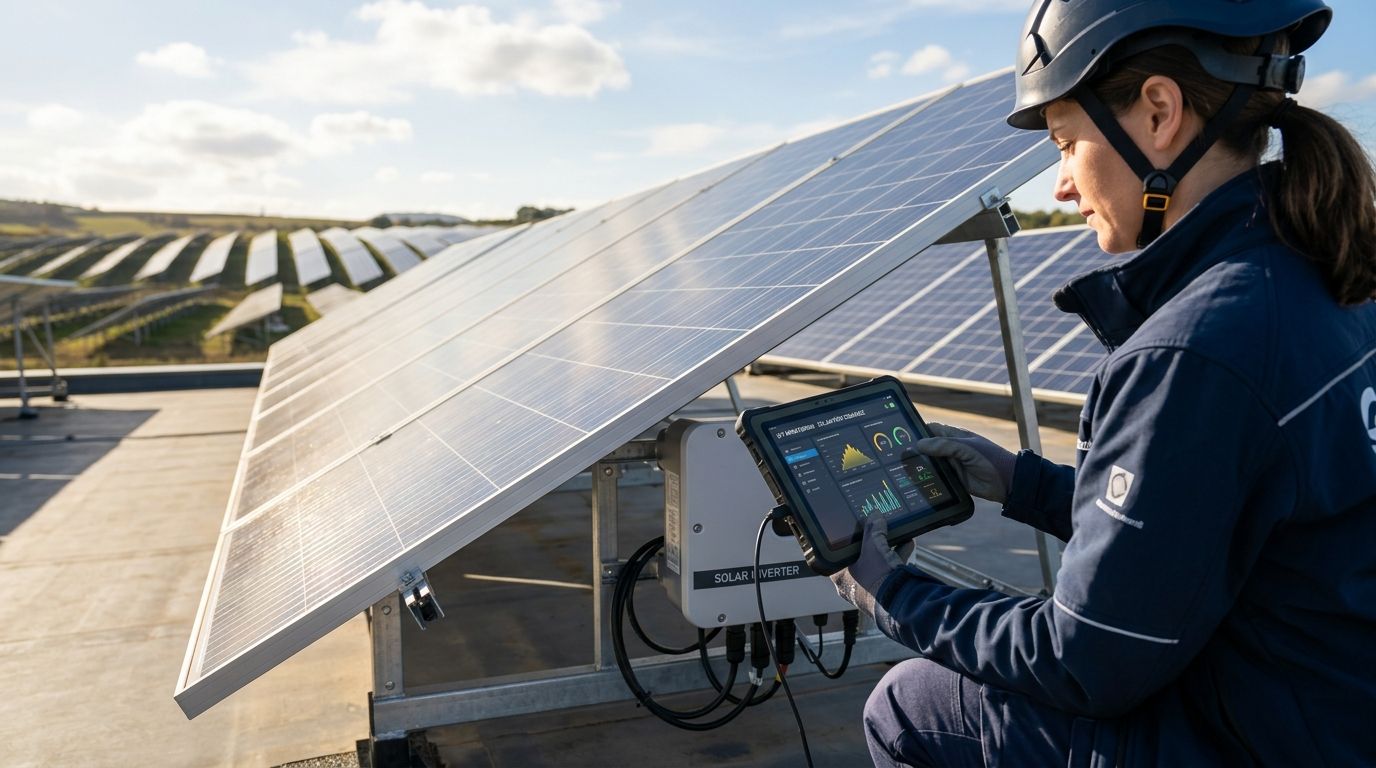
Solar O&M teams use IoT monitoring for inverter and panel performance to catch string-level output drops, inverter fault codes, and panel soiling before they turn into a gap on the monthly production report. Rooftop commercial and utility-scale portfolios both share the same problem: the inverter manufacturer's portal tells you what the inverter thinks happened, not what the sun actually delivered.
- IoT monitoring solar inverter panel performance means pairing SunSpec Modbus inverter data with independent irradiance and temperature sensors, not relying on one portal.
- The Kilo IoT Platform reads inverter and meter data over MQTT, adds LoRaWAN or mioty field sensors, and fires alarms when performance ratio drops.
- A digital twin map of combiner boxes and strings stops a single failed string from hiding inside an inverter-level average.
- Escalation chains route a critical inverter fault to an on-call tech in minutes instead of waiting for someone to check a shared login.
Why IoT monitoring matters for solar O&M teams
Most string inverters (SolarEdge, SMA, Fronius, Huawei) already expose data over SunSpec Alliance Modbus registers, and IEC 61724 sets the terminology and measurement guidelines the industry uses for PV performance monitoring — irradiance, module temperature, and performance ratio (PR) are all defined there, not invented per vendor. The gap is that the manufacturer portal reports at the inverter or optimizer level. It rarely tells you which string inside a combiner box dropped output, and it almost never correlates that drop against measured plane-of-array irradiance on the same 15-minute interval used for interconnection reporting.
O&M contracts and warranty claims live or die on that correlation. An inverter that logs a fault code at 2 p.m. on a clear day is a different problem than the same inverter reporting zero output during a cloud bank — and a spreadsheet built from manual portal exports usually can't tell the two apart fast enough to matter.
Connect inverter and meter data first
Start with what's already wired. Every grid-tied string inverter and most revenue-grade meters at the point of interconnection already speak a protocol you can read without adding hardware.
- Pull SunSpec Modbus TCP or RS-485 registers directly from each inverter
- Log revenue-grade meter output (kWh) at the point of interconnection
- Capture DC input current per string where the inverter reports it
- Record inverter status and fault codes at native polling interval
- Align every reading to the same 15-minute interval used for utility reporting
Add environmental sensors for context
Inverter and meter data alone can't separate a real fault from a cloudy afternoon. That takes plane-of-array irradiance and module temperature measured on site, and for field arrays without trenched power or network runs, wiring a data logger to every combiner box isn't realistic. This is where battery-powered LoRaWAN or mioty sensors reporting into a cloud platform replace a data-logger build-out — Kilo's built-in LoRaWAN and mioty network server means there's no separate network server to stand up before the first sensor reports.
- Plane-of-array pyranometer for measured irradiance
- Back-of-module temperature sensor at a representative panel
- Weather station for ambient temperature and wind speed
- Clean vs. exposed reference-cell pair for soiling ratio
- Rain gauge to time cleaning against recent rainfall
Solar-rated weather stations and module temperature sensors that hold up to outdoor UV and thermal cycling are available worldwide through Kilo Electronics, Kilo's hardware partner.
Map strings and combiner boxes on a site view
A CAD single-line diagram and a spreadsheet of string IDs work, but they go stale the moment a tech reroutes a combiner box during a repair. A live digital twin keeps the map current because devices report their own position and status.
- Map widget pinning every inverter and combiner box to its physical location
- Chart widget per string showing DC current against its siblings
- Color-coded status per device (producing, faulted, offline)
- Gauge widget for live performance ratio at plant or block level
- Image or floor-plan pin for array zones on large ground-mount sites
Kilo's per-device digital twin plus a live 3D building or site twin binds each sensor to its object on the map, so a string fault shows up where the tech actually has to walk, not as a row in a table.
Build performance ratio rules and alarms
The manual version of this is a daily spreadsheet formula: measured output divided by expected output from measured irradiance, per IEC 61724's performance ratio definition, checked by an analyst each morning. That works at one site. It falls apart across a ten-site portfolio.
- Threshold rule on performance ratio drop against the site's own baseline
- Direct alarm on inverter fault or status codes
- String current deviation rule against sibling strings in the same combiner box
- Zero-production flag during confirmed daylight hours
- Isolation resistance or ground fault flag where the inverter reports it
Kilo's visual rules engine (BPMN) with CEL expressions lets an ops lead build that comparison without writing code, version it, test it against a saved payload before deploy, and roll back a bad rule in one click.
Route inverter faults to the right person
An alarm nobody sees is worse than no alarm — it creates a false sense of coverage. A phone tree or shared inbox works until the person on it is out.
- Critical inverter fault escalates to the on-site tech by SMS immediately
- Moderate performance-ratio drop routes to the O&M manager by email next business day
- Quiet hours suppress non-critical string variance alerts overnight
- Unacknowledged critical alarms escalate automatically to the EPC contact
- Every alarm logs into one inbox for warranty and contract documentation
Kilo's five severity tiers and multi-step escalation chains (email, SMS, push) with quiet hours and a centralized inbox are built for exactly this handoff between night shift and day shift.
Track soiling and schedule panel cleaning
Fixed-calendar cleaning wastes a wash on a site that got rain last week and misses one that didn't. A reference-cell pair — one kept clean, one left exposed — gives a direct soiling ratio instead of a guess.
- Calculate soiling ratio from the clean vs. exposed reference-cell pair
- Skip a scheduled wash automatically when the rain gauge crossed a threshold
- Add a particulate sensor in arid or high-dust sites
- Log cleaning contractor confirmation against the alarm that triggered it
Report performance for O&M contracts and warranty claims
A monthly spreadsheet export to the asset owner is the baseline every portfolio starts with. At scale it turns into a data-entry job. Pushing the same performance ratio, availability, and fault history straight into a reporting tool a finance or asset management team already uses removes that step, which is the same pattern covered in integrating IoT sensor data with Power BI or Tableau dashboards.
- Performance ratio trend chart by site and by string
- Availability percentage (uptime) per inverter
- Curtailment event log with cause and duration
- Warranty claim package with timestamped fault history
- REST API pull for finance or asset management reporting
See solar site monitoring in Kilo
Connect inverter, meter, and field sensor data on one dashboard.
How solar monitoring options compare for O&M teams
| Option | Best for | Data source | Key limitation |
|---|---|---|---|
| Inverter manufacturer's native portal | Single-vendor sites checking basic uptime | SunSpec Modbus from the inverter only | No independent irradiance context, no cross-vendor view |
| Plant SCADA system | Utility-scale sites with an existing control room | PLC and Modbus tags across the plant | Heavy to deploy for a single rooftop or small C&I site |
| Manual spreadsheet from portal exports | A single small site with no budget for tooling | Copy-pasted portal data | No real-time alarm, breaks down past one or two sites |
| General IoT monitoring platform (Kilo) | Multi-vendor, multi-site portfolios needing one dashboard | MQTT from inverters/meters plus LoRaWAN/mioty field sensors | Requires connecting each inverter's Modbus feed at setup |
A performance ratio that quietly drifts for two weeks is worth more than any single inverter fault code — the fault code tells you something broke, the PR trend tells you production is already gone.
“The first fault a solar site reports is rarely the first one that actually happened.”
Common mistakes solar O&M teams make with IoT monitoring
- Trusting the inverter portal as the whole picture. It reports what the inverter measured at its own terminals, not what a specific string or panel row actually produced.
- Skipping independent irradiance measurement. Without a plane-of-array pyranometer on site, a real production drop and a cloudy afternoon look identical in the data.
- Monitoring only at the inverter level. A single failed string can hide inside an inverter's blended total for weeks before the aggregate number moves enough to notice.
- Sending every fault code to one person. Unfiltered alarms train the on-call tech to ignore the channel, so the one critical fault gets missed with the noise.
- Cleaning on a fixed calendar instead of a soiling reading. A wash scheduled the week after rain is wasted labor; one skipped after a dry, dusty month is lost production.
FAQ
What's the best IoT platform for solar inverter and panel performance monitoring?
For a multi-vendor or multi-site portfolio, a general IoT monitoring platform that reads SunSpec Modbus over MQTT and adds independent field sensors, such as the Kilo IoT Platform, covers more ground than a single inverter manufacturer's portal. Single-vendor, single-site setups can often get by on the native portal alone.
Can you monitor solar panels without adding a cellular connection at a remote site?
Yes — LoRaWAN and mioty sensors are built for battery-powered, low-bandwidth reporting from field arrays that don't have cellular coverage or trenched network runs. Kilo's built-in LoRaWAN and mioty network server reads that data without a separate network server deployment.
What sensors do I need to detect solar panel soiling?
A clean-versus-exposed reference-cell pair gives a direct soiling ratio, and pairing it with a rain gauge lets a rule skip a scheduled cleaning after recent rainfall. A particulate sensor adds value in arid or high-dust sites.
Is inverter-level monitoring enough, or do I need string-level sensors?
Inverter-level data blends every string into one number, so a single failed string can hide inside the total for weeks. String-level current monitoring at the combiner box catches that failure immediately instead of waiting for the aggregate to drop enough to notice.
How does IoT monitoring differ from a SolarEdge or SMA portal?
The manufacturer portal reports what that inverter measured at its own terminals. An IoT monitoring platform adds independent irradiance and temperature sensors and combines data across inverter brands on one dashboard, which matters once a portfolio has more than one vendor.
What standard governs PV performance monitoring terminology?
IEC 61724 defines photovoltaic system performance monitoring, including how performance ratio, irradiance, and module temperature are measured and reported. SunSpec Alliance defines the Modbus register maps most inverters expose that data through.
Can IoT monitoring detect inverter faults before they cause extended downtime?
A rule built on inverter status codes and a performance-ratio threshold fires an alarm as soon as the fault registers, and an escalation chain gets it to the on-call tech within minutes instead of at the next scheduled site visit. It flags the fault; it doesn't predict it before it happens.
A solar array producing under a drifting performance ratio for two weeks straight, with no fault code thrown, is the failure mode that costs the most in 2026 — it never trips an alarm built only on inverter status. Building the rule on measured irradiance against actual output, not just fault codes, is what catches it.