
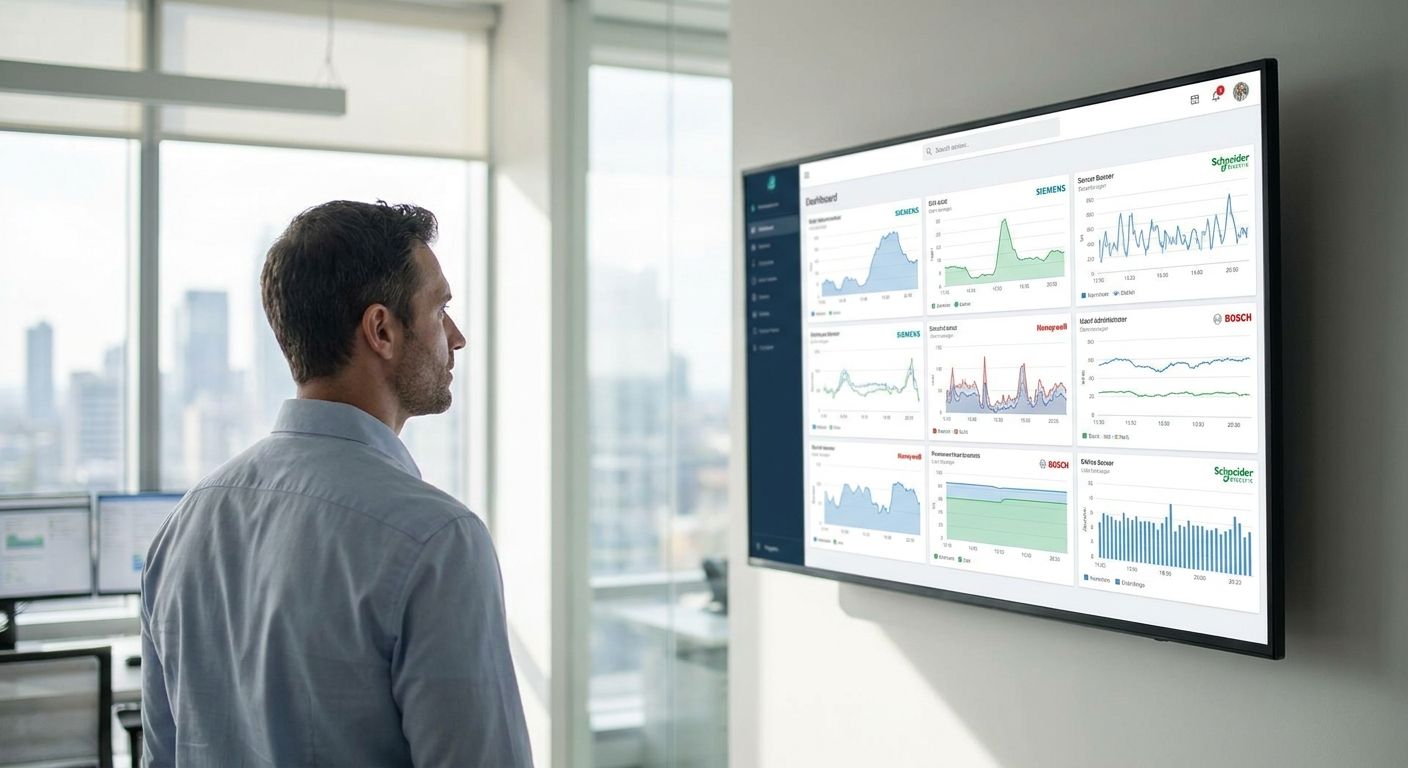
You consolidate sensors from different manufacturers into one dashboard by routing every device through a platform that speaks its native protocol directly, then normalizing the readings into one data model, one rules engine and one alarm chain. The dashboard is the easy part. The real work is getting a Siemens BACnet controller, a Honeywell BMS export, a handful of LoRaWAN temperature sensors and a mioty vibration sensor onto the same server without stacking a separate gateway and a separate login for each brand.
- You consolidate building sensor brands into one dashboard by ingesting each protocol (BACnet, Modbus, LoRaWAN, mioty, MQTT) at the platform layer, not with one gateway per brand.
- MQTT is the practical bridge for BMS, PLC and energy meter exports that don't speak LoRaWAN or mioty natively.
- A digital twin per device lets a temperature sensor from one vendor and a vibration sensor from another sit in the same rule and the same alarm chain.
- Zigbee and BLE sensor networks usually need a migration step, not a bridge, before they join a LoRaWAN-based dashboard.
- Kilo's built-in LoRaWAN and mioty network server removes the need to run a third-party network server just to get multi-brand devices talking.
Why sensor brand consolidation is a real 2026 facilities problem
Most buildings didn't plan their sensor stack, it accumulated. A BMS installer put in BACnet controllers a decade ago, a refrigeration contractor added Modbus energy meters, and a facilities team bolted on LoRaWAN temperature sensors last year because they were cheap and battery-powered. Each brand ships its own app or its own cloud portal, and none of them talk to each other.
That leaves a facilities manager checking four logins to answer one question: is the walk-in cooler holding temperature right now. Retrofitting a legacy building with wireless IoT sensors usually starts exactly here, before anyone talks about a single dashboard.
BACnet itself is standardized under ANSI/ASHRAE Standard 135, which is why most commercial BMS hardware can at least export data in a common structure. Modbus, by contrast, is a de facto industrial standard with no single governing body, which is part of why every energy meter vendor implements it slightly differently. Consolidation means absorbing both realities into one system instead of forcing every vendor onto identical hardware.
How do you consolidate multiple building sensor brands into one dashboard?
The process is the same whether you're merging two brands or twelve:
- Inventory every protocol in the building — BACnet, Modbus, LoRaWAN, mioty, MQTT, BLE, proprietary cellular. Write down which brand uses which.
- Pick a platform with native multi-protocol ingestion, not a dashboard that requires a separate gateway box per vendor. Multi-protocol IoT gateway software exists specifically to avoid a rack of single-purpose gateways.
- Route BMS, PLC and energy meter data through MQTT where the device already supports it. Connecting Modbus PLCs to a cloud IoT dashboard is the same pattern applied to industrial controllers.
- Normalize every device into one data model. In Kilo, every sensor — regardless of brand or protocol — gets its own digital twin, so a Siemens BACnet point and a LoRaWAN humidity sensor both show up as devices with the same structure of attributes, telemetry and history.
- Build the rules and alarms once, against the normalized model, not once per vendor app. A single CEL-based rule can fire off a reading from any connected brand.
- Lay dashboard widgets on top — map, chart, gauge, floor-plan pin — pulling from all sources at once instead of tab-switching between vendor portals.
| Existing system | Common protocol | How it joins the dashboard |
|---|---|---|
| Legacy BMS (Siemens, Honeywell, Johnson Controls) | BACnet (ANSI/ASHRAE 135) | BACnet-to-MQTT bridge feeds normalized data in |
| Energy meters, PLCs | Modbus RTU/TCP | Modbus gateway publishes to MQTT |
| Battery-powered temperature/humidity sensors | LoRaWAN | Built-in LoRaWAN network server, no third-party server needed |
| High-density industrial sensors | mioty | Built-in mioty network server |
| Legacy smart-building sensors | Zigbee, Z-Wave, BLE | Usually migrated rather than bridged |
“If a sensor doesn't speak an IP protocol, a gateway has to translate it before any dashboard can show the reading next to everything else.”
Consolidating BACnet, Modbus and BMS data into one dashboard
BACnet and Modbus devices are the ones that already existed before anyone talked about a unified dashboard, so they're usually the constraint, not the sensors being added. The practical move is an MQTT connector: the BMS or PLC publishes its points to an MQTT broker, and the platform subscribes and treats each point as a device the same way it treats a wireless sensor.
This matters because BACnet and Modbus data tend to be dense — a single chiller plant BMS can expose hundreds of points — and a dashboard that can't filter or group them by zone becomes unusable fast. Integrating IoT sensor data via API is the fallback when the BMS vendor doesn't support a direct MQTT publish and you need to pull data through their REST endpoint instead.
Kilo's take: an MQTT connector accepts publishes from any device, PLC, energy meter or BMS, and each incoming point becomes its own digital twin — no separate network server, no vendor-specific plugin per brand.
Consolidating LoRaWAN and mioty sensors from different vendors
LoRaWAN sensors from different manufacturers are the easiest brand mix to consolidate, because LoRaWAN itself is a LoRa Alliance standard — the radio layer is shared even when the vendor firmware isn't. The friction shows up in payload decoding: every brand encodes its temperature, humidity or door-open reading differently inside the LoRaWAN frame, so the platform needs a payload decoder per device type, not per protocol.
mioty sensors, standardized under ETSI TS 103 357, solve a different problem: telegram splitting spreads each transmission across multiple sub-packets and frequencies, which is why mioty tends to show up in dense industrial deployments where LoRaWAN's duty-cycle limits get restrictive. A platform with a built-in network server for both protocols means adding a mioty vibration sensor next to an existing LoRaWAN temperature sensor doesn't require standing up a second network server.
Best for: facilities mixing a handful of LoRaWAN sensor brands with a smaller set of high-density mioty sensors on the same site. Watch out for: payload decoders — confirm the platform already has one for your specific sensor model before assuming "LoRaWAN" alone means plug-and-play.
Consolidating legacy Zigbee, Z-Wave and BLE sensors
Zigbee and Z-Wave sensors are the outlier in most building consolidation projects, because both protocols are mesh-based and short-range, built for consumer smart-home use rather than industrial-scale deployment. Bridging them into a LoRaWAN-based dashboard usually means running a hub that translates Zigbee frames into MQTT, which adds a point of failure that BACnet and LoRaWAN gateways don't have.
Most facilities teams that hit this wall end up migrating rather than bridging. Migrating a Zigbee sensor network to LoRaWAN walks through when a swap makes more sense than a permanent bridge — typically once the Zigbee mesh starts covering more than a single floor.
BLE sensors follow a similar logic: fine for a single room's occupancy or asset tracking, awkward at building scale because BLE range depends on gateway density in a way LoRaWAN and mioty don't.
Why consolidation approaches vary by building
- Number of existing brands — two vendors is a bridging problem, six vendors is a platform-selection problem.
- Protocol diversity — a building running only BACnet consolidates differently than one running BACnet plus LoRaWAN plus BLE.
- Retrofit vs. new construction — retrofits inherit legacy protocols; new builds can standardize on LoRaWAN or mioty from day one.
- Whether a BMS already exists — an existing BMS becomes a data source to bridge, not something to replace.
- Reporting requirements — some teams only need one dashboard; others need sensor data flowing into Power BI or Tableau for compliance or executive reporting on top of the live dashboard.
- Staffing — a single facilities manager wants a simpler consolidation path than a system integrator managing dashboards for multiple clients.
See a multi-brand dashboard in action
Check how Kilo ingests BACnet, Modbus, LoRaWAN and mioty sensors on one server.
Can one dashboard show sensors from different manufacturers?
Yes — one dashboard can show sensors from different manufacturers once each device is normalized into a common data model at the platform layer, regardless of the protocol or brand it originated from. The manufacturer's own app becomes unnecessary once its device is publishing into the shared platform.
Do you need a separate gateway for every sensor brand?
No, you don't need a separate gateway for every sensor brand if the platform has a built-in network server for the protocols involved — LoRaWAN and mioty gateways can share one server, and MQTT-publishing devices need no gateway at all. Where a separate gateway is unavoidable is protocol translation for non-IP systems like older Zigbee mesh networks or serial-only Modbus RTU devices.
Is BACnet compatible with a cloud IoT dashboard?
BACnet is compatible with a cloud IoT dashboard through an MQTT bridge that republishes BACnet points as MQTT messages, since BACnet itself (ANSI/ASHRAE Standard 135) doesn't natively publish to the internet. Most BMS vendors either support this bridge directly or allow a third-party BACnet-to-MQTT gateway to sit in front of the controller.
What to check before consolidating sensor brands onto one dashboard
Confirm payload decoders exist for every specific sensor model, not just the protocol family — two LoRaWAN temperature sensors from different brands can encode identical readings in incompatible byte layouts. Check whether the platform's rules engine can reference devices from every protocol in a single rule; a system that silos LoRaWAN rules from BACnet rules defeats the point of consolidating in the first place. And if hardware needs replacing during the project rather than just bridged, sensors and gateways compatible with the same platform are available worldwide through Kilo Electronics, Kilo's hardware partner.
FAQ
How do you combine sensors from multiple brands into one dashboard?
You combine sensors from multiple brands into one dashboard by ingesting each protocol (BACnet, Modbus, LoRaWAN, mioty, MQTT) at the platform level and normalizing every device into the same data model. The brand's own app becomes redundant once the device is publishing into the shared platform.
Can BACnet and LoRaWAN sensors share the same alarm system?
Yes, BACnet and LoRaWAN sensors can share the same alarm system once both are normalized into a common device model, so a single rule can escalate a BACnet chiller alarm and a LoRaWAN temperature alarm through the same severity tiers and contact chain.
Do I need a network server for both LoRaWAN and mioty sensors?
You need a network server capable of handling both protocols if you're running LoRaWAN and mioty sensors together, but it can be a single built-in server rather than two separate systems — Kilo's platform runs both natively.
Can Zigbee sensors be bridged into a LoRaWAN dashboard?
Zigbee sensors can be bridged into a LoRaWAN dashboard through a translation hub, but most teams migrate the Zigbee mesh to LoRaWAN instead once it covers more than a single floor, since bridging adds an extra point of failure.
What protocol should new sensor brands standardize on?
New sensor brands should standardize on LoRaWAN or mioty when battery life and wireless range matter, or MQTT when the device is already wired into a BMS, PLC or energy meter with network connectivity.
Is Modbus compatible with cloud IoT platforms?
Modbus is compatible with cloud IoT platforms through a Modbus-to-MQTT gateway, since Modbus itself is a serial or local-network protocol with no built-in internet publishing.
Do multi-brand sensor deployments need one dashboard per site?
No, multi-brand sensor deployments don't need one dashboard per site — a single facility monitoring dashboard can span multiple locations once every site's devices are normalized into the same platform.
One detail that surprises teams mid-project in 2026: the hardest brand to consolidate is rarely the newest one. Fresh LoRaWAN or mioty sensors ship with clean payload documentation. The five-year-old BACnet controller with no available spec sheet is the one that eats the integration budget.